


In Cannes’ darkened screening rooms, the supposed future of cinema flickered into life this week and it was strange. The first edition of the World AI film festival (WAIFF) showcased visions of men with fish scales erupting from their necks and seaweed from their mouths, a heroine with a heart beating outside her body and so many massed armies of AI-generated tanned men sweeping across battlefields that David Lean would have blushed.
Last week the Cannes film festival, entering its 76th year, banned the emerging technology from its Palme d’Or competition, insisting “AI imitates very well but it will never feel deep emotions”. But this week the Croisette was taken over by the upstart AI film movement and their big-tech backers amid increasing investment and attention from the Hollywood studios. A “nouvelle vague”, they said, is coming.
Many of the films on show were a world away from the sun-drenched glamour usually associated with Cannes icons such as Brigitte Bardot or George Clooney. One was about a man who makes billions from a company based on selling the idea “nothing matters”. There were numerous Blade Runner-ish dystopias and renditions of feverish nightmares that seemed to channel wider social anxieties about AI. And there was the odd entry that sailed close to the great controversy about AI and culture – copyright theft.
A short film that contained lead characters remarkably similar to Aardman Animation’s Oscar-winning Wallace and Gromit, was shortlisted for an award, causing some raised eyebrows. It certainly looked like a copy to Mathieu Kassovitz, the multiple award-winning director of the gritty 1995 classic La Haine, who said very simply: “What the fuck?”

The festival organisers responded by saying their jury had noticed “a strong resemblance to an existing work” and “decided not to award or screen it”.
“The WAIFF is extremely committed to respecting copyright,” it said. But the case was a reminder that the AI models being used to create AI cinema have been trained on millions of hours of careful and expensive human labour and that the big tech companies that sell them are under pressure to ensure compensation and consent.
The festival was raw and patchy, as befitting an industry in its infancy, and the moment was frequently compared to 1895, when the Lumière brothers projected their first film. But AI cinema will soon be reaching a theatre near you. Last week Batman star Val Kilmer, who died a year ago, appeared in a trailer for a film in which his posthumous “performance” comes AI generated. Big name Hollywood players including Ron Howard, James Cameron and Matthew McConaughey have invested in the technology and the chatter in the festival corridors was of the AI film festival overhauling its analogue rival.
Hollywood studios are interested in using AI to allow them “more shots on goal” by making several $50m (£37m) budget AI or hybrid films instead of just one $200m conventional film, said the LA film and tech executive Joanna Popper, who was among the judges. Paramount, for example, under the ownership of David Ellison, son of tech billionaire Larry Ellison, has said AI will affect every aspect of its business.
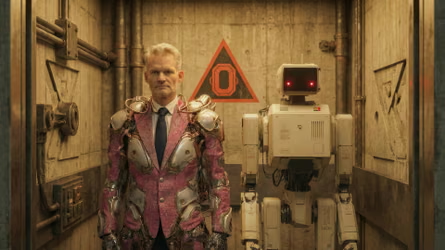
On the evidence of WAIFF, AI cinema is very different to conventional cinema and not in an immediately appealing way. There were few laughs: AI actors do not appear blessed with comic timing. There were also baffling films that explored what it might be like for a human to get sucked into a launderette coin slot, another which imagined what it would look like for a woman to slice and devour a bloody raw liver and a long work which had members of the 19th-century French elite jerking awkwardly to life from the pages of a history book to tell the story of Napoleon III.
A recurring habit among the AI directors was to be more captivated by technical precision than narrative heart, prioritising hyper-realistic flesh tones and razor-sharp shadows over storytelling. But it was the sub-trend for photorealistic animals behaving like humans – not least bears on sunbeds and pigs on golf carts – that tipped some over the edge.
“That should be a rule – no pigs on golf carts,” said one AI film-maker, as the credits rolled on some of the 5,000 AI-created films submitted for competition – up from 1,000 the previous year, when the inaugural festival was held in Nice.
The festival’s slogan was “New waves of creation” but this could more usefully have been “Just because you can, doesn’t mean you should”.
Many film-makers were relative unknowns using AI’s ability to create films on far lower budgets and there were some hits, including a poignant short by 22-year-old Swiss-Italian Dario Cirrincione, exploiting the strangely uncanny, disassociated quality of AI video to express what dementia might feel like. The AI sequence in his film cost him €500 (£433), while conventional special effects would have been closer to €20,000, he said.
Heavyweight film-makers in attendance included Gong Li, the Chinese superstar of Raise the Red Lantern, Kassovitz, and Claude Lelouch, the 88-year-old Oscar-winning director of the 1966 Un Homme et une Femme. After working with 8mm, 9mm, 16mm, 35mm, super 35 and 70mm film formats, Lelouch announced he is using AI to make his 52nd film, and declared: “I’ve got my childhood back.”
But the directors and actors at the festival found themselves in a paradoxical position. They wanted to embrace methods to make film-making quicker, more expressive and economical yet also demand recompense from the Silicon Valley companies accused of stealing the same creatives’ intellectual property to train the AI models that make that possible.
As Agnès Jaoui, a celebrated French actor who chaired the competition jury, said: “Ever since I accepted … everyone has been yelling at me. Are you validating AI?”

It was complicated to have it both ways. Asked if he was concerned about AI stealing other artists’ intellectual property, Kassovitz, who is making his next feature with AI and is opening an AI studio in Paris, said: “Fuck copyright.” But he also said if anyone used AI to do “stupid shit” with La Haine, he would sue.
Gong, the festival president and a legend of Chinese cinema, restricted her comments on the opening night to three sentences that reflected wider uncertainty about where AI cinema is heading: “AI can be controversial. But it can also open new ways to imagine stories. Let’s explore this together.”
Some festivalgoers noted the irony that the most compelling part of the festival may have been an 80-piece human orchestra playing Ravel’s Boléro in front of a montage of human dancers at the opening ceremony in the Palais des Festivals. After hours of AI films it seemed to put the technology on notice: human art is not done yet.
Despite the rising investment in AI in the mainstream film industry, next month’s Cannes film festival won’t have AI films in competition. Its president, Iris Knobloc said: “A film is not an assembly of data; it is a personal vision.” Films were made by people who had suffered, loved and doubted. It may prove to be a vain last stand.
“They can do what they want,” said the WAIFF founder, Marco Landi, a tech executive who once led Apple in Europe. “But I would alert them: there’s a wave mounting and is becoming big. You have two solutions: stay there and the wave will destroy you or you start to ask what can I do with this wave.”