










For many people, owning a yacht is the ultimate dream. But recently I reported on what happens when that dream is abandoned, and one man’s uphill battle to clean up rotting boats left behind in Cornwall, England.
In this week’s newsletter, it’s my pleasure to revisit Cornish boat engineer Steve Green, who says he “nearly fainted” when hundreds of Guardian readers flooded his crowdfunder with donations and notes of thanks after we told his story.
More on Green’s mission, and the generosity of readers that followed, after this week’s climate reads.
Essential reads
-
How car-loving American cities fell so far behind their global peers on public transit
-
As household bills soar, is it time for a working-class climate agenda?
In focus
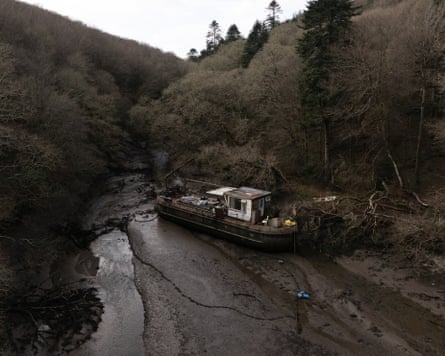
Using his dilapidated Volkswagen camper van (named Cecil) which runs on donated chip oil from local pubs, Steve Green is on a mission to haul 166 forgotten, disintegrating fibreglass yachts out of the beautiful, secret creeks of Cornwall’s Helford and Fal rivers.
These boats are far more than an eyesore. They leak toxins into the water, and marine biologists have compared the thousands of “javelins” of fibreglass they have found embedded in the flesh of sea creatures near wrecks like these to the noxious fibres of asbestos.
This is not just a Cornish problem. Across the UK, fibreglass boats bought in the cheap boat-building boom of the 1960s and 70s are now reaching the end of life. There is no plan for what to do with them. With no requirement to licence a boat in coastal waters here, owners can simply abandon a yacht and disappear.
Every boat that Green (and Cecil) drag out costs Clean Ocean Sailing, the tiny organisation he runs with his wife, between £1,000 and £3,000 to dump. They will all end up in landfill. Last year Green, who has a young family, ran up £8,000 on personal credit cards when charitable funding grants didn’t cover all the boats he towed to the recycling centre in Truro.
I wrote about Green and his crusade two weeks ago. Within an hour of my story going live on the Guardian website donations started pouring in – and haven’t stopped.
“We are still pinching ourselves,” Green says now, sounding clearly emotional. “It’s beyond comprehension. Guardian readers have saved us. They really have.”
Individuals gave anything from £2.50 to £1,000 each and have taken Green’s crowdfunder pot well over £23,000. He says he was touched too by the many personal messages thanking him and urging him to keep going.
A donor called Dan wrote: “Read about you in the Guardian. A proper hero.”
“Just read about your beautiful project in the newspaper,” another said. “I am a pensioner in middle England. You give me joy in my heart with your brave endeavours.”
Many contributors said they had holidayed, sailed or just paddled in the water in Cornwall and wanted these special rivers to be protected. “Great work cleaning up the creeks I spent my childhood on, so glad someone cares enough to be doing something about it,” one said.
Readers who said they had never been to Cornwall wanted to help Green too. A donor called Liz wrote: “Just read that Guardian article. To my shame I had no idea what happened to unwanted boats and I live on the Yorkshire coast!”
Green may be stunned by their kindness, but he has already cracked into action to make use of it. He has put legal notices on about 20 abandoned yachts, which give owners 30 days to come forward and claim them before they are taken away.
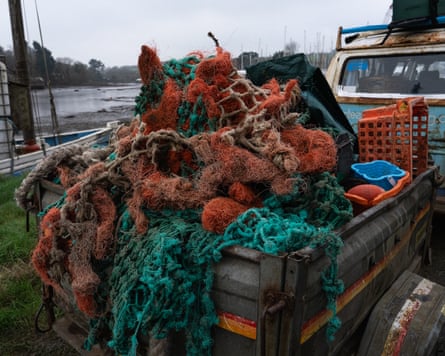
Usually this will be a formality. “Most don’t want to be found,” Green says.
Yet the owner of one 24-foot yacht has already responded. “They emailed apologising and saying it was a project that went wrong,” Green says. This means he can now start clearing it of rubbish, bailing it out and floating it to a place where it can be winched on to Cecil’s trailer or pulled upstream to Truro by Annie, the 100-year-old wooden “pirate ship” schooner Green has lived on for almost 20 years. But while this owner is sorry, he is not offering to foot the bill for the fees Green will incur when the boat gets there.
A few days after my story was published, Green assembled what he calls “a small army” of local volunteers and pulled seven small boats, including abandoned dinghies, out of the water, knowing that for once he could afford a skip to put them in.
“It’s amazing to be able to do that,” he says. “We’ve been so limited in what we could do because of money. Getting stuck in, getting all these wrecks out, is just wonderful.”
He laughs and then says quietly to me: “Thank you. It feels like we aren’t doing this on our own any more.”
Read more:
‘I needed to be in that strange, flat place’: how an Orkney garden healed a writer
One ship, three deaths: the shocking truth behind working conditions on a Chinese fishing vessel
‘The water is no longer our friend’: how dredging is pushing Lagos Lagoon towards ecosystem collapse