


The lexicon of a British parliamentary scandal is arcane.
As Keir Starmer fights to remain prime minister, he has had to respond to a “humble address”, had his judgment picked over during an “emergency opposition day debate” and now faces the ignominy of a “privilege motion”.
Close observers of UK politics will, however, recognise these terms as familiar: they are all parliamentary tools used by Labour in opposition as they tried to hold the Conservatives accountable at various points – not least during the Partygate affair that helped bring down Boris Johnson.
At first sight, the two controversies are very different.
Johnson was ousted in the wake of allegations that he had attended parties in Downing Street during a pandemic lockdown he presided over. Starmer is alleged to have allowed his officials to bypass normal security vetting procedures to install the Labour veteran Peter Mandelson as ambassador to Washington, as revealed by a Guardian investigation last week.
But one of the key accusations that Starmer threw at Johnson in 2022 – and which he is now facing – is of misleading parliament, an act which the ministerial code of conduct deems a resignation offence.
Much of what Labour did in parliament at that time was built around proving that specific point – a playbook that opposition Conservatives say they are studying. “We absolutely have learned the lessons from what happened during Partygate,” said one Conservative veteran. “Our long-term strategy is to trap the prime minister progressively until he can no longer deny that he misled parliament.”
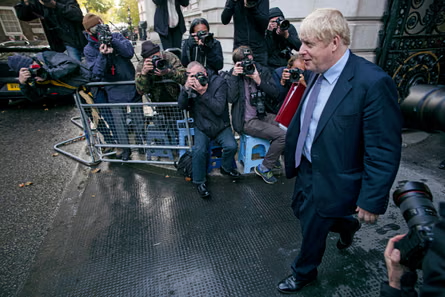
Starmer’s problems stem from his decision in late 2024 to appoint Peter Mandelson, a Labour peer and veteran of successive governments, as ambassador in Washington.
Politicians are rarely appointed to UK diplomatic posts and the decision was controversial, not least because Mandelson had twice been forced to resign from government over separate scandals. He was also known to have been a friend of Jeffrey Epstein, even after the New York financier was convicted of sexual offences against children.
Starmer sacked Mandelson within a year of him taking post after documents showed his friendship with Epstein was closer than realised. But it is not the cosy messages that Mandelson exchanged with Epstein that are now under scrutiny; it is instead the revelation that Starmer appointed Mandelson despite vetting officials recommending that he be denied security clearance.
That disclosure came about only because of a process started by Kemi Badenoch, the Conservative leader. Earlier this year, she secured a “humble address” motion demanding that the government publish all the documents relating to Mandelson’s appointment.
Technically a petition to the monarch, a humble address can be used to extract documents from the bowels of the government machinery. Starmer used the tactic four times in opposition, whether to access documents relating to Brexit or to see the security advice given before Johnson elevated Evgeny Lebedev, the newspaper magnate, to the House of Lords.
Ministers have typically used national security exemptions to prevent having to disclose sensitive documents in response to a humble address. But on this occasion, the process of gathering the files threw up something even the prime minister says he was not expecting: written advice that Mandelson should not be granted security clearance.
The Guardian’s disclosures last week that that advice existed and was overlooked by the Foreign Office has thrown the government into disarray and prompted another flurry of parliamentary activity as the Conservatives look to take advantage.
Earlier this week, Badenoch brought an emergency motion to the floor of the House of Commons, urging MPs to hold the government to account for the decision to appoint Mandelson. And now she is pushing for a potentially more far-reaching debate: a vote on whether parliament’s privileges committee should investigate whether Starmer misled the Commons when he repeatedly told MPs “full due process” had been followed.
In the UK, misleading the house is counted as “contempt of parliament” and is one of the most serious offences a parliamentarian can commit. Anyone who accuses another MP of misleading parliament is liable to be thrown out of the chamber by the speaker. An MP found guilty of having done so can be suspended. And when Labour forced a privileges committee investigation into whether Johnson had lied over the lockdown parties, it led to his resignation as an MP.
“Misleading parliament has always been a big deal,” said the Conservative veteran. “We are very aware of a change in the meaning of contempt in 2022 which means that it is contempt not only to mislead the house but also to refuse to answer reasonable questions in it.”
Tim Bale, a professor of politics at Queen Mary, University of London, said: “Command of parliamentary process is incredibly important for a leader of the opposition. If Badenoch has that, she can use it, if not to prise Starmer out of Downing Street, then at least to so damage the morale of Labour MPs and ministers that his position is untenable.”
Though much of the focus has been on what Starmer knew about Mandelson’s security vetting and whether he misled MPs about it, the prime minister faces much deeper-rooted problems. Almost as soon as he won a historic victory in 2024, things began to unravel for his Labour government, in part because of the budgetary problems they encountered.
In an effort to save money, the chancellor, Rachel Reeves, announced a deeply unpopular cut to winter fuel subsidies for pensioners soon after taking office. Then she unveiled a budget that raised taxes to levels not seen since the 1940s. As the economy continued to flatline, ministers looked to save money from the welfare budget, only to have to back down in the face of opposition from their own MPs.
As the decisions have been taken, Starmer’s net approval rating has dropped from around 0 to about -40 percentage points, a historically low figure. Next month, he faces elections that could see his party swept from power in councils across the country, and come third in its former strongholds of Scotland and Wales.
All of this has created a situation where scandals that could otherwise have been weathered threaten to topple the government. “Popular prime ministers and governments are able to fend off anything the opposition does,” said Bale. “But if they are in trouble, anything the opposition does tends to feed into the instability.”
The problems for Starmer are especially acute given that he came to power promising an end to the chaos and scandal of the Conservatives’ 14 years in charge. As a former public prosecutor and scourge of Johnson, his reputation was, in the words of one ministerial colleague, that of being “Mr Rules”.
Many people think Starmer’s travails do not compare with the extended rule-breaking seen under Johnson.
Hannah White, the chief executive of the Institute for Government thinktank, said: “Like Partygate, the Mandelson case is exposing a prime minister’s mistake through the mechanism of a parliamentary inquiry, ratcheting up the frustration of their backbenchers with their leader.
“But the real damage from Partygate came from the public anger at what was seen as Johnson’s sustained hypocrisy of setting rules for the public which he didn’t follow himself. Whereas Starmer’s peril is in how his party view his judgment in decisions, and particularly appointments, he has made in doing the job.”
When Starmer looks back on his time pursuing Johnson, he may reflect that it was not the Partygate scandal that finally caused the former prime minister’s downfall. Instead it was a later controversy concerning alleged sexual misconduct by the former Conservative MP Chris Pincher, who Johnson had made a minister.
That was the point at which his MPs lost confidence in the prime minister and started refusing to defend him publicly. And when more than 50 ministers and aides resigned in a rolling walkout from government, Johnson accepted his fate and quit.
Veterans of that period saw a similarity this week in the behaviour of Starmer’s energy secretary, Ed Miliband, who appeared reluctant to defend the prime minister on television. “A mistake was made,” Miliband told Sky News. “Peter Mandelson should never have been appointed. And that was a mistake. And the prime minister has apologised for it. Rightly so.”
Bale said: “Where this scandal and Partygate are similar is that it actually hinges on the confidence of the cabinet. Once you start losing the support of your cabinet, that spells the end, and that might be what is happening now.”