


‘We ought to do something jolly … we need something to give Britain a lift.” So said Herbert Morrison, a key figure in Clement Attlee’s postwar Labour government, selling to the cabinet the idea of a Festival of Britain. It kicked off 75 years ago this weekend with a service of dedication at St Paul’s, lasted for five months and consisted of a nationwide celebration of British achievements in the arts and sciences. But did it succeed, and did it leave any lasting legacy?
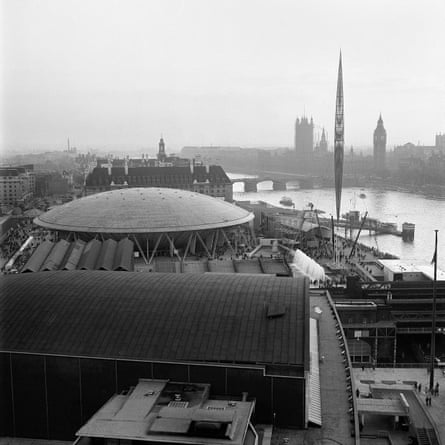
I say it was a national event but there is little doubt that much of the focus was on an exhibition on London’s South Bank which reclaimed a huge tract of derelict land and attracted 8.5 million visitors. As an 11-year-old schoolboy, I was one of them, making the pilgrimage from Leamington Spa with my family. I still recall the excitement of the Dome of Discovery which was a vast scallop shell containing segments devoted to earth, sea, sky, the polar regions and outer space. The site was also dominated by the massive cigar-shaped Skylon, described as a kind of “luminous exclamation mark”. After a morning on the South Bank we spent an afternoon at the Battersea Park Pleasure Gardens where there was a funfair, a miniature railway and, best of all, a theatre resurrecting old-time music hall. Returning home, I felt as if I had been to an exhausting but exhilarating party.
It took time for me to realise that my enthusiasm was not universally shared. It was only when I read a brilliant essay by Michael Frayn in an anthology, Age of Austerity, edited by Michael Sissons and Philip French and published in 1963, that I saw just how contentious the Festival of Britain was. Frayn argues that its main supporters were the radical middle classes: readers of the Guardian and the Observer, the signers of petitions, the backbone of the BBC whom he dubs the Herbivores. The festival’s opponents, among whom Frayn lists “the readers of the Daily Express; the Evelyn Waughs; the cast of the Directory of Directors”, are classified as Carnivores.
It is a fascinating division and one that has grown more pronounced with time. Today the Herbivores would be for the European Union, a multicultural society and gender equality and anti-fossil fuels, while the Carnivores, who now have their own political party in Reform and their own TV station in GB News, would take a vehemently oppositional view. The division in British life didn’t start with the Festival of Britain but, as Frayn makes clear, the event threw it into sharp relief.
But did the festival accomplish anything? It certainly didn’t save Labour from electoral defeat in October of that year and no two historians agree on its impact. Arthur Marwick saw the festival as a testament to “the genuine and justified pride in real achievements made by 1951” and a prelude to the cultural transformations of the 1960s. Kenneth O Morgan in The People’s Peace took the opposite view. “The point of reference,” he says of the festival, “was the Victorian or Edwardian past. Britain in 1951 was on display as the somewhat geriatric heir of those earlier societies, not the enterprising youthful harbinger of the new.”
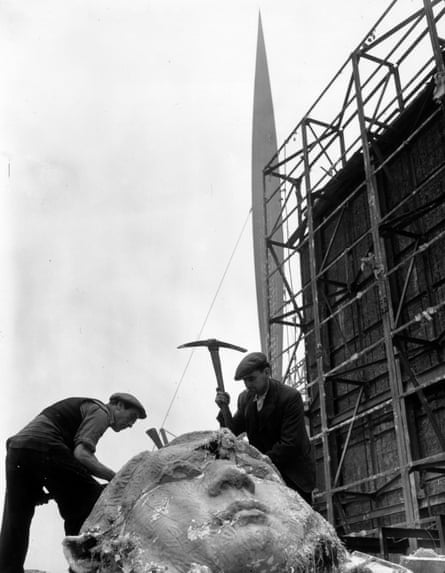
So who is right? I am not a historian but my own assessment would be that the festival was both bracing in itself and beneficial in its impact. It is perfectly true that one of the first actions of the incoming Conservative government was to demolish the prime exhibits of the festival including the Dome of Discovery and the Skylon. “David Eccles, the new Minister of Works,” writes Frayn, “took Gerald Barry (the festival’s director) on a tour of the site, indicating the buildings to be torn down, like a dictator’s henchman picking out prisoners for execution.”
But the Royal Festival Hall proved happily indestructible and the Telekinema, created to show documentaries and experimental work, was transformed a year later into the National Film Theatre and today, under the name of the BFI, offers an amazing repertory of work. Even more significant is the fact that the cultural centre of London has shifted from the increasingly garish West End to the South Bank where you can walk from the National Theatre and Hayward Gallery at one end to Shakespeare’s Globe and Tate Modern at the other and take in a huge spectrum of art and entertainment.
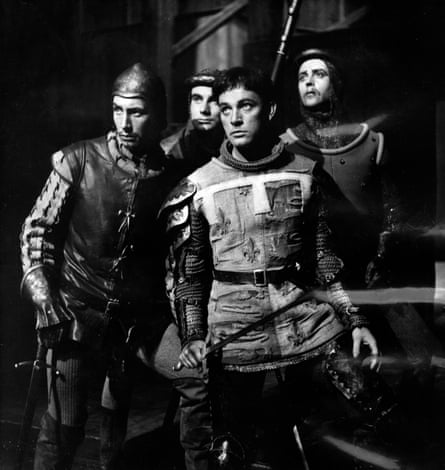
In 1951 there was a proliferation of arts festivals across the UK, from Bath to Belfast and Cardiff to Cheltenham, that spawned a host of celebrations that survive to this day. I would cite one very specific example of the Festival of Britain’s legacy. To mark the occasion the Shakespeare Memorial theatre in Stratford-upon-Avon decided to mount a sequence of history plays comprising Richard II, Henry IV, Parts One and Two and Henry V. A remarkable company, including Michael Redgrave, Harry Andrews and a young Richard Burton, was assembled, and Anthony Quayle, Stratford’s director, claimed that, aside from a season in 1905, “I cannot ascertain that these four histories have been played as a cycle since Shakespeare’s day.” If today we regularly perform Shakespeare’s histories not as single events but as a developing sequence, it is thanks to the Festival of Britain: just one more instance of its durable impact and justification of Herbert Morrison’s declared intention of lifting the spirits of the British people.