


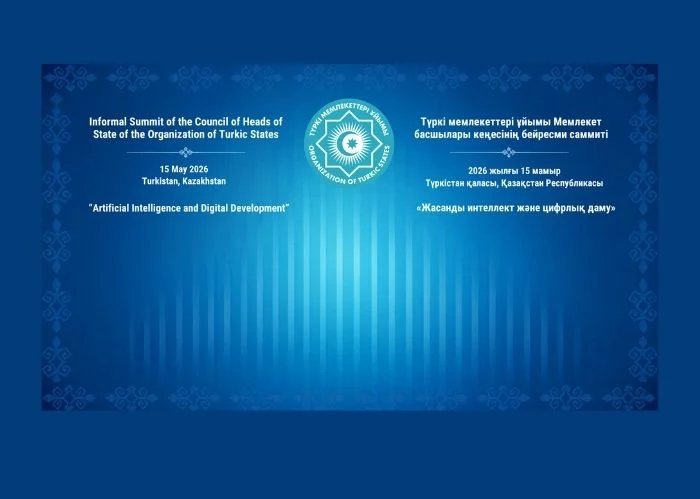
An informal summit of the Council of Heads of State of the Organization of Turkic States (OTS) on the theme “Artificial Intelligence and Digital Development” will be held in Turkestan on 15 May with the support of Kazakhstan.
The informal summit will bring together heads of state and government from OTS member countries, observer states, as well as the Secretary-General of the organisation.
The choice of venue is also symbolic. Turkestan is not only one of the oldest cities in Kazakhstan, but also an important spiritual centre of the Turkic world. Holding the summit there underscores the participating countries’ desire to give integration processes not only a pragmatic, but also a civilisational dimension.
In recent years, the Organization of Turkic States (OTS) has evolved from a primarily cultural and humanitarian platform into one of the most prominent regional centres for political and economic cooperation across Eurasia. Today, the OTS includes Azerbaijan, Türkiye, Kazakhstan, Kyrgyzstan and Uzbekistan, while Hungary, Turkmenistan and the Turkish Republic of Northern Cyprus hold observer status. In a relatively short period, the organisation has managed to establish a network of specialised institutions — from the Parliamentary Assembly and the Turkic Academy to an investment fund and economic coordination mechanisms.
In recent years, the OTS has significantly increased its international profile, particularly after the Second Karabakh War and the subsequent changes in the transport and logistics architecture of the South Caucasus. Azerbaijan’s victory and the restoration of Baku’s sovereignty over all its territories have substantially altered the regional balance of power and opened up new opportunities for the implementation of transregional projects, including the Middle Corridor — a route linking China and Central Asia with Europe via the Caspian Sea, Azerbaijan and Türkiye.
The significance of the Organization of Turkic States is steadily growing. Today, the organisation is becoming a platform through which regional countries seek to collectively respond to global challenges - from energy security to digital transformation. It is therefore no coincidence that the current summit is devoted to artificial intelligence and digital development.
At the OTS summit in Gabala in 2025, innovation, artificial intelligence, digital connectivity and transport corridors were already identified as strategic directions for the organisation’s development. Turkestan marks the next stage of this process, where the focus may shift towards concrete political decisions.
The global race in artificial intelligence is already shaping the future of the world economy. According to the McKinsey Global Institute, AI is expected to contribute around $13 trillion to the global economy by 2030. PwC estimates the potential impact to be even greater, at $15.7 trillion. The United States, China and the European Union have already entered into full-scale competition for leadership in the new technological era. The EU is adopting a comprehensive AI Act, China is developing its own system for regulating generative technologies, and the US is accelerating investment in AI infrastructure.
Against this backdrop, the question facing the Turkic states is particularly pressing: either they develop their own digital strategy now, or they risk becoming mere consumers of foreign technologies and externally imposed rules in the future. It is precisely this understanding that underpins the logic of the Turkestan summit.
For Central Asian countries, digitalisation is becoming a matter not only of economic development, but also of sovereignty. Competition among the world’s technological centres — the United States, China and the European Union — is forcing middle powers to seek their own models of technological adaptation. Within the OTS framework, issues such as shared digital infrastructure, cybersecurity, e-governance, educational platforms and technological investment are being discussed. Of particular interest is the idea of creating a unified Turkic digital space coordinating transport data, customs systems, logistics platforms and electronic services. In the long term, this could significantly accelerate trade and reduce dependence on external centres of technological control.
Azerbaijan plays a key role in the OTS’s digital transformation. The ASAN Service system established in Baku has become one of the most successful examples of the digitalisation of public services in the post-Soviet space and has twice been recognised by the UN as a global best practice in public administration. The UN Interregional Centre for Public Administration Innovation in Baku further reflects the international recognition of Azerbaijan’s digital governance model.
Kazakhstan, the host of the current summit, is also actively promoting a digital agenda. President Kassym-Jomart Tokayev has previously proposed creating a unified OTS digital transport and logistics centre using artificial intelligence technologies. Kazakhstan has already provided broadband internet access to more than 98 per cent of settlements and is actively modernising its state digital platforms.
Uzbekistan is accelerating reforms in ICT and the digital economy. Meanwhile, Bishkek has been declared the “Digital Capital of the Turkic World 2025”. The harmonisation of a unified Turkic Latin-based alphabet has become not only a cultural step, but also an important technological development. Standardising the script opens up opportunities for the development of shared AI language models, unified digital databases and technological platforms in Turkic languages.
The OTS is gradually forming its own digital and geo-economic space. Another demonstration of these ambitions is the 12U OTS-SAT satellite project under the OTS flag, which is scheduled for launch in 2026. This initiative is not merely a space programme, but also part of a broader effort to create a shared communications, navigation and monitoring infrastructure.
Many still perceive the Organization of Turkic States as a regional cultural club united by common linguistic and historical heritage. However, the real scale of the OTS today is far greater than such simplified perceptions suggest. The combined GDP of member states has already exceeded $2.1 trillion, while total trade turnover has reached $1.1 trillion. The population of the Turkic states stands at nearly 179 million people — around 2.8 per cent of the world’s population. In terms of total territory, the Turkic states rank seventh globally, while economically they constitute one of the world’s largest economic spaces.
The OTS is also gradually moving beyond being solely an economic project. A shared information space is emerging, the number of joint educational and cultural initiatives is growing, and cooperation among youth and academic institutions is strengthening. The Turkestan summit is likely to represent another step towards consolidating this common identity.
At first glance, the summit in Turkestan may appear to be just another international meeting accompanied by traditional declarations and diplomatic rhetoric. In reality, however, the Turkestan summit carries much deeper significance. It represents the Turkic world’s attempt to address one of the central challenges of our era: whether it can emerge as an independent centre of power in an increasingly complex world, actively participate in the technological revolution, or remain merely a grouping of Turkic states united by ethnic and linguistic commonality.
By Tural Heybatov
此内容由惯性聚合(RSS阅读器)自动聚合整理,仅供阅读参考。 原文来自 — 版权归原作者所有。