


Tajik President Emomali Rahmon’s state visit to China from 11 to 14 May is more than a routine diplomatic event. His talks with Chinese President Xi Jinping in Beijing on 12 May showed that China is continuing to systematically strengthen its position in Central Asia, while Tajikistan is becoming an increasingly important partner for Beijing in several areas at once — trade, infrastructure, raw materials, transport connectivity and security.
One of the main reasons behind the visit is China’s growing economic importance for Tajikistan. Beijing has become one of Dushanbe’s key trading partners and one of the main sources of goods, equipment, technology and investment. For a landlocked and mountainous country like Tajikistan, cooperation with China is not simply a matter of trade figures. It is directly linked to infrastructure development, road construction, industrial modernisation and access to broader regional markets.
Trade turnover between the two countries has been growing steadily in recent years. China supplies Tajikistan with machinery, vehicles, construction materials, consumer goods, electronics and industrial equipment. Tajikistan, in turn, exports mainly raw materials and agricultural products to the Chinese market. This imbalance reflects the broader structure of economic relations between Beijing and many Central Asian states: China exports finished goods and technology while importing raw materials and resources.
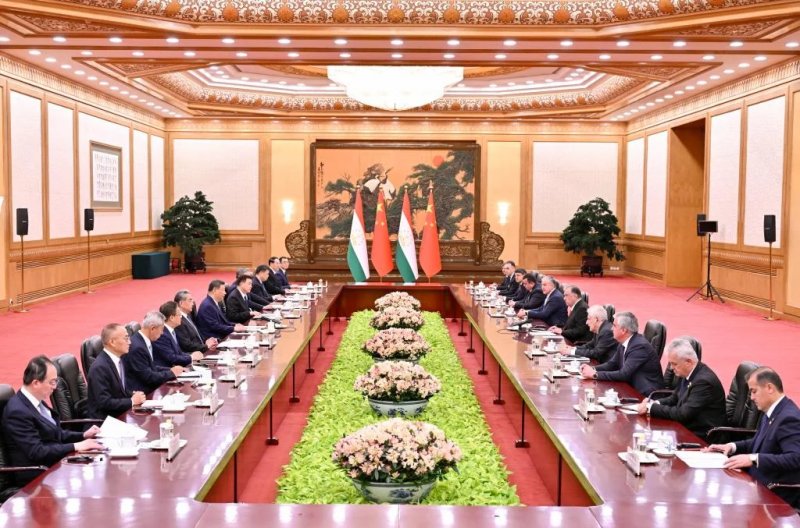
Credit:Xinhua/Yin Bogu
For Dushanbe, this creates both opportunities and risks. On the one hand, Chinese investment helps Tajikistan develop infrastructure, attract capital and modernise parts of its economy. On the other hand, growing dependence on a single major external partner may limit the country’s room for manoeuvre in the long term. This is why Rahmon’s visit to Beijing should be viewed not only through the lens of diplomacy, but also as part of Tajikistan’s effort to secure economic stability while preserving a multi-vector foreign policy.
Infrastructure is one of the key areas of cooperation. Tajikistan needs roads, tunnels, logistics routes and energy projects to overcome its geographic isolation. China, through the Belt and Road Initiative, has been actively investing in transport connectivity across Central Asia. For Beijing, Tajikistan is important as part of a broader regional network linking China with Central Asia, South Asia and potentially the Middle East and Europe.
Transport routes are not just an economic issue for Tajikistan; they are also a matter of national development. Better roads and logistics corridors can connect remote regions, increase trade, reduce dependence on traditional routes and make the country more attractive to investors.
For China, these projects help expand its economic presence and create long-term influence without the need for direct political pressure.
Another important reason behind the visit is the raw materials agenda. Tajikistan has significant reserves of gold, silver, antimony and other minerals. China, meanwhile, is interested in securing access to resources needed for industry, high technology and the energy transition. This explains why cooperation in mining, including more environmentally sustainable extraction, has become part of the bilateral agenda.
For Tajikistan, Chinese participation in mining projects can bring investment, jobs and export revenues. However, it also raises questions about how much of the added value will remain inside the country. If Tajikistan remains primarily a supplier of raw materials, its economy may become even more dependent on external demand. Dushanbe’s main challenge, therefore, is to turn Chinese investment not only into extraction projects, but also into processing, industrial development and technology transfer.
Security is another major factor. Tajikistan shares a long border with Afghanistan, giving the country strategic importance for China.
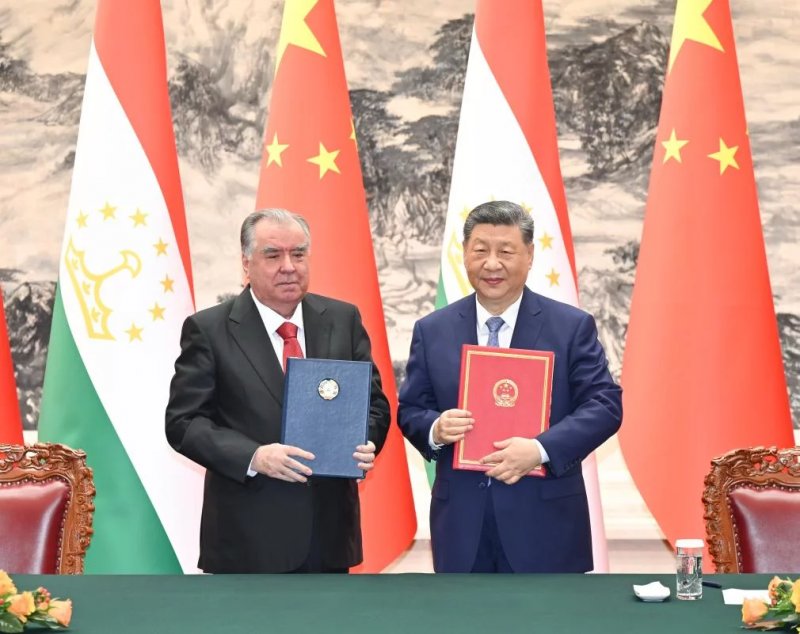
Credit: Xinhua/Li Xiang
Beijing is deeply interested in stability along the Afghan direction, especially given its concerns over extremism, cross-border threats and security risks linked to Xinjiang. For this reason, China-Tajikistan cooperation increasingly includes not only trade and infrastructure, but also border security, law enforcement coordination and regional stability.
This makes Tajikistan a particularly important partner for Beijing. Unlike some other Central Asian countries, Tajikistan is directly exposed to instability originating from Afghanistan. China sees cooperation with Dushanbe as part of a wider security belt along its western borders. For Rahmon, Chinese support in this area is also valuable, as Tajikistan faces complex security challenges and needs external assistance to strengthen border control and counter transnational threats.
The visit also carries broader geopolitical significance. Central Asia has become an increasingly important arena for both competition and cooperation among major powers. Russia still retains strong influence in Tajikistan through security ties, labour migration and historical links. However, in trade, investment and infrastructure, China has become the dominant external player. This does not mean that Dushanbe is turning away from Moscow. Rather, Tajikistan is seeking to balance between major powers and use China’s economic capacity to support its own development.
At the same time, Beijing’s growing role reflects a wider regional trend. China is not trying to replace Russia through loud political statements. Instead, it is building long-term influence through roads, trade, loans, investment, technology and security cooperation. This approach allows Beijing to become deeply embedded in the economies of Central Asian states while avoiding direct confrontation with other actors.
For China, Tajikistan is important for several reasons. It is a neighbour, a security partner, a potential source of mineral resources and a participant in regional transport projects. For Tajikistan, China is a source of funding, infrastructure and access to development opportunities that are difficult to obtain elsewhere on the same scale.
The main result of Rahmon’s visit is that China-Tajikistan relations are moving to a more practical and strategic level. The two sides are not only exchanging diplomatic statements; they are building a framework for long-term cooperation in trade, investment, transport, mining, technology and security.
However, the central question remains whether Tajikistan will be able to turn this cooperation into sustainable national development, or whether it will become even more dependent on Chinese capital, goods and infrastructure projects. The answer will depend on Dushanbe’s ability to diversify its economy, strengthen local industry and ensure that foreign investment serves the country’s long-term interests.
(If you possess specialized knowledge and wish to contribute, please reach out to us at opinions@news.az).
此内容由惯性聚合(RSS阅读器)自动聚合整理,仅供阅读参考。 原文来自 — 版权归原作者所有。