


Trinity College Dublin’s Elva Arulchelvan highlights five tips for improving both your working and long-term memory.
As a researcher investigating how electric brain stimulation can improve people’s powers of recollection, I’m often asked how memory works – and what we can do to use it more effectively. Happily, decades of research have given us some clear answers to both questions.
Memory essentially operates in three stages, with different brain regions contributing to each one.
Sensory memory, which can last only milliseconds, registers raw information such as sights, sounds and smells. These are first processed by the brain’s five primary sensory cortices (visual cortex for sights, auditory cortex for sounds and so on).
Working (short-term) memory holds and manipulates a small amount of information over several seconds or more. Think of this as your brain’s mental workspace: the system that lets you do mental arithmetic, follow instructions and comprehend what you’re reading. So it mainly involves the prefrontal cortex – the front part of your brain that supports attention, decision-making and reasoning.
Finally, long-term memory stores information more permanently, from minutes to a lifetime. This includes both ‘explicit’ memories (facts and life events) and ‘implicit’ ones (skills, habits and emotional associations).
For long-term memories, the hippocampus and temporal lobes – located deep within the brain, around the sides of your head near your temples – contribute largely to memories involving facts or life events, while the amygdala (near the hippocampus), cerebellum (at the back of the brain) and basal ganglia (deep in the brain) process emotional or procedural memories.
Working memory often acts as a conscious gateway to long-term memory – but it has its limits. In 1956, the American psychologist George Miller proposed that we can only hold about seven ‘chunks’ of information in our working memory at any time.
While the exact number is debated to this day, the principle holds: working memory is limited. And that limitation can shape how effectively we learn and remember things.
But you can also get your memory working more effectively. Here are five easy steps for improving both your working and long-term memory.
Put your phone away
Smartphones reduce your working memory capacity. Even just having a phone nearby – no matter if it’s face down and on silent – can reduce performance on memory and reasoning tasks.
The reason is that part of your brain is still subtly monitoring it. Even resisting the urge to check notifications consumes mental resources – which is why researchers sometimes call smartphones a “brain drain”. The solution is simple: put your phone in another room when you need to focus. Out of sight really does free up mental capacity.
Stop your mind racing
Stress and anxiety can take up valuable mental space. When you’re worrying about something or are distracted by racing thoughts, part of your working memory is already in use.
Relaxation training and mindfulness practices can improve both working memory and academic performance, probably by reducing stress levels. And if meditation feels intimidating, try breathing techniques such as ‘cyclic sighing’. Inhale deeply through your nose, take a second shorter inhale, then slowly exhale through your mouth. Repeating this for five minutes can calm the nervous system and create better conditions for learning.
Get chunking
Everyone can expand their working memory using the technique of chunking – grouping information into meaningful units. In fact, you probably already do it to remember some phone numbers or lists of words – breaking long sequences into bite-size chunks that your brain can recall as a mini-group.
The same principles apply if you’re delivering a presentation, to help your audience remember your key points more effectively. Chunking would involve grouping 10 case studies, say, into three or four themes, each with a short headline and single key takeaway.
Repeat this structure on each slide: one idea, a few supporting details, then move on. By organising information into meaningful patterns, you reduce cognitive load and make it more memorable.
Become a retriever
In the 19th century, German psychologist Hermann Ebbinghaus demonstrated how quickly we forget information after learning it. Within about 30 minutes, we lose roughly half of what we have learned, with much more fading over the next day. Ebbinghaus called this the forgetting curve. The light blue line on the chart below illustrates this.
The forgetting curve – and how to disrupt it
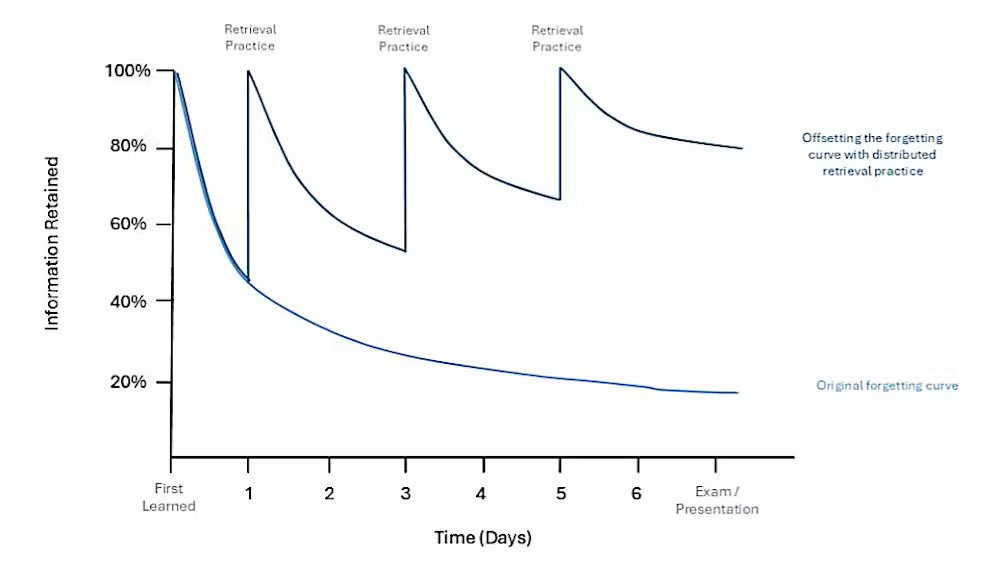
The forgetting curve. Image: Elva Arulchelvan (CC BY-SA 4.0)
However, there is a way of ensuring that more sinks in when you are trying to learn a lot of information in a short period of time: retrieval practice.
When preparing to give a talk or studying for an exam, rather than simply rereading your notes, keep testing how much you remember. Use flash cards, answer practice questions, or try explaining the material out loud without notes.
Memory works through associations. Each time you successfully retrieve information, you link the material to new prompts, examples and contexts. This builds more cues to accessing the information, and strengthens each memory pathway. Often when we ‘forget’, the memory isn’t gone – we just lack the right retrieval cue.
Give yourself a break
Research shows that memory is more effective when study or practice sessions are spread out, rather than massed together. If you are studying for an exam, build solid blocks of downtime into your revision schedule. The dark blue line on the chart above illustrates how spacing out your practice sessions can help you remember more information over time, by adjusting Ebbinghaus’s forgetting curve.
One study suggests leaving gaps between each revision session that equate to 10-20pc of the time left until your exam or presentation. So, if your deadline is five days away and you do hours of revision a day, you should still take between a half and full day off in between sessions. In other words, don’t overdo it – you probably won’t see the rewards!
If you only remember one thing from this article about improving memory, make it this. Memory isn’t just about intelligence, it’s about strategy. Small changes in how you study or work can make a real difference in how well, and how long, you remember crucial information.

Elva Arulchelvan is completing a PhD in psychology and neuroscience for the Lab for Clinical and Integrative Neuroscience in Trinity College Dublin (TCD), Ireland. She is also a lecturer in psychology for social work students in TCD. Arulchelvan’s PhD research focuses on memory and forgetting processes. In particular, her PhD research involves investigating peripheral nerve stimulation’s effect on memory and forgetting in both clinical and non-clinical groups.
Don’t miss out on the knowledge you need to succeed. Sign up for the Daily Brief, Silicon Republic’s digest of need-to-know sci-tech news.