


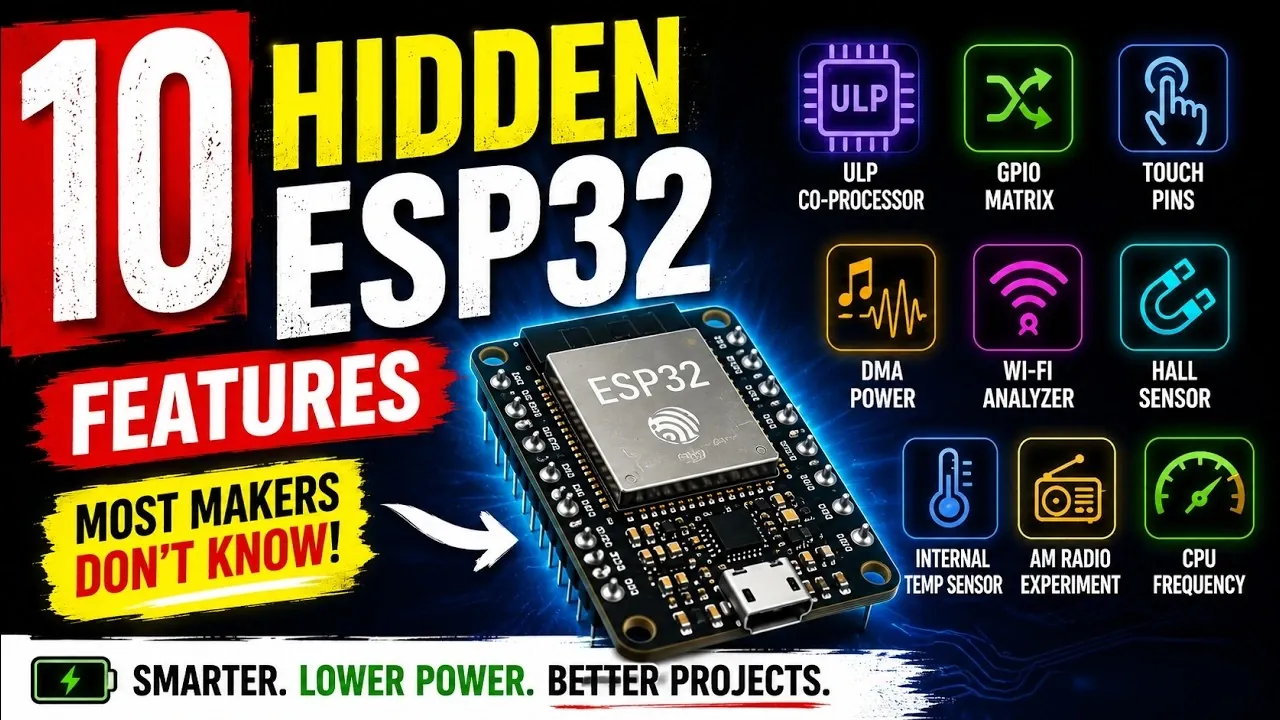
The ESP32 microcontroller is widely known for its Wi-Fi and Bluetooth capabilities, but it also includes a range of lesser-known features that can elevate your projects to new levels of functionality. In a recent breakdown by Tech Panda, one standout example is the Ultra-Low Power (ULP) coprocessor, which allows the ESP32 to perform simple tasks like monitoring sensors while the main processor remains in deep sleep mode. This feature is particularly valuable for battery-powered devices, such as IoT sensors or wearables, where energy efficiency is critical. By using these hidden capabilities, makers can optimize their designs for both performance and longevity.
In this feature, you’ll explore how to take advantage of these overlooked functionalities to enhance your projects. Learn how the GPIO Matrix simplifies hardware design by allowing dynamic pin reassignments, perfect for adapting to evolving prototypes. Discover how the built-in touch-sensitive pins allow for sleek, interactive interfaces without additional components. You’ll also gain insight into practical applications of features like RTC memory for low-power data retention and Wi-Fi Promiscuous Mode for network analysis. These insights will help you unlock the full potential of the ESP32 and apply its advanced features to your own designs.
Hidden Features of ESP32
TL;DR Key Takeaways :
- The ESP32 features an Ultra-Low Power (ULP) coprocessor that enables energy-efficient designs by performing simple tasks while the main processor remains in deep sleep mode, ideal for battery-powered projects.
- The GPIO Matrix allows flexible pin mapping, allowing dynamic reassignment of pin functions for adaptable hardware design and simplified prototyping.
- Built-in touch-sensitive pins enable the creation of touch-based interfaces without additional hardware, adding interactivity and aesthetic value to projects.
- Direct Memory Access (DMA) improves performance by offloading data transfer tasks from the CPU, making it ideal for high-speed applications like displays and audio processing.
- Wi-Fi Promiscuous Mode provides insights into network activity and signal strength, useful for debugging, optimizing IoT device placement and studying wireless protocols.
1. Ultra-low Power Operation with the ULP Coprocessor
The Ultra-Low Power (ULP) coprocessor is a critical feature for energy-efficient designs. It allows the ESP32 to perform simple tasks, such as monitoring sensors or managing timers, while the main processor remains in deep sleep mode. This drastically reduces power consumption, making it ideal for battery-powered projects like remote sensors, wearables, or IoT devices. For example, you can program the ULP coprocessor to periodically check a temperature sensor and wake the main processor only when specific thresholds are exceeded. This approach not only saves energy but also extends the lifespan of your devices in the field.
2. Flexible Pin Mapping with the GPIO Matrix
The GPIO Matrix provides unmatched flexibility in assigning functions to GPIO pins. Unlike traditional microcontrollers with fixed pin assignments, the ESP32 allows you to reconfigure pin functions dynamically. This feature simplifies hardware design, especially when dealing with space constraints or complex layouts. For instance, if you need to adapt your circuit for a new peripheral or redesign your PCB, the GPIO Matrix ensures you can reassign pins without making significant hardware changes. This flexibility is invaluable for prototyping and iterative development, where adaptability is key.
3. Touch-sensitive Inputs via Built-in Touch Pins
The ESP32’s built-in touch-sensitive pins make it easy to create touch-based interfaces without requiring additional hardware. These pins detect changes in capacitance, allowing you to design hidden touch buttons, sliders, or custom touch panels. For example, you can integrate touch-sensitive controls into a minimalist design, combining aesthetics with functionality. This feature is particularly useful for projects where traditional buttons might disrupt the design or where you want to add an interactive element to your application.
4. Data Transfer Optimization with DMA
Direct Memory Access (DMA) is a powerful feature that offloads data transfer tasks from the CPU, improving overall performance. This is especially beneficial for applications requiring high-speed data handling, such as driving high-resolution displays, audio processing, or managing large data streams. By using DMA, you can reduce CPU load, minimize lag and ensure smoother operation in demanding projects. For example, when working with a graphical user interface or real-time audio processing, DMA ensures that data flows seamlessly, enhancing the user experience.
5. Wi-Fi Signal Monitoring in Promiscuous Mode
The ESP32’s Wi-Fi Promiscuous Mode allows you to monitor Wi-Fi activity on specific channels. While it doesn’t decode full packets, it provides valuable insights into signal strength, network traffic and wireless communication patterns. This feature is particularly useful for debugging connectivity issues, analyzing network performance, or studying wireless protocols for educational purposes. For instance, you can use it to identify interference sources or optimize the placement of your IoT devices for better signal reception.
Enhance your knowledge on ESP32 by exploring a selection of articles and guides on the subject.
- Arduino Nano ESP32 handheld console with round color display
- T-Display AMOLED Touch ESP32 board binary converter project
- Super Tiny RP2040/ESP32 Board Display for IoT and DIY Projects
- Loud ESP ESP32 audio development platform
- Tiny Holo Cubic display features a 1.3-inch TFT IPS and ESP32 microcontroller
- LilyGo T Watch Keyboard C3 mini computer kit
- Track Room Occupancy Without Cameras Using ESP32 Wi-Fi Drops
- New CodeCell C6 IoT ESP32 Board : Same Price, Improved Low-Power Design
- ESP32-M1 Reach Out a compact, open and richly-featured ESP32-M1 dev board
- DIY 3D Printer Emission Monitor Helps Improve Indoor Air Quality
6. Magnetic Field Detection with the Hidden Hall Sensor
The ESP32 includes a built-in Hall sensor capable of detecting changes in magnetic fields. While not as precise as dedicated magnetic sensors, it is sufficient for basic applications like lid detection, proximity sensing, or simple security mechanisms. For example, you could use the Hall sensor to detect when a magnetic cover is opened or closed, adding an interactive or safety feature to your project. This hidden functionality is particularly useful for compact designs where adding external sensors might not be feasible.
7. Low-power Memory Retention with RTC Memory
The Real-Time Clock (RTC) memory in the ESP32 allows you to retain specific variables during deep sleep mode. This feature is essential for low-power designs, as it enables the microcontroller to resume tasks without reinitializing all variables. For instance, you can store sensor readings, timestamps, or system states in RTC memory, making sure seamless transitions between active and sleep modes. This capability is particularly valuable for applications like data logging or periodic monitoring, where preserving context between wake cycles is critical.
8. Temperature Measurement with the Internal Sensor
The ESP32’s internal temperature sensor provides a way to monitor the chip’s temperature. While it is not highly accurate, it is useful for diagnostics and thermal management. For example, you can use it to ensure your project operates within safe temperature limits, particularly in environments with fluctuating conditions. This feature can also help you identify potential overheating issues during development, allowing you to implement cooling solutions or optimize power usage.
9. Radio Signal Experiments with AM Functionality
The ESP32 supports basic AM radio signal experiments, opening the door to educational and exploratory projects. While not a primary feature, this capability allows you to experiment with transmitting simple audio signals or studying electromagnetic interference. For example, you can use the ESP32 to create a basic AM transmitter for learning purposes or to explore the principles of radio frequency communication. This feature adds an extra layer of versatility, making the ESP32 a valuable tool for both hobbyists and educators.
10. Dynamic Power Optimization with CPU Frequency Control
The ESP32’s Dynamic CPU Frequency Control enables the microcontroller to adjust its processing speed based on workload demands. This feature optimizes power consumption, making it ideal for battery-powered projects. For instance, the CPU can operate at a lower frequency during idle periods to conserve energy and ramp up during processing-intensive tasks to maintain performance. By dynamically managing power usage, you can extend battery life without compromising the functionality of your application.
Unlocking the Full Potential of the ESP32
The ESP32’s hidden features offer a wealth of opportunities for makers and developers looking to enhance their projects. From ultra-low power operation and flexible pin mapping to touch-sensitive inputs and advanced data transfer capabilities, these functionalities expand the microcontroller’s versatility and efficiency. By exploring these lesser-known capabilities, you can design more innovative, reliable and professional-grade applications. Whether you’re optimizing power usage, simplifying hardware design, or experimenting with new technologies, the ESP32 equips you with the tools to bring your ideas to life.
Media Credit: Tech Panda
Disclosure: Some of our articles include affiliate links. If you buy something through one of these links, Geeky Gadgets may earn an affiliate commission. Learn about our Disclosure Policy.