


Sign up to see the future, today
Can’t-miss innovations from the bleeding edge of science and tech
Elon Musk, in trademark fashion, has made grand promises about Tesla’s Robotaxi efforts. Before he launched the service last summer, he proclaimed that over 1,000 of the self-driving cabs would be roaming the city streets “within a few months.” He also said that one million self-driving Teslas using the Robotaxi software would be roaming the country by the end of 2026.
In an earnings call after the launch, Musk upped the ante even further.
“We’ll probably have autonomous ride-hailing in about half the population of the US by the end of the year,” he predicted.
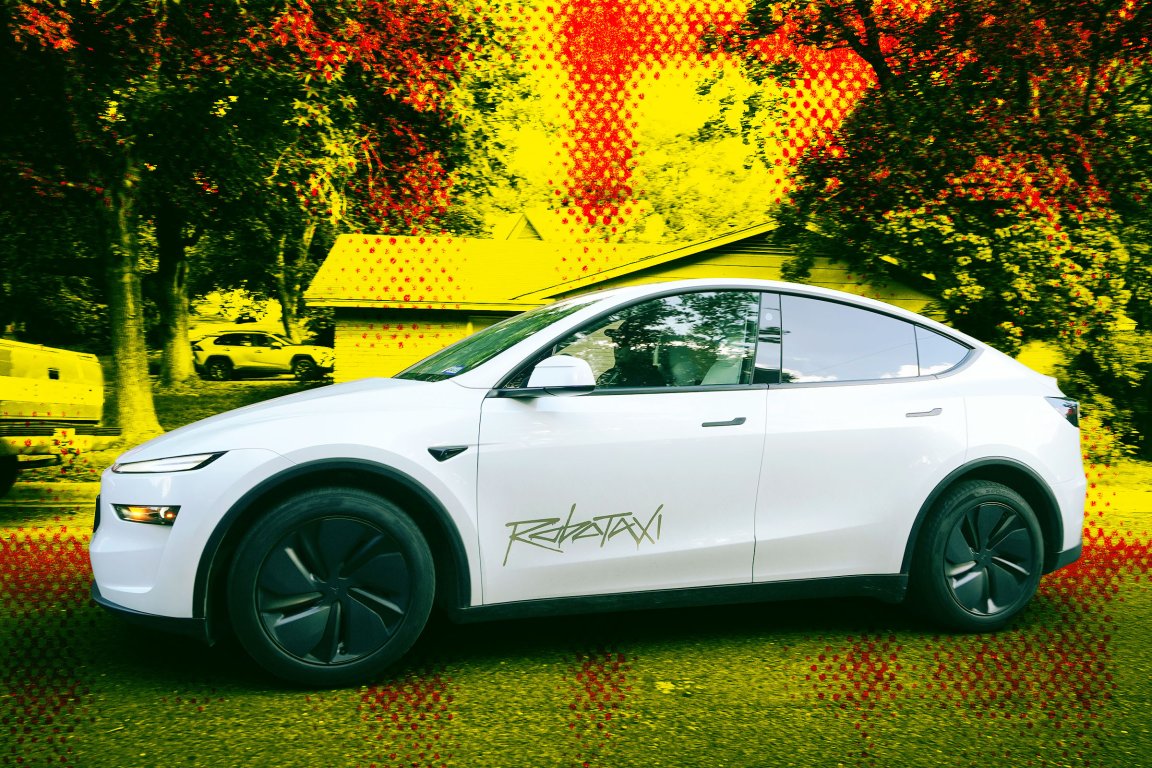
Needless to say, Musk’s service is drastically short of living up to any of these ambitions. There are just 59 Robotaxis on the road, Bloomberg reports, with at least some of them still requiring physical human supervision. Its efforts to expand past its home base in Austin, Texas are floundering, with the company forced to admit to California state regulators that its self-driving cabs don’t actually drive themselves, according to the reporting.
This incremental progress would be permissible at a smaller company. But Musk has persistently wooed investors with his sci-fi vision of the company’s future, keeping its stock buoyant and driving its market cap well past the $1 trillion mark. (Even this is a let down: when he announced a Robotaxi pivot in 2024, Musk projected it would help push Tesla’s valuation to $30 trillion. That is not a typo.)
The monstrous hype has put Tesla in a paradoxical position: the business side of things looks more precarious than ever, with cratering profits and a plunging public image, but its market valuation has soared.
Musk has defended the slow progress by stressing the company is “paranoid about safety.” There’s an element of truth to this, given the tiny fleet size and that many of the Robotaxi rides remain supervised by human workers. But on the other hand, Musk is clearly willing to casually overstate the capabilities of his tech to keep stringing along Wall Street.
“Tesla, which by all indications is a confident company run by a supremely confident person, is clearly not confident in the reliability of their technologies,” Bryant Walker Smith, an autonomous vehicles researcher and associate professor of law at the University of South Carolina, told Bloomberg. “The scale of this is very small.”
The picture on the ground painted by Bloomberg echoes the complaints raised by customers ever since the Robotaxi service was opened up to the public, after it was initially limited to a cadre of uncritical Tesla influencers. Wait times frequently stretch up to 30 minutes, even in Austin, where most of the Robotaxis are deployed, with the app often barring users from booking rides during periods of “high service demand.”
And the cars behave erratically, picking up and dropping off customers at bizarre and inconvenient locations, such as in an alley. Around one in three of the rides have a human monitor sitting in the car, whose presence seems mostly perfunctory; one rider complained that his Robotaxi dropped him a quarter mile from his actual destination, despite a monitor being in the car.
All the while, there’s been a frustrating element of smoke and mirrors surrounding the Robotaxi efforts. Until now, Tesla’s didn’t disclose official figures on the size of its fleet and has belatedly reported Robotaxi crashes to regulators, heavily censoring the circumstances of the accidents. In January, when Musk announced that the Robotaxis would finally start giving rides in Austin with a human supervisor in the car, it soon emerged that this was yet more sleight-of-hand: the rides were still being supervised by having another human-driven car tailing the Teslas.
More on Tesla: Tesla Insiders Admit Self-Driving Is a Complete Disaster