
惯性聚合 高效追踪和阅读你感兴趣的博客、新闻、科技资讯
阅读原文 在惯性聚合中打开

推荐订阅源

GbyAI
GbyAI
Martin Fowler
Martin Fowler
I
InfoQ
腾讯CDC
钛媒体:引领未来商业与生活新知
钛媒体:引领未来商业与生活新知
爱范儿
爱范儿
Microsoft Security Blog
Google DeepMind News
D
DataBreaches.Net
云风的 BLOG
云风的 BLOG
F
Fortinet All Blogs
N
Netflix TechBlog - Medium
博客园 - 聂微东
Microsoft Azure Blog
D
Docker
博客园 - 三生石上(FineUI控件)
Y
Y Combinator Blog
博客园 - Franky
Engineering at Meta
Engineering at Meta
B
Blog
罗磊的独立博客
Apple Machine Learning Research
Jina AI
Jina AI
V
Visual Studio Blog

Futurism

Man Creates Tiny Submarine for His Parakeet to Experience Life Underwater The Effects of AI-Generated Code Tearing Through Corporations Is Actually Kind of Funny Trump Hires Orbital Towing Company to Build Space Interceptors Psychologists Found Something Horrible About the Kind of Men Seeking Trad Wives To Get Swole, Teens Are Pumping Themselves Full of Drugs Meant for Fattening Cows for the Slaughterhouse Foolish Pollsters Are Now Just Asking AI What Voters Would Say in Response to Questions and Publishing It at Face Value OpenAI Says It’s Already Made $100 Million by Stuffing ChatGPT With Ads Man Punished for Breaking Into Moo Deng’s Zoo Enclosure AI Is Causing Healthcare Costs to Surge There’s a Mass Rebellion Against AI in the Workplace People Who Lose Their Job to AI Are in for a World of Pain, Goldman Sachs Report Finds OpenAI Says Not to Worry About UBI, Because It Has Another Idea Police Officer Helplessly Waves Arms at Waymo That Careened Wrong Way Through Whataburger Drive-Thru Someone Just Threw a Molotov Cocktail At Sam Altman’s House New York Times Makes Substantial Changes to Article That Glazed a Sleazy AI Startup: “Our Piece Should Have Included That Information” Space Scientists Wince as Astronauts’ Lives Depend on Artemis 2’s Controversial Heat Shield During Plunge Back to Earth The Moon Astronauts Have Been Working Out With a NASA Rowing Machine in Space First AI Model From Zuckerberg’s Wildly Expensive Superintelligence Lab Flops Compared to Virtually All Rivals Economists Starting to Admit They May Have Been Wrong About AI Never Replacing Human Jobs AI-Powered Drug Marketer Medvi Responds After Allegations About Fake Doctors and Patients As Astronauts Visit the Moon, NASA Insider Says Agency Is in Shambles Behind the Scenes Man Lights 1.2 Million Square Foot Warehouse on Fire for Not Paying Him Enough NASA Scientists Screamed With Delight When They Saw Something Smashing Into the Moon Google Says Showing Polymarket Bets on Google News Was a Mistake Las Vegas Sphere Turns Into Huge Moon to Celebrate NASA Mission The New York Times Says It’s Identified the Creator of Bitcoin We Talked to a Writer Accused of Publishing An AI-Generated Essay in The New York Times Naked Man Bursts Into Tesla Service Center With a Shotgun Student Dies When Hospital Has No ICU Doctors, Calls One on Videochat Who Pronounces Him Dead Remotely, Lawsuit Claims Analysis Finds That Google’s AI Overviews Are Providing Misinformation at a Scale Possibly Unprecedented in the History of Human Civilization
Scientists Detect Weird Anomalies in Clouds of Venus
Frank Landymore · 2026-05-17 · via Futurism

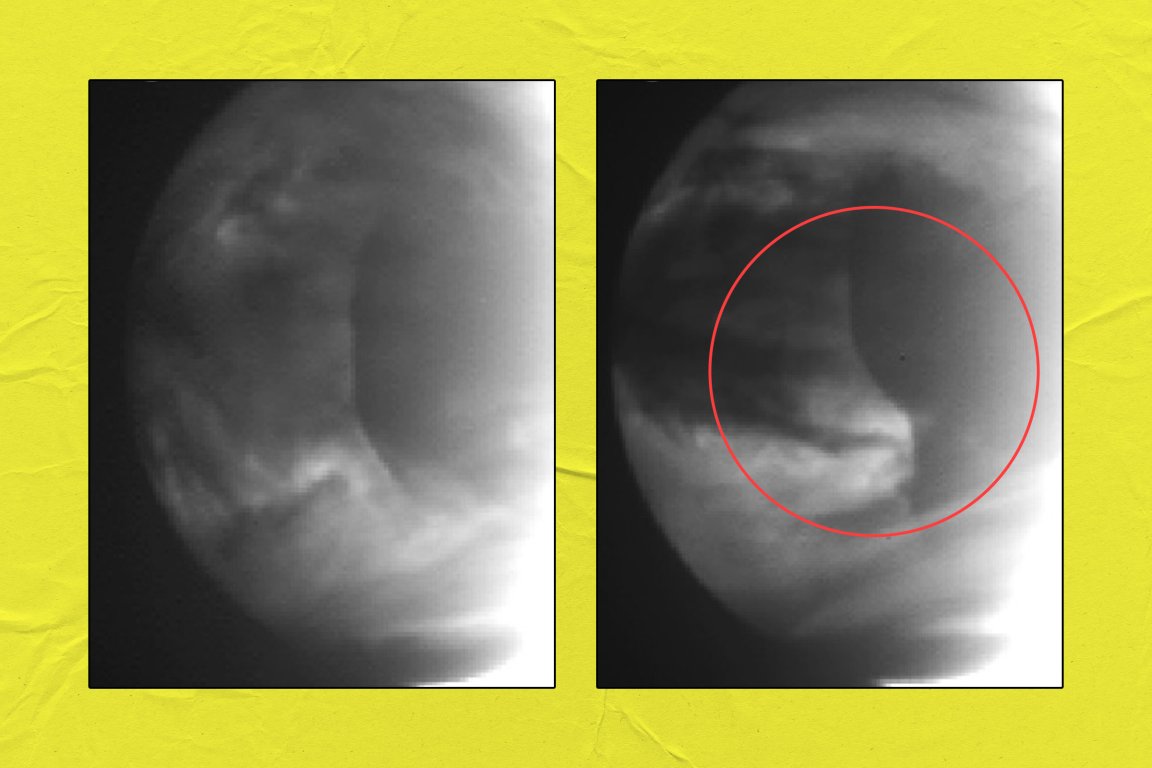
Two black-and-white images of a planet with a crescent shape, showing cloud formations. The right image has a red circle highlighting a specific area on the planet's surface. The background is yellow.

Imamura et al.

Sign up to see the future, today

Can’t-miss innovations from the bleeding edge of science and tech

Mysteries abound on our planetary neighbor Venus, not least of all because it’s permanently shrouded in a thick and nigh-impenetrable layer of clouds.

But when the Japanese Aerospace Exploration Agency’s Akatsuki space probe visited the steaming hot world in 2016, it managed to spot something anomalous in the atmospheric veil obscuring the planet’s inscrutable surface: an enormous wave tearing through the atmosphere for days at a time, creating a cloud that stretched up to 3,700 miles across. What possibly could’ve been responsible for this monstrosity was unclear.

Now, astronomers have an answer about what they glimpsed. In a new study published in Journal of Geophysical Research: Planets, a team led by researchers from the University of Tokyo suggest that the atmospheric behemoth was spawned by turmoil in a lower cloud layer, in a phenomenon known as a “hydraulic jump” that burst to the surface.

“We identified the phenomena, but for years we couldn’t understand it,” said lead author Takeshi Imamura at the University of Tokyo in a statement about the work. “However, thanks to this research, we’re now able to show that this cloud disruption is caused by the largest known hydraulic jump in the solar system.”

The Venusian atmosphere is primarily made of carbon dioxide, creating an extreme greenhouse effect that’s responsible for the planet’s hellish temperatures. Within this atmosphere are three distinct cloud layers. The clouds are composed of sulfuric acid, and their sheer celerity puts them in a class above Earth’s. Unlike the ponderous, floating balls of cotton we associate with clouds on our planet, Venus’ “superrotate,” meaning they swirl around the planet 60 times faster than the planet itself turns. To astronomers, Venus’s persistent and extreme clouds provide a way of probing fleeting atmospheric phenomena on Earth.

But even by Venus’s standards, a giant acid cloud bank thousands of miles across was extreme. Enter hydraulic jumps: you can see phenomenon in the kitchen sink, when water from the tap hits the basin and appears shallow but spreads quickly, then slows and rises in depth.

Now blow that up to a planetary scale. On Venus, an atmospheric wave in its lower cloud layers can abruptly destabilize and slow down as a result, the team found. This creates a powerful updraft that blasts sulfuric acid vapor into the topmost layer, where it condenses into a massive but lumbering cloud bank which moves slower than its surroundings, creating a distinct wave front. The astronomers say it’s the first example of a hydraulic jump seen on another planet.

“Venus has three distinct cloud layers, and the dynamics of the lower and middle layers are not so well understood,” Imamura said in the statement. “Our discovery of a hydraulic jump on Venus connecting a very large-scale horizontal process with a strong localized vertical wave is unexpected, as in fluid dynamics these are usually disconnected.”

More on space: Scientists Spot Huge Cave on Venus