


China is working toward its own moon landing. Could it put astronauts on the moon before NASA’s Artemis program does?
By Andrew Jones edited by Lee Billings
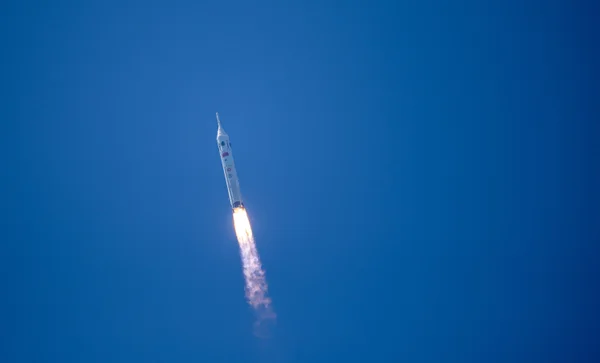
A single-stage version of China’s in-development moon rocket, the Long March 10, soars through the sky during a flight test from the Wenchang Space Launch Site on February 11, 2026. The rocket also carried an uncrewed Mengzhou capsule, a spacecraft that alongside China’s Lanyue moon lander is planned to take the nation’s astronauts to the lunar surface by 2030.
CFOTO/Future Publishing/Getty Images
NASA has launched four astronauts on a pioneering journey around the moon—the Artemis II mission. Follow our coverage here.
With Artemis II’s Orion spacecraft and its four crew nearing a splashdown off San Diego, Calif. after a spectacularly successful flyby of the moon, NASA’s plan to return humans to the lunar surface for the first time in more than 50 years now seems almost unstoppable. But it may still be Chinese astronauts, rather than American ones, who will take the next fateful steps on the moon in the 21st century.
NASA’s Artemis II circumlunar mission has dominated the spaceflight calendar this year, with its crew reaching new heights and returning stunning views of Earth from deep space. Yet China has quietly been making its own large, if less headline-grabbing strides toward putting its astronauts on the moon.
On February 11 a single-stage version of China’s in-development moon rocket, the Long March 10, topped with a Mengzhou spacecraft, lifted off from a pad at the Wenchang Space Launch Site on the nation’s southern island of Hainan. Early in the ascent, mission controllers deliberately triggered a solid rocket system designed to rapidly pull the spacecraft away from danger in case of trouble with its launcher. Mengzhou then descended via parachutes for recovery in the South China Sea, marking a successful in-flight abort of the uncrewed spacecraft. Meanwhile the Long March 10 stage continued its flight to simulate a full orbital mission before it performed a boost-back burn and a controlled, propulsive splashdown into the waves—a feat that NASA’s current moon rocket, the Space Launch System (SLS), simply cannot match.
If you're enjoying this article, consider supporting our award-winning journalism by subscribing. By purchasing a subscription you are helping to ensure the future of impactful stories about the discoveries and ideas shaping our world today.
These tests pave the way for the next crucial milestone: a full orbital flight of the Long March 10 and Mengzhou later this year, though most likely without crew. As is typical of China, which tends to be tight-lipped about many specifics of its space plans, the nation has not divulged when exactly this flight will take place. Candidate mission patches for the inaugural flight suggest that Mengzhou, which features a low-Earth orbit variant designed to carry six or seven astronauts and another to take three to low lunar orbit, could rendezvous with or fly alongside China’s Tiangong space station. The rocket will be the Long March 10A, a slimmed-down version of the rocket that will be meant for low-Earth orbit rather than any lunar destination.
China is not yet ready to perform a crewed circumlunar mission like the U.S., which began development of the Orion spacecraft in the 2000s and redesigned it to go with the SLS rocket in the early 2010s. But China is progressing on all the necessary hardware to reach the moon, with a stated goal of a crewed landing before 2030. Notably, the nation has already tested a key component that the U.S. is still working to bring online: the landing hardware. Last year China demonstrated its Lanyue crewed lunar lander, performing a propulsive lunar landing and lunar launch tests in simulated moon gravity conditions. In the U.S. SpaceX and Blue Origin are both working on NASA-funded lander concepts needed to make a 2028 Artemis landing possible. Meanwhile new launch facilities at Wenchang to host the full Long March 10 rocket are almost completed.
The full Long March 10 will use a common booster core configuration, similar to how the SpaceX Falcon Heavy is essentially a triple-sized Falcon 9. After test flights of the 10A, the next step will be bundling together three booster cores—something commercial firm CAS Space achieved in China for the first time late last month—for the larger rocket and test flights to the moon.
To get to the moon, China will use two Long March 10 rockets, one launching a crewed Mengzhou spacecraft and the other lofting the Lanyue lunar lander. These will meet up in low lunar orbit, with two astronauts transferring from Mengzhou to Lanyue for the descent to the lunar surface. It is likely that China will perform crewed low-Earth orbit and uncrewed lunar missions before progressing to an Artemis II–style mission in the next couple of years, setting up a potential crewed lunar landing attempt before the decade is out.
NASA, aiming for a landing in 2028 with Artemis IV, relies on a complex network of commercial and international partners, while China’s more centralized approach depends largely on its state-owned contractor, the China Aerospace Science and Technology Corporation.
“If the Chinese can maintain a single concentrated effort, they will retain an advantage, as the U.S. is splitting its resources and seemingly making large structural programmatic changes very late in the day,” says Bleddyn Bowen, co-director of the Space Research Center at Durham University in England. “Ironically, today China’s effort resembles the 1960s U.S. Apollo moon program more, while the U.S. Artemis program resembles the Soviet Union’s competing design bureaus of the late 1960s.”
The narrative of a “race” is hard to avoid. But that depends on the point of view of the competitor. “It really is one-sided, at least in public,” says Victoria Samson, chief director for space security and stability at the Secure World Foundation. “The United States constantly cites China’s intentions for the moon as the reason why the U.S. has to get back there first, while I don’t think I’ve seen anything equivalent come from Chinese statements.” That’s not to say China isn’t invested in lunar exploration: Samson views geopolitical competition with the U.S. as a driver for the Chinese space program.
“I do see the United States getting there first but just barely, and I think that the Chinese have a better chance of getting a permanently crewed station on the moon first,” she adds.
Race or not, the two rivals will need to reach an understanding on key aspects of lunar exploration, Samson says.
“If the United States is serious about having a permanent human presence on the moon, we are going to have to figure out how to coordinate with the Chinese on matters of safety and interoperability—whether we like it or not,” she says. “People’s lives will depend on it.”
If you enjoyed this article, I’d like to ask for your support. Scientific American has served as an advocate for science and industry for 180 years, and right now may be the most critical moment in that two-century history.
I’ve been a Scientific American subscriber since I was 12 years old, and it helped shape the way I look at the world. SciAm always educates and delights me, and inspires a sense of awe for our vast, beautiful universe. I hope it does that for you, too.
If you subscribe to Scientific American, you help ensure that our coverage is centered on meaningful research and discovery; that we have the resources to report on the decisions that threaten labs across the U.S.; and that we support both budding and working scientists at a time when the value of science itself too often goes unrecognized.
In return, you get essential news, captivating podcasts, brilliant infographics, can't-miss newsletters, must-watch videos, challenging games, and the science world's best writing and reporting. You can even gift someone a subscription.
There has never been a more important time for us to stand up and show why science matters. I hope you’ll support us in that mission.
此内容由惯性聚合(RSS阅读器)自动聚合整理,仅供阅读参考。 原文来自 — 版权归原作者所有。