


June 16, 2026
The higher education innovator shares thoughts on communicating science and connecting research to what the public values
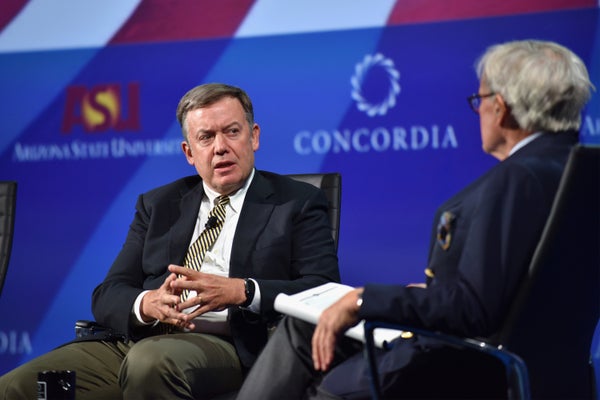
Bryan Bedder/Stringer/Getty Images for Concordia Summit
Michael M. Crow is an American academic leader and science and technology policy scholar who has served as president of Arizona State University (ASU) since 2002. He previously held senior academic roles at Columbia University and is known for advancing ASU’s “New American University” model.
[This interview was edited for length and clarity.]
How would you describe the current state of American science?
If you're enjoying this article, consider supporting our award-winning journalism by subscribing. By purchasing a subscription you are helping to ensure the future of impactful stories about the discoveries and ideas shaping our world today.
I’m going to be very positive about American science. It’s almost unbelievable—the rate of production, the unbelievable enhancements by new technologies that are enabling science. I think the state of American science is that it is strong. It is integrated. It’s powerful. It’s emboldened by hundreds of thousands of graduate students and tens of thousands of research groups. It’s really going strong.
What needs to change in American science?
A couple of things: One, scientists speak gibberish, and we need to find ways to translate gibberish to English and Spanish and other languages so that more people can understand what we’re doing and why we’re doing it. So we have a deep translation problem that needs to change.
Second, I think that American [researchers] need to focus on how we portray what we’re doing to help the U.S. to be better in the future. It can’t just be “All science is good, and all science leads to good things.” Now it has to be “Here’s what we did, here’s what we’re doing, and here’s why we’re doing it.”
So I think that the improvement we need is more connections to what people want. For instance, in Arizona we have a project called the Center for the Future of Arizona, and we look for shared public values [that] more than 70 percent of the population believes in.... The highest shared public value is [having] blue skies, clean water and clean air. And so we need to figure out how to deliver that while, at the same time, not saying to people that the only way to get there is you never get to drive your car again.
What gives you optimism right now?
The optimism that I have is that scientists are still determining their own agenda. You know, we’re still chasing the inner workings of quantum entanglement; we’re free to develop new math theories, new ways of understanding the vortices of the stars and how they work.... So what gives me hope is that there’s no diminishment. It’s just go, go, go all the time.
Hope for me is also the progress that we’re making now with supercomputers and augmented intelligence—that’s what I call it instead of artificial intelligence because there’s nothing artificial about it. We’re going to be able to solve more quickly and move more quickly. A single Ph.D. student in the future may do the work of 20 Ph.D.s in the past.
What’s your best advice for an early-career scientist?
One: Be as aware of other disciplines as you possibly can be, if not actually being in an interdisciplinary field. Two: Understand who’s funding you and why they’re funding you, and be sympathetic to them. Three: Realize that you that you lived and you live in one of the most unbelievably privileged positions that humans have ever been able to live in. You get to determine your own problem. You get to work on your own quest. You get to define how you’re going to do it. Other people pay you to do this, and so you should realize that you’re in a gifted, gifted position.
How has your field changed in the past few years?
Well, I’m a weirdo—I’m a designer of knowledge enterprises, a science and technology policy management scholar—and so my field has changed because of the speed of change, the speed of knowledge production, the enhancement of computational tools, the enhancement of visualization tools, the enhancement of all that stuff. I mean, just the speed of everything is just infinitely faster.
And I think there’s also more competition. People are talking about the sky is falling because the Chinese have an elaborate scientific apparatus. I’m like, “Okay, what are you, afraid? Are you unwilling to compete? Do you think you’re going to get beat just because someone else showed up with their own bat at the softball field? Why don’t we get in there, and why don’t we start hitting more home runs? We’ll show them what home runs are all about.”
If you enjoyed this article, I’d like to ask for your support. Scientific American has served as an advocate for science and industry for 180 years, and right now may be the most critical moment in that two-century history.
I’ve been a Scientific American subscriber since I was 12 years old, and it helped shape the way I look at the world. SciAm always educates and delights me, and inspires a sense of awe for our vast, beautiful universe. I hope it does that for you, too.
If you subscribe to Scientific American, you help ensure that our coverage is centered on meaningful research and discovery; that we have the resources to report on the decisions that threaten labs across the U.S.; and that we support both budding and working scientists at a time when the value of science itself too often goes unrecognized.
In return, you get essential news, captivating podcasts, brilliant infographics, can't-miss newsletters, must-watch videos, challenging games, and the science world's best writing and reporting. You can even gift someone a subscription.
There has never been a more important time for us to stand up and show why science matters. I hope you’ll support us in that mission.
此内容由惯性聚合(RSS阅读器)自动聚合整理,仅供阅读参考。 原文来自 — 版权归原作者所有。