


June 16, 2026
The science historian talks about scientific integrity and public opinion
Kris Connor/Getty Images
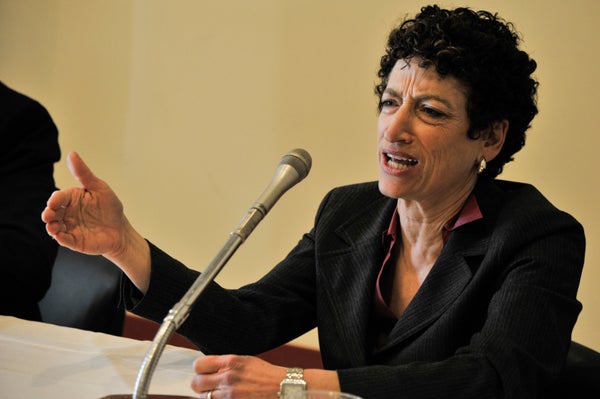
Naomi Oreskes is an Earth scientist, historian of science and public speaker. She is currently the Henry Charles Lea Professor of the History of Science at Harvard University and an affiliated professor of Earth and planetary sciences. She is author or co-author of numerous books, including the best-selling Merchants of Doubt.
[This interview was edited for length and clarity.]
How would you describe the current state of American science?
If you're enjoying this article, consider supporting our award-winning journalism by subscribing. By purchasing a subscription you are helping to ensure the future of impactful stories about the discoveries and ideas shaping our world today.
I’d say the state of American science is very mixed. In general, scientists are continuing to do great work. The quality of science being done in America is very high and remains high. But the scientific enterprise is clearly under stress. Scientists are under stress personally and emotionally because we’re living in a situation where we have tremendous hostility coming from the highest levels of the U.S. government. The enterprise as a whole is under stress from attacks on science, particularly government science—the federal agencies that have lost enormous amounts of expertise in the past 18 months or two years.
What needs to change in American science?
A few things. I don’t approve of the present government’s policies, so I’d like to see those change. I’d like to see continued, robust support for public science because there are so many areas important to the health and well‑being of the American people that we can’t expect the private sector to undertake. These aren’t things that generate quarterly returns to shareholders. Sustained public support for science is essential.
I also worry about public confidence. I don’t think we yet have good data on how recent attacks have affected public opinion, but I worry people have taken the message that we don’t really need these agencies—that they’re inefficient. The so‑called Department of Government Efficiency [DOGE] was offensive on many levels, including legally—it was never created by Congress. But it gave the impression of massive inefficiency in federal science, which I don’t think is true.
And finally, we need to clean up our own house. There are legitimate concerns about scientific integrity. I’ve been writing about corruption related to glyphosate. Universities and institutions haven’t done enough to ensure integrity so the public knows that when we publish peer‑reviewed science, while it will never be perfect, we have procedures to minimize fraud, malfeasance and error. Right now we don’t have those procedures well enough in place.
What gives you optimism right now?
I actually hate that question. I’m an adherent of Roy Scranton’s philosophy of ethical pessimism. I think it’s borderline unethical to focus on the positive when really troubling things are happening that hurt people. What’s ethical is being honest about problems, confronting them clearly and asking what we can realistically do.
The pressure to be optimistic leads to wishful thinking. Take the Intergovernmental Panel on Climate Change: they include large contributions from carbon capture and storage to stay below 1.5 degrees [Celsius of global warming above preindustrial levels], but that technology doesn’t exist at scale. Scientists say it’s the only way they can see meeting the target—but that gives people a false sense of security. That kind of optimism actually does damage.
What’s your best advice for an early-career scientist?
Don’t go into science unless you love it. I meet young people who think they should become scientists because they care about climate change—that’s all wrong. Climate change is so multifaceted that almost any field can contribute: law, business, art, communications.
Follow your heart. People do the best work when they love what they do. If you’re doing science because you think you should, that’s a recipe for suffering.
How has your field changed in the past few years?
I’m primarily professionalized as a historian of science, but I consider myself a scientist and still work with Earth scientists and publish in scientific journals.
When I entered history of science, it was very narrow—mostly physics or Darwin. History of Earth science barely existed. There were maybe five of us, all supportive because we wanted the field to grow. You couldn’t say “professor of the history of Earth science.” Now you can. I recently saw a job ad preferring Earth and environmental science—that’s what I hoped to see happen.
The field has become much more capacious. We now understand the diversity of sciences—geochemistry, atmospheric chemistry, toxicology, epidemiology—all with different methods and evidentiary standards. You can’t use physics as a model for all science. Different questions require different tools. If a carpenter showed up with only a hammer, you’d be suspicious. For a long time, we thought physics alone could answer everything—we now know that’s wrong.
If you enjoyed this article, I’d like to ask for your support. Scientific American has served as an advocate for science and industry for 180 years, and right now may be the most critical moment in that two-century history.
I’ve been a Scientific American subscriber since I was 12 years old, and it helped shape the way I look at the world. SciAm always educates and delights me, and inspires a sense of awe for our vast, beautiful universe. I hope it does that for you, too.
If you subscribe to Scientific American, you help ensure that our coverage is centered on meaningful research and discovery; that we have the resources to report on the decisions that threaten labs across the U.S.; and that we support both budding and working scientists at a time when the value of science itself too often goes unrecognized.
In return, you get essential news, captivating podcasts, brilliant infographics, can't-miss newsletters, must-watch videos, challenging games, and the science world's best writing and reporting. You can even gift someone a subscription.
There has never been a more important time for us to stand up and show why science matters. I hope you’ll support us in that mission.
此内容由惯性聚合(RSS阅读器)自动聚合整理,仅供阅读参考。 原文来自 — 版权归原作者所有。