


Debris is a growing threat to orbital infrastructure, and it's only going to get worse as the number of launches increases
By Adam Kovac edited by Claire Cameron

Getty Images/World Map Courtesy of NASA
Almost half the stuff in orbit around Earth can be classified as space junk, and the problem is only going to get worse as launches and orbital infrastructure increases.
Using data from the U.S. Space Force’s Space-Track.org, engineering component supply company ACCU determined there are currently 33,269 trackable objects in orbit. Of those, 17,682 are satellites. The rest is some form of junk, ranging form expended rocket bodies, to debris, to objects that could not be identified.
“This means that nearly 47% of tracked objects are space junk,” the company wrote in a new report. “However, with many satellites no longer operational, it means the true proportion of inactive or uncontrollable objects is even higher.”
If you're enjoying this article, consider supporting our award-winning journalism by subscribing. By purchasing a subscription you are helping to ensure the future of impactful stories about the discoveries and ideas shaping our world today.
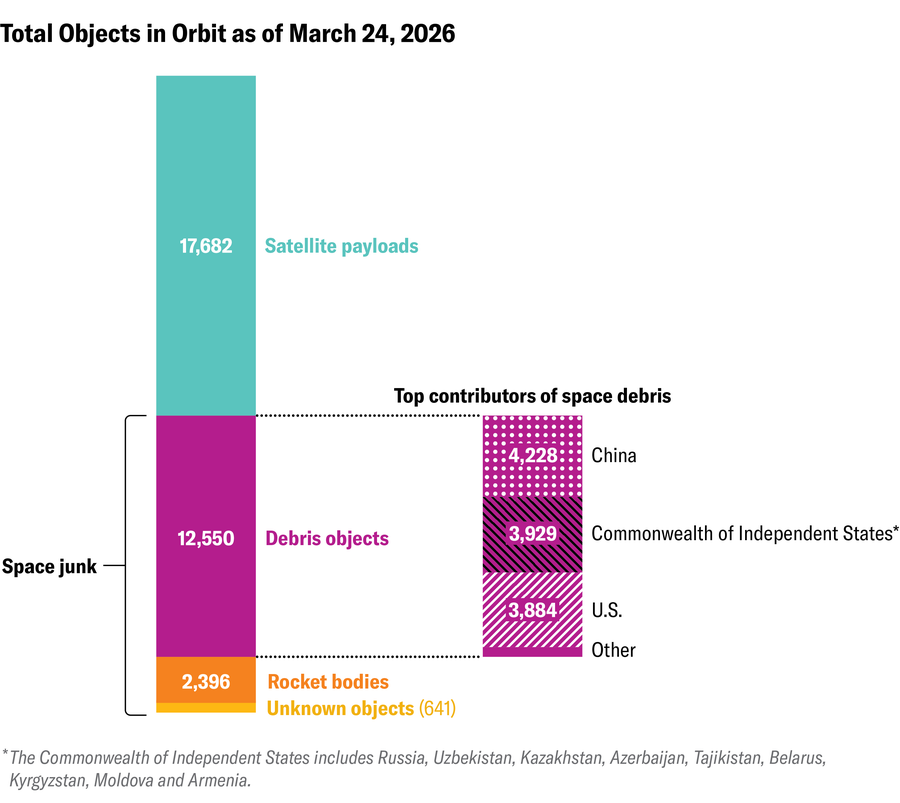
Space junk has been accumulating since the first satellite, Sputnik 1, was launched in 1957. Yet the problem has grown sharply over the past decade as the cost of launches dropped and the cadence of space flights has increased. The amount of trackable objects in orbit rose by around 10,000 between 2020 and 2025 alone.
The scale of the issue may be grossly underestimated. ACCU notes that there may be millions of objects too tiny to track, such as paint flecks and other debris that came loose from rockets and other spacecraft. That poses a major risk: Most objects in orbit are traveling at upwards of 17,000 miles per hour—at that speed, even the tiniest mote could inflict significant damage on orbiting infrastructure. In 2024, astronauts aboard the International Space Station had to take shelter following a collision with a small piece of debris, which left a visible chip in a window. That incident prompted the launch of a U.S. governmental program aimed at finding and monitoring low Earth orbit's tiniest pieces of garbage. And in 2025, several Chinese taikonauts became stranded on the Tiangong space station after a suspected piece of space junk cracked the window of their return capsule.
While there’s a chance an orbiting piece of junk could hurt or kill an astronaut, the ACCU's analysis suggests that the greatest danger is to satellites, with 7 pieces of junk for every 10 operational satellites.
Despite being a problem that’s literally around the globe, the causes are not global. The report estimates that China is responsible for 65 percent of the debris in orbit while the U.S. and the Commonwealth of Independent States—comprised of Russia and eight other, smaller countries—account for an estimated 40 percent and 23 percent, respectively.
Space agencies such as NASA, the Japanese Space Agency, and the U.K. and European Space Agencies are working to clean up lower-Earth orbit. Several private companies have also began marketing their services as space garbage collectors. But until large amounts of junk are removed, the ACCU called on spacecraft designers to take the threat more seriously.
“For the engineers shaping the spacecraft of tomorrow, they must keep space debris in mind from the start,” the report authors write. “Every component, from its precision, durability, and material, has to be chosen carefully to survive potential impacts. Space debris is a key challenge of the modern space age, but how it is tackled will drive innovation and define the future of space exploration.”
If you enjoyed this article, I’d like to ask for your support. Scientific American has served as an advocate for science and industry for 180 years, and right now may be the most critical moment in that two-century history.
I’ve been a Scientific American subscriber since I was 12 years old, and it helped shape the way I look at the world. SciAm always educates and delights me, and inspires a sense of awe for our vast, beautiful universe. I hope it does that for you, too.
If you subscribe to Scientific American, you help ensure that our coverage is centered on meaningful research and discovery; that we have the resources to report on the decisions that threaten labs across the U.S.; and that we support both budding and working scientists at a time when the value of science itself too often goes unrecognized.
In return, you get essential news, captivating podcasts, brilliant infographics, can't-miss newsletters, must-watch videos, challenging games, and the science world's best writing and reporting. You can even gift someone a subscription.
There has never been a more important time for us to stand up and show why science matters. I hope you’ll support us in that mission.
此内容由惯性聚合(RSS阅读器)自动聚合整理,仅供阅读参考。 原文来自 — 版权归原作者所有。