


June 16, 2026
On steering the path forward for research and innovation
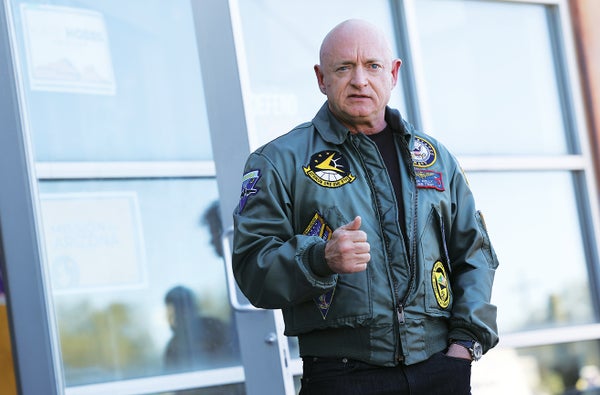
Kevin Dietsch/Getty Images
Mark Kelly is a former U.S. Navy combat pilot and NASA astronaut who has served as a U.S. senator from Arizona since 2020. He earned a bachelor’s degree in marine engineering and nautical science from the U.S. Merchant Marine Academy and a master’s degree in aeronautical engineering from the Naval Postgraduate School. In 1996 Kelly was selected as an astronaut, and he has spent more than 50 days in space, traveling more than 20 million miles. He retired from NASA in 2011 after commanding Space Shuttle Endeavour on its final flight.
An edited transcript of the interview follows.
How would you describe the current state of American science?
If you're enjoying this article, consider supporting our award-winning journalism by subscribing. By purchasing a subscription you are helping to ensure the future of impactful stories about the discoveries and ideas shaping our world today.
From a standpoint of still having great scientists and being the world’s best innovators and inventors, I would give us high marks. My concern is that we have some folks in government who don’t believe in science and don’t believe in the investments that need to be made for us to stay in that leadership position.
We’ve got the world’s biggest economy, in my view, not because of real estate developers but because of science and decades and decades of the federal government investing in research and education—especially the education of scientists and engineers and the funding of Ph.D. programs, as well as our investment in our national laboratories.
I think all that together has been an incredible gift to the U.S., and now we see that being rolled back, and it’s really a big concern of mine.
What needs to change in American science?
I think something needs to change in American government. I’ve spoken to directors of labs and centers here who are very concerned with their budget. I’ve had people tell me they’re not going to be able to do any science anymore, so they might as well just close the doors. Those are the kinds of cuts that have been proposed.
Right now we’ve somewhat successfully pushed back on the worst of that. But we’ve got a few more years of this administration, and you never know what comes next.
What gives you optimism right now?
I think despite the challenges we face from government officials who really just don’t believe in the scientific method and the value of science, we still are a place that attracts some of the best scientists in the world.
Now that’s starting to change. We’re seeing scientists go to China because that’s where the investments are being made. But so far I think we’re still well positioned.
What’s your best advice for an early-career scientist?
Specifically for people who want to be astronauts, there are a couple of options. The astronaut job is very competitive: there are thousands of applications for a handful of spots. When I applied, it was fewer but still in the thousands. The number has gone up because it’s easier to get the information out there now that there is a process going on to select astronauts.
I tell people to go into one of the fields that qualify you to be an astronaut. I was a U.S. Navy test pilot, or you could be a scientist, engineer or medical doctor. But find something that you really like to do because if you like it, you can be good at it. And then have other experiences. We want people who can actually do things instead of people who just know things.
How has your field changed in the past few years?
I think we needed to shift some things around. Making the decision to try to test the entire Artemis system, including the lander in low-Earth orbit, is probably a good one to mitigate some of the risk. Going right into a landing on the surface of the moon seemed incredibly ambitious.
I also think that if you’re not changing things, they’re often getting worse. So we need to be reevaluating how we spend limited resources and making sure they’re going to the right place. Often in some of these NASA centers and government labs, you see overlapping capability. Maybe we don’t need three low-speed wind tunnels in different places. Maybe we could get by with one.
Often that becomes a political problem because the members of Congress who have those [projects] in their district don’t want to get rid of them. But it’s important to figure out where to best apply resources to get the maximum benefit. And I don’t want to be that critical of my colleagues, but, you know, we don’t have a lot of people in elected office who have a background in science and engineering. In the Senate, there are three engineers out of 100 people.
If you enjoyed this article, I’d like to ask for your support. Scientific American has served as an advocate for science and industry for 180 years, and right now may be the most critical moment in that two-century history.
I’ve been a Scientific American subscriber since I was 12 years old, and it helped shape the way I look at the world. SciAm always educates and delights me, and inspires a sense of awe for our vast, beautiful universe. I hope it does that for you, too.
If you subscribe to Scientific American, you help ensure that our coverage is centered on meaningful research and discovery; that we have the resources to report on the decisions that threaten labs across the U.S.; and that we support both budding and working scientists at a time when the value of science itself too often goes unrecognized.
In return, you get essential news, captivating podcasts, brilliant infographics, can't-miss newsletters, must-watch videos, challenging games, and the science world's best writing and reporting. You can even gift someone a subscription.
There has never been a more important time for us to stand up and show why science matters. I hope you’ll support us in that mission.
此内容由惯性聚合(RSS阅读器)自动聚合整理,仅供阅读参考。 原文来自 — 版权归原作者所有。