


These monkeys are literally eating dirt to help digest human junk food
Gibraltar’s macaques have been observed engaging in geophagy, the consumption of soil and clay, in an apparent attempt to quell their nausea from eating fatty and salty foods offered by tourists
By Adam Kovac edited by Claire Cameron
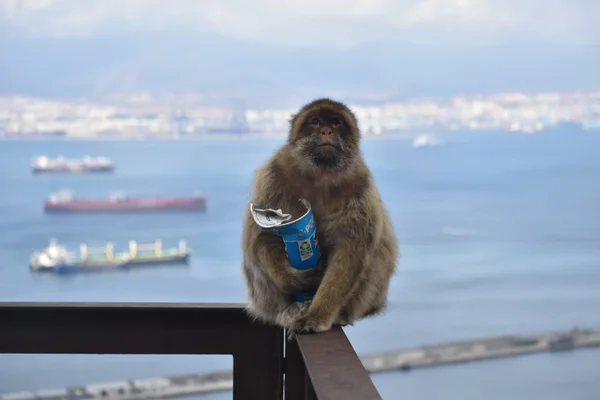
Martin Nicourt/Gibraltar Macaques Project
Join Our Community of Science Lovers!
Not content with ruining their own appetite with junk food, tourists in Gibraltar may also be turning the stomachs of the region’s iconic feral macaques. Monkeys in the tourism hotspot have apparently learned to eat dirt to soothe stomach upsets caused by eating too much sweet, fatty and salty snacks fed to them by visitors, a new study found.
The British territory’s Barbary macaques are the only wild monkeys in Europe. That’s made them a tourist draw, and those tourists bring foods quite unlike the seeds, fruits and vegetables that typically make up a macaque’s diet.
In the new study, published on Wednesday in Scientific Reports, University of Cambridge biological anthropologist Sylvain Lemoine and his team report observing the macaques intentionally eating soil, dirt and clay—a practice known as geophagy. While geophagy has previously been studied in humans, certain birds and various other animals, this marks the first time Gibraltar’s macaques have been formally documented engaging in the behavior.
On supporting science journalism
If you're enjoying this article, consider supporting our award-winning journalism by subscribing. By purchasing a subscription you are helping to ensure the future of impactful stories about the discoveries and ideas shaping our world today.
The soil and clay consumption wasn’t limited to a handful of events. Over the course of more than 612 hours of observation across nine locations, the researchers documented 46 different instances of geophagy among at least 44 individual monkeys out of the territory’s 230 or so macaques. The behavior also seems to be more frequent among the Gibraltar’s monkeys than it is among other primates that are known to occasionally engage in eating soil, according to the study.
The dirt eating was widespread, with males and females from different groups of monkeys partaking during multiple times of the year, and was generally associated with areas where there were more tourists.
The observations led the researchers to their conclusion, which is that tourists are likely offering up so many sweet, salty and fatty foods for the monkeys to eat that it’s causing the animals to self-medicate by seeking out additional bacteria and minerals through ingesting dirt. The soil could also act as a way for the macaques to fight nausea and diarrhea by forming a barrier in the digestive tract, the researchers say. The junk food is so pervasive that the scientists estimated that its consumption likely makes up almost 20 percent of the time that the monkeys spent eating.
“We think the macaques started eating soil to buffer their digestive system against the high-energy, low-fibre nature of these snacks and junk foods, which have been shown to cause gastric upsets in some primates,” Lemoine said in a statement.
The monkeys’ taste for junk food is driven by the same biological forces that drive humans to keep popping another chip into their mouth, he added.
“Humans evolved to seek out and store energy-dense fats and sugars to survive periods of scarcity, leading us to crave high-calorie junk food,” he said. “Availability of human junk food could trigger this same evolutionary mechanism in macaques.”
It’s Time to Stand Up for Science
If you enjoyed this article, I’d like to ask for your support. Scientific American has served as an advocate for science and industry for 180 years, and right now may be the most critical moment in that two-century history.
I’ve been a Scientific American subscriber since I was 12 years old, and it helped shape the way I look at the world. SciAm always educates and delights me, and inspires a sense of awe for our vast, beautiful universe. I hope it does that for you, too.
If you subscribe to Scientific American, you help ensure that our coverage is centered on meaningful research and discovery; that we have the resources to report on the decisions that threaten labs across the U.S.; and that we support both budding and working scientists at a time when the value of science itself too often goes unrecognized.
In return, you get essential news, captivating podcasts, brilliant infographics, can't-miss newsletters, must-watch videos, challenging games, and the science world's best writing and reporting. You can even gift someone a subscription.
There has never been a more important time for us to stand up and show why science matters. I hope you’ll support us in that mission.