


June 16, 2026
The director of Lawrence Livermore National Laboratory discusses changing the pace of scientific research
Chip Somodevilla/Getty Images
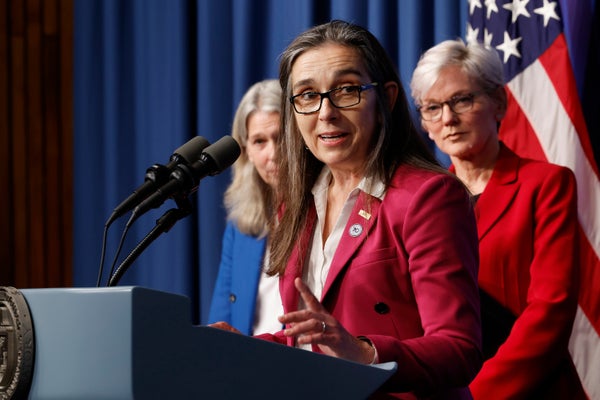
Kim Budil is an American physicist. She has been director of Lawrence Livermore National Laboratory since 2021 and is the first woman to hold the role. Her research focuses on high-power laser science, fusion research and national security programs within the U.S. national laboratory system.
[This interview was edited for length and clarity.]
How would you describe the current state of American science?
If you're enjoying this article, consider supporting our award-winning journalism by subscribing. By purchasing a subscription you are helping to ensure the future of impactful stories about the discoveries and ideas shaping our world today.
I would describe the current state of American science as changing fast but certainly strong. The U.S. has a very rich and robust scientific ecosystem, with a fantastic academic sector, incredible industrial research and national labs trying to bridge between those two communities, but an increasingly competitive environment internationally. And so, as that spins up..., we need to shift into a new gear.
What needs to change in American science?
One is the pace we operate at—in an environment that changes much faster than what we’re used to and from a position where we’re no longer an uncontested leader in every domain where we choose to participate. That’s been changing over the past couple of decades, but it’s really changing in meaningful ways now.
I think the second thing we have to get used to is a very different balance of capabilities across that ecosystem. So, just as an example, the emergence of large language models from these big artificial intelligence companies—that’s really different, right? We don't usually see these powerful technologies emerging outside the government-funded sphere. So how do we work with that community, not as providers but as peers? How do we engage in a way that ensures you always get the public benefit of these very powerful technologies, you understand the risks, and you can manage those, and you get the full benefit of the potential upside in a rapidly changing environment? Maybe we can’t wait for a new AI rules-and-regulations order to emerge. We have to build this ecosystem.
What gives you optimism right now?
I think, for me, the incredible opportunity that we have in front of us with new technologies and an incredible community of people who are learning to use these new technologies in new ways.
For us, we work in fundamental discovery science, but we also do a lot of applied research. The convergence of these new AI models with large-scale computing with new types of experimental capabilities and new types of manufacturing technologies means we’re changing the way we think about technology. New things are possible. I think that it’s a superexciting time to be a researcher.
What's your best advice for an early-career scientist?
I think the most important thing is to be curious, to be interested, to be open, and to know that the path you set out on today will almost certainly look different five years from now, 10 years from now and 20 years from now. That’s the beauty of being a scientist, that you get to change and grow and learn and evolve as the science changes.
How has your field changed in the past few years?
I started out, years ago, in what’s now called high-energy-density science, so using big laser systems to study the most extreme states of matter in the universe. When I started doing that work, the states we could achieve, the capabilities we had in hand, the types of laser systems that we were using—today they would be considered peashooters. It’s like going from analog to digital.
I’ve seen us create lasers and experimental capabilities that so far outstrip where we started that people show me data today, and I think, “If you hadn’t shown me those data, I would have believed it wasn’t possible to get them.” And we’ve generated a cadre of scientists who now move seamlessly between experimental science and computational work and theory in a way that used to be more stovepiped, I would say. So I feel like the whole discipline has really grown up, and we’re just starting to reach our stride.
If you enjoyed this article, I’d like to ask for your support. Scientific American has served as an advocate for science and industry for 180 years, and right now may be the most critical moment in that two-century history.
I’ve been a Scientific American subscriber since I was 12 years old, and it helped shape the way I look at the world. SciAm always educates and delights me, and inspires a sense of awe for our vast, beautiful universe. I hope it does that for you, too.
If you subscribe to Scientific American, you help ensure that our coverage is centered on meaningful research and discovery; that we have the resources to report on the decisions that threaten labs across the U.S.; and that we support both budding and working scientists at a time when the value of science itself too often goes unrecognized.
In return, you get essential news, captivating podcasts, brilliant infographics, can't-miss newsletters, must-watch videos, challenging games, and the science world's best writing and reporting. You can even gift someone a subscription.
There has never been a more important time for us to stand up and show why science matters. I hope you’ll support us in that mission.
此内容由惯性聚合(RSS阅读器)自动聚合整理,仅供阅读参考。 原文来自 — 版权归原作者所有。