

惯性聚合 高效追踪和阅读你感兴趣的博客、新闻、科技资讯
阅读原文 在惯性聚合中打开

推荐订阅源

WordPress大学
WordPress大学
O
OpenAI News
钛媒体:引领未来商业与生活新知
钛媒体:引领未来商业与生活新知
博客园 - 三生石上(FineUI控件)
Webroot Blog
Webroot Blog
GbyAI
GbyAI
S
SegmentFault 最新的问题
Cyberwarzone
Cyberwarzone
Exploit-DB.com RSS Feed
J
Java Code Geeks
Google DeepMind News
cs.CV updates on arXiv.org
博客园 - 【当耐特】
S
Secure Thoughts
酷 壳 – CoolShell
酷 壳 – CoolShell
AWS News Blog
AWS News Blog
Engineering at Meta
Engineering at Meta
S
Security Affairs
H
Help Net Security
Microsoft Security Blog
D
DataBreaches.Net
云风的 BLOG
云风的 BLOG
Hugging Face - Blog
Hugging Face - Blog
Google DeepMind News
Spread Privacy
Spread Privacy
T
Threatpost
Forbes - Security
Forbes - Security
C
Cisco Blogs
Scott Helme
Scott Helme
Attack and Defense Labs
Simon Willison's Weblog
腾讯CDC
The Last Watchdog
The Last Watchdog
Cloudbric
Cloudbric
Last Week in AI
Last Week in AI
Recorded Future
Recorded Future
小众软件
小众软件
V
Vulnerabilities – Threatpost
美团技术团队
人人都是产品经理
人人都是产品经理
有赞技术团队
有赞技术团队
Apple Machine Learning Research
Hacker News - Newest:
Hacker News - Newest: "LLM"
I
Intezer
月光博客
月光博客
C
Cyber Attacks, Cyber Crime and Cyber Security
博客园 - 司徒正美
C
Cybersecurity and Infrastructure Security Agency CISA
Martin Fowler
Martin Fowler
博客园 - 聂微东

Scientific American

Former deputy surgeon general Erica Schwartz nominated as new CDC chief NASA Artemis II astronauts say thank you to the world Congress grills RFK, Jr., about vaccines and cuts to health budget How the Grand Canyon formed is a surprisingly messy story. Here's the latest clue How far from humanity were the astronauts of Artemis II? The answer will surprise you Effect of antiamyloid Alzheimer’s drugs ‘absent or trivial,’ Cochrane review finds The Trump administration is looking to experts to weigh in on peptides When a naked mole rat queen dies, that usually means war—but not for this colony NASA needs nuclear power for its moon base. Here’s the White House plan to get it Why do older people have fewer seasonal allergies? 250-million-year-old fossil proves mammal ancestors laid eggs A face-swapping illusion can unlock childhood memories 30 years of Pokémon—how the Japanese franchise mirrors real-world science Sperm whales may make their own vowel sounds, similar to human language Colombia will euthanize Pablo Escobar’s invasive ‘cocaine hippos’ NASA’s Artemis III will pit SpaceX against Blue Origin The East Coast could see blazing hot temperatures this week. Here’s why Scientists just discovered 5.6 million bees under a New York State cemetery The real science of Pokémon How chemists engineer the signature smells of luxury perfumes How two mathematicians solved a cryptography mystery The engineering marvels hidden inside six-figure watches Expensive versus affordable binoculars—what’s the difference? How physicists found a new type of magnet hiding in plain sight A hot pair of supplements, creatine and methylene blue dye, may not work together Unlikely paths to discovery The baffling ecological disaster that's killing America’s freshwater mussels Poem: ‘How I Became a Spitfire Pilot during My Cataract Operation’ DARPA built an AI to fact-check enemy weapons claims Mathematicians created an ‘impossible’ shape that shouldn’t exist How cosmic rays are helping mining companies find critical minerals underground New evidence links heart disease to inflammation—and drugs can stop it An asteroid extinguished all the dinosaurs except for birds. Here’s why Math Puzzle: A disassembly job May 2026: Science History from 50, 100 and 150 Years Ago Readers respond to the January 2026 issue How to build a space hotel The humble ham sandwich inspired a math theorem for sharing food fairly Imperiled ‘cloud jaguar’ spotted in Honduran mountains for the first time in a decade Person functionally cured of HIV after bone marrow transplant from sibling Dream Chaser space plane faces uncertain future in NASA’s push for the moon Bizarre ‘compleximers’ break the rules of both glass and plastic This method to reverse cellular aging is about to be tested in humans The Artemis II mission worked—but should we really keep returning to the moon? How DNA forensics is transforming studies of ancient manuscripts Beetle larvae mimic flower scents to attract bee hosts See NASA’s Artemis II mission around the moon in 12 stunning photos New study shows how the brain weighs evidence to make decisions What NASA’s Artemis II tells us about the ‘overview effect,’ moon joy and awe New metal with triple copper’s heat conduction challenges fundamental physics NASA’s Artemis II reveals why humans still love the moon NASA’s Artemis II moon mission splashes down The Expanse authors James S. A. Corey explore alien war in new book The Faith of Beasts New particle mass measurement deepens quantum mystery NASA’s Artemis II crew returns today—here’s what to know ahead of splashdown Why bombing Iran’s nuclear power plant could cause an environmental disaster Mysterious heart neurons maintain blood pressure to prevent fainting NASA’s Dragonfly mission will send a nuclear-powered flying drone to Titan This sci‑fi twist on Moby-Dick will blow your mind Medieval aurora poetry provided clues to historic solar storms White House budget puts 54 NASA science missions on the chopping block NASA’s Artemis II moon mission is on track for Friday splashdown Timeline of the Artemis II moon mission’s return to Earth Why can’t humans regenerate limbs? New research offers a clue How the wildlife trade boosts the chance of a disease jumping from animals to humans Two hundred chimpanzees are embroiled in a ‘civil war’ NASA’s Artemis II moon mission preps for its last full day in space How China could still win the new moon race Lyme disease is spreading, but a new vaccine could curb infections No, Shroud of Turin DNA analysis doesn't show relic's origins, experts say What’s the deal with the Artemis II music? The crew finally gave us some answers The world’s deepest sensors will detect earthquakes around the world from far below Antarctica Why Artemis II’s reentry may be the moon mission’s greatest challenge yet NASA’s Artemis II moon mission is focusing on its return to Earth What is the quantum ‘Ghost Murmur’ purportedly used in Iran? Scientists question CIA’s claim of long-range heartbeat detection How well GLP-1 weight loss drugs work may depend on your genetics NASA’s Artemis moon missions are a game changer for astronomy Tracking Artemis II—after its historic lunar flyby, NASA’s moon mission heads home NASA’s Artemis program has sparked a race to land U.S. rovers on the moon Do people see robots as having race? New studies clash as humanoids enter the real world Health experts warn of rising measles cases in undervaccinated communities In a first, Artemis II moon mission astronauts make ‘ship to ship’ call to ISS The mathematically correct way to slice a pizza See NASA’s Artemis II mission’s first incredible photos of the moon, Earth and a total solar eclipse In an echo of Apollo 8, NASA’s Artemis II astronauts witness stunning ‘Earthrise’ and ‘Earthset’ NASA’s Artemis II astronauts celebrate epic lunar flyby with stunning new images NASA’s Artemis era may finally solve three major moon mysteries NASA’s Artemis II ‘free return’ trajectory lets gravity do the driving Trump speaks with NASA's Artemis II astronauts after historic moon flyby NASA’s Artemis II crew experience total solar eclipse from space NASA’s Artemis II moon mission reaches greatest distance from Earth NASA’s Artemis II astronauts break Apollo’s distance record Watch live—NASA’s Artemis II’s moon flyby is underway Bypass the Strait of Hormuz with nuclear explosives? The U.S. studied that option in the 1960s NASA’s Artemis II mission is about to pass behind the moon NASA’s Artemis II, endangered species and oil, low western U.S. snowpack Where is Artemis II? NASA astronauts near the moon for first time in more than 50 years NASA’s Artemis II laser communications system is beaming 4K video from the moon NASA’s Artemis II moon mission is gearing up for its lunar flyby What will NASA’s Artemis II astronauts see on the moon?
‘Golden rule’ in abstract art just discovered by mathematicians
2026-05-15 · via Scientific American

Mathematicians have calculated a “golden rule” for abstract art that famous artists tend to follow when they compose their works. Artificial intelligence, the team found, does not follow such implicit rules about shape placement, possibly explaining why computer-generated art doesn’t usually evoke awe from viewers.

Scientists and philosophers have long tried to decipher why art moves people: Are there underlying features shared among masterpieces? Do painters unconsciously use similar shapes, contours or compositions to elicit an emotional response? Many of the ways researchers have tried to categorize shapes or complexity in paintings are “arbitrary,” however, says Jacek Rogala, a neuroscientist at the University of Warsaw and co-senior author of the new study.

Rogala, co-senior author Shabnam Kadir, a mathematician at the University of Hertfordshire in England, and their colleagues looked to persistent homology, which is part of topology, a mathematical field that studies shapes as they deform and stretch. In this case, the team analyzed the contours of color in the works of Polish artist Lidia Kot. Then the researchers compared how people responded to Kot’s art and similar AI-generated art both in an art gallery and a lab.


On supporting science journalism

If you're enjoying this article, consider supporting our award-winning journalism by subscribing. By purchasing a subscription you are helping to ensure the future of impactful stories about the discoveries and ideas shaping our world today.


The team found that viewers were drawn to certain mathematical features of abstract art and that artists created paintings with a remarkably consistent visual balance, whether they were conscious of it or not. At the same time, context matters: the way people responded to human versus AI art depended on whether they saw it on a computer screen, in the lab or in an art gallery.

First, let’s consider the math. Turning a painting into a set of data is no easy feat. Persistent homology accomplishes this by coding each layer of color to a shape. Imagine a painting of a Holstein cow: If you take everything away but the black pixels, you’ll get a few splotches of cow spots, each a unique shape. Now mark down the features of those shapes. Then add in your next-lightest color, dark gray. Your cow is now composed of some spots and a few shadows. Mark that down, too. Keep going, adding lighter and lighter shades, until your whole painting is a white cow with dark spots again.

What you’ve just built is a dataset of all the contours in the painting, or all the ways the artist positioned color in different shapes on the canvas. If you could toggle through the layers, it would morph from spots to cow and back again. And at every stage, you’ve got a snapshot of the features of these shapes, a chunk of data researchers call a “barcode.” (While an untrained human might come up with a barcode that read something like, “Um, squiggly?” mathematicians use more sophisticated numerical descriptors.)

“It is a way to talk more formally about art but without removing the soul of it,” says Barbara Guinti, a mathematician at the University at Albany, State University of New York, who was not involved in the new study.

You can do a lot of things with these barcodes. Vanessa Robins, a mathematician at the Australian National University, who wasn’t involved in the research but was one of the original developers of the method, said she and her colleagues have been using persistent homology to analyze the branching patterns in people’s lungs to see if these shapes influence survival in certain lung diseases. In Rogala and Kadir’s study, the team took the data and first decided to figure out if there were features that defined how shapes were framed in abstract art and, if so, whether they carried over from painter to painter.

“What is abstract art?” Kadir says. “Is it a bunch of nonsense that my child could create?”
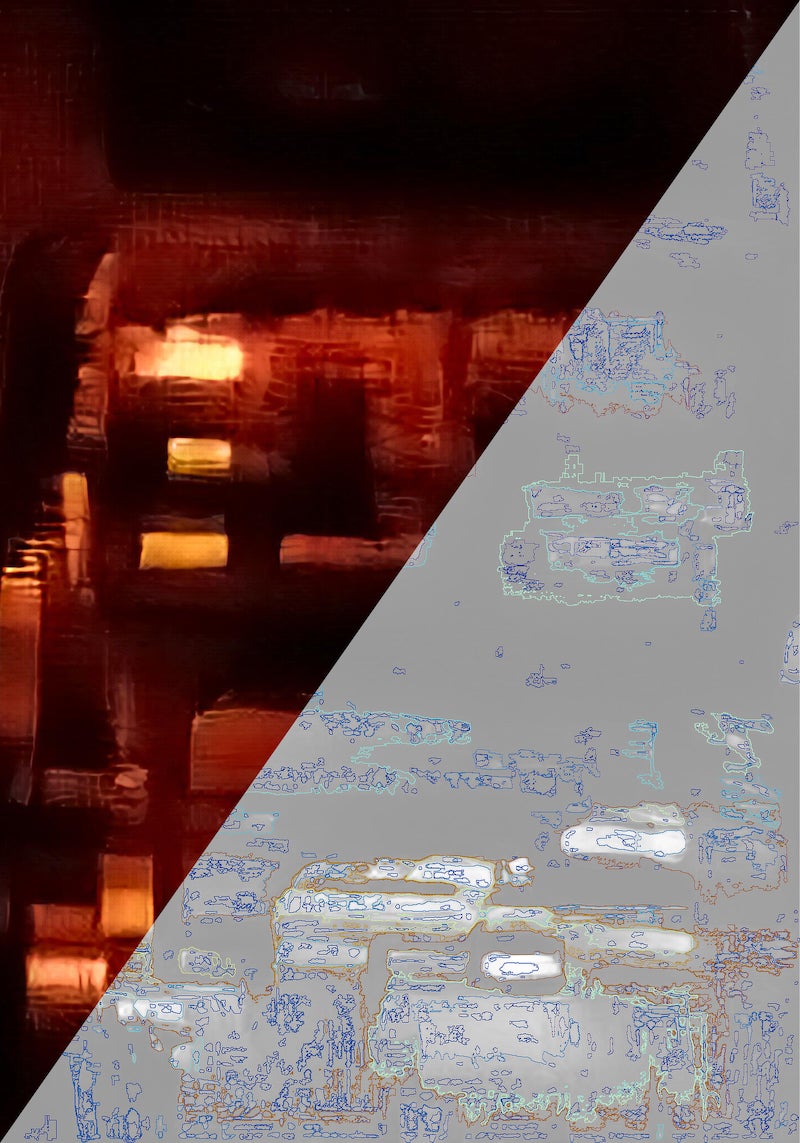
An ambiguous abstract painting with an overlay on the left side showing little shapes mapped out.

A map of shapes (right) within a complete painting (left), showing how images are made up of layers of complex shapes that can be picked out and analyzed.

Mathematically speaking, the answer is no. It turns out that Kot and famous abstract artists Mark Rothko, Wassily Kandinsky, Kazimir Malevich, Jackson Pollock and Maria Jarema all shared something in common. Do you remember our cow? If we toggle from black to white, we should get the mirror image of the bovine that we’d see if we toggled from white to black: spots to cow for the former and cow to spots for the latter. This symmetry, called Alexander duality, breaks down when shapes cross the boundaries of a painting. (Remember that our shapes get really weird in that middle bit of transitioning from spots to cow.) Bits and pieces sprawling off the edge of a canvas lead to a mathematical asymmetry. As it turned out, human abstract artists all violated this symmetry by a similar ratio (0.4, for the record, though there will not be a quiz). This discovery indicates that they had been following a certain pattern when they arranged shapes in relation with edges, Rogala says.

“It reminds us of other famous ratios in art, like the golden ratio,” Kadir says. That ratio, which works out to 1.618 to 1, tends to make objects like seashells or sunflowers look visually pleasing.

The researchers also mocked up AI “art” that matched the color intensity of Kot’s work but did so without any artistic intention. This AI art, the researchers found, did not follow the ratio for shape placement they had observed in works by human artists.

To further understand how people perceive shape features in human-made versus AI art, Kadir and her colleagues also recruited 58 participants, either college-age art students or people of similar age and socioeconomic status. Half viewed Kot’s art in the gallery and then in the lab. The other group viewed AI art, without knowing it was AI-made, in the gallery and then in a lab.

In the lab, the human art got higher ratings than the AI imagery, and people gazed at the human art for longer. In the gallery, both types of imagery got similar ratings, and people fixed their gaze at the AI imagery twice as long, the researchers reported in the journal PLOS Computational Biology. This may also be a result of topology, Rogala says. Under gallery lighting, the shapes made by color gradients may pop as people move around the art, a very different experience than viewing a static illuminated image on a screen, he adds. In other words, the fairly flat-looking AI creations may have gotten a boost from the generous lighting of a real art gallery. These findings leave a lot more to explore, Rogala says, including whether non-Western art follows these same hidden patterns of shape and form.