


By
Aliza Chasan
Digital Content Producer
Aliza Chasan is a Digital Content Producer for "60 Minutes" and CBSNews.com. She has previously written for outlets including PIX11 News, The New York Daily News, Inside Edition and DNAinfo. Aliza covers trending news, often focusing on crime and politics.
Nichole Marks is a producer at 60 Minutes, where she's covered a wide range of topics, including science, technology, the arts, breaking news and investigations for the last 16 years. Previously, she worked at the CBS Evening News and CBS Weekend News.
Emily Cameron
/ CBS News
Big Chief Demond Melancon is so devoted to making the elaborate, beaded suits he wears on Mardi Gras day that once it lost him his home.
Melancon participates in New Orleans' Black Masking tradition, better known as the Mardi Gras Indians. Broken up into groups, what they call tribes, Melancon and other members of the community roam some of the city's historically Black neighborhoods each year on Mardi Gras day, chanting and squaring off in mock battles, in competition to show whose suit is, in their words, the prettiest.
It's a culture that has been passed down for generations, and tribe members spend countless hours and thousands of dollars sewing and adorning their suits with tiny beads, plumes and rhinestones over the course of a year, all with the goal of preserving a tradition that historians say dates back to the 1800s. This year, Melancon wore a 10-foot-tall suit that weighed 120 pounds; he needed a U-Haul to move from place to place.
Putting on the suit is transformative. Melancon becomes "somebody that's ready to honor everything that I was taught by my elders," he said. "And I'm ready to kill you dead with a needle and thread."
The battles between tribes are a competition of artistry and talent, but are rooted in something much deeper.
Where did the Mardi Gras Indians tradition come from?
Despite the name, Mardi Gras Indians are not Native American tribes. Although, many members of the community told 60 Minutes they have Indigenous heritage.
There's no single definitive origin story for the Mardi Gras Indians, but historians have found references to the tradition dating back to the mid-1800s. According to stories passed down through the tribes for generations, when enslaved people in New Orleans escaped, Native Americans in the bayous gave them refuge. Some believe that the Mardi Gras Indian tradition started as a way to honor those Indigenous tribes while also expressing their African roots.
Howard Miller is the president of the Mardi Gras Indian Council, a governing body for the tribes, and big chief of the Creole Wild West. He said the culture of Mardi Gras Indians was shaped by resistance to oppression.
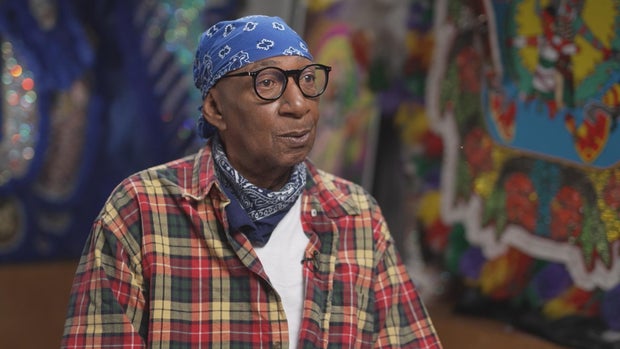
"Here in America, especially here in the South, everything about Africa was forbidden. So we went behind our masks as Indians to practice our culture," he said. Until the 1990s, many of New Orleans' famed Mardi Gras krewes were segregated. Today, the tribes continue to march through their neighborhoods rather than on the city's parade routes. The Mardi Gras Indian tradition, Miller said, is grounded in community and "about uplifting our people in a proudly manner."
Though the display on Mardi Gras is hard to miss, much of the culture takes place behind closed doors – only tribe members are let in on the making of a Mardi Gras Indian suit. In 1969, a then 12-year-old Miller desperately wanted to join a tribe. It took him six weeks of waiting outside a big chief's home – first outside the gate, then the yard — before eventually working his way onto the front porch. He'd peek through the windows as the big chief worked on his suit. One day, a thunderstorm started as he watched.
"And the chief said, 'That boy still on the porch?' And somebody said, 'Yup.' 'Tell that boy to come on in here.' That's how I got in the house," Miller said.
Miller is now a big chief. There's a hierarchy of positions in each tribe: the big chief leads, a spy boy is the eyes and ears of the tribe, the flag boy acts as the flag bearer, the wild man works to make space and the big queen holds the tribe together.
The masks — and the suits that go with them
The extravagant suits worn by Mardi Gras Indians are plumed, bejeweled, beaded and sequined. They're handcrafted in secret over an entire year to be unveiled on Mardi Gras day and only worn a handful of times.
Melancon and his wife, Alicia Winding, sewed beads the size of chia seeds onto canvas to craft the art for Melancon's suit. They stitched rhinestones into place using dental floss. Melancon's fingers were swollen from puncture wounds.
"I sew from 6 in the morning to 12 at night," Melancon said.
He works on it every day.
"Without these beads, I couldn't breathe," he said.
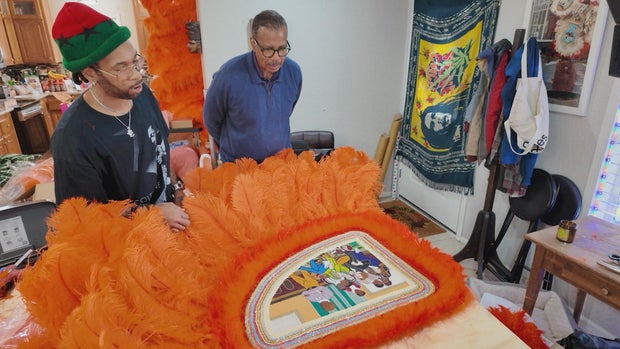
Melancon said he's motivated by the community.
"It fuels the fire because you're doing it for them. Like, you do this for your community and your people," he said.
The beaded panels on this year's suit, which he says cost $25,000 to make, told the story of the Amistad, a slave ship seized by captive Africans in 1839. One panel depicted when the Africans won their freedom in a case that went to the U.S. Supreme Court.
Melancon said that when he dons his suit, the spirits of his ancestors come down.
"They come in through me to walk in their shoes on the streets of New Orleans like they taught us," Melancon said. "So what we [are] doing is we're preserving it for that next generation to be able to walk like I walked."
Preservation comes at a heavy personal price. For years, Melancon used to work laying concrete and cooking lobsters. He'd pour his spare time and money into his creations. He even lost a home after putting everything he had into a suit.
Melancon now makes a living as an artist. His suits and beaded portraits have been displayed in museums and galleries around the world. His work will be featured at next month's Venice Biennale in Italy; it's the world's most prestigious recurring art exhibition.
Inspiring the next generation of Mardi Gras Indians
Melancon said he hopes his success in the art world will inspire a younger generation to carry on the culture.
"I pray it does. And I pray one of them picks up a needle and wants to do what I do," he said.
Time and money aren't the only obstacle. The working-class neighborhoods that sustain the tribes have been thinned and scattered by Hurricane Katrina and gentrification. But Joseph Pierre Boudreaux, better known as Big Chief Monk of the Golden Eagles Tribe, is determined to hold onto the community and legacy.
"We're going to do it. We're going to do it, let the world know that we're here and we've been here," Boudreaux said. "We ain't just got here. We've been here."
He committed the sounds of the Mardi Gras Indians to vinyl in the 1970s as one of the first musicians to marry the tribes' chants to New Orleans funk music. His albums have earned two Grammy nominations. Boudreaux's son described his impact on the culture as being like the impact "Michael Jordan had on basketball."
"You know, my father, he took something that was made for the culture in the streets, and he was one of the pioneers that took it global," Joseph Boudreaux Jr. said. "There's not a person in the city of New Orleans that sews an Indian suit and they don't put on his music."
For decades, Boudreaux sewed and beaded suits for his children and grandchildren. This year, his family helped the now 84-year-old big chief sew his.
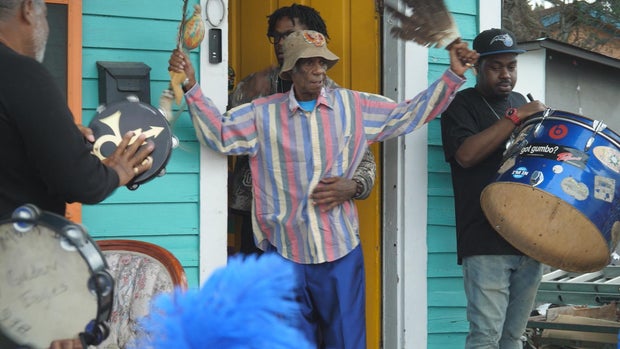
Big chiefs aren't just heads of their tribes; they're mentors and community leaders. Boudreaux is one of the most respected. Just before Mardi Gras, he was diagnosed with cancer. He was too weak to march this year, but the crowds gathered outside his home on Mardi Gras morning as he sent the tribe off with a song. The big chief also had a message to share.
"If you don't keep it going, if you lose it, it's gone forever, it's finished," he said. "And that thing just disappear? Not here in New Orleans."
In: