


Opinion The tech hardware industry may be facing something of an existential crisis if one veteran analyst is correct – the days of shifting boxes are going to be limited to mere replacement cycles.
This was the message delivered by Steve Brazier, formerly CEO at Canalys until it was bought by Informa, where he is now a Fellow.
"I come on stage with a smile, but you may not be smiling by the end of this presentation," he told an audience of resellers and distributors at the Canalys Channels Forum in Berlin last October.
"For 30 years or more, the channel has actually been easy to run. You thought you were all business leaders and geniuses for the success you had. But if we boil it down, you sat there, you waited for new hardware products to launch in all sorts of different categories, and you followed that growth as those different categories grew year after year after year.
"Unfortunately, we're calling a turning point today in that 30 years, which is essentially across the board the hardware industry is no longer growing, whether that's printers or PCs or servers or storage or Wi-Fi or routing or all our major categories."
Most of the major hardware vendors sell via third-party suppliers that then take their PCs, servers, and other tech kit to customers, provide installation, integration, and other services.
The travails of the channel are reflected by the traditional big brands whose legacy operations faltered. Cisco, for example, has struggled to lift its switching and router business out of the doldrums, reporting declines of 15 percent in its FY 2024.
HPE – which used to transact around 80 percent of its global revenue via distributors and resellers – only grew in its fiscal 2024 due to AI server sales in its Compute division. These sales weren't very profitable, despite taking place outside of the channel, so no middlemen were involved to take a cut.
The channel used to account for $4 in every $5 that HPE generated in sales, but that figure has fallen to 65 percent over the years, due to direct selling of HPC kit in addition to AI servers and more.
Brazier said emerging technologies including the metaverse, 3D printing, and IoT have failed to become "material businesses," telling the 1,000-strong tech exec audience, "don't get too depressed" as the traditional growth drivers are "not declining" but they aren't growing either.
"Running flat business is OK, but they're all essentially flat, a replacement business. The outlier is cybersecurity," he said, which remains a double-digit growth market as the cyber baddies are relentlessly still causing harm.
The picture is "more bleak" in Europe as "economies are developing more slowly," unlike the US. Why?
"Actually, one of the biggest differences between the US economy and the European economy is the US has more immigration. But politically, it's so hard for politicians to stand up and say, 'If you want more growth, we need more immigration'."
Companies headquartered on Europe's side of the pond, including Computacenter, that have also established operations in the US were able to offset slowing trade in the UK last year.
Others are building ever bigger cloud services businesses: Insight purchased SADA, which has Google Cloud skills; CDW bought AWS partner Mission Cloud; and WWT bought cloud migration specialist Softchoice.
So is the Canalys founder correct?
Simon Ewington, HPE worldwide channel and partner ecosystem leader, told The Register that Brazier is "always" provocative, a point echoed by Steinar Sønsteby, CEO of Atea – one of Europe's largest services-based resellers.
"As a long-time friend of Steve, I can truly recognize his provocative style," Sønsteby told us.
Data collected by Canalys does back up Brazier's points, so his speech wasn't baseless by any means. The bigger resellers and distributors are getting bigger but via acquisition.
Sønsteby continued: "I feel comfortable that the IT industry will keep on growing as digitalization has never been more critical. The channel in Europe will consolidate to fewer and bigger players as the OEMs downsize and need the channel more than ever – but need players that can add value for the OEM and the customers."
Added value is in the eye of the beholder.
James Rigby, CEO at SCC, told us he attended the event – as did The Reg – saying: "I think the general feeling was that he [Brazier] was being overly pessimistic. And to be honest, I think the discourse is probably 12 months too late."
Rigby describes the past 12 months as "hard yards for everybody" and tough in terms of "cost pressures" and sliding "demand." He points toward the Windows 11 refresh and AI as beacons of hope and cause for "optimism about demand going forward." Some of our readers may disagree.
Canalys reckons that tech buyers are nervous about uncertain geopolitics, which are constraining budgets. Customers are extending sales cycles, making it harder for the channel to find growth. And following a sustained refresh cycle, fueled by the pandemic, there is a saturation in terms of computers, networking kit, and other areas.
Brazier told The Register today that the challenges faced by the channel are reflected in the market capitalizations of the biggest players (as demonstrated by the graph below).
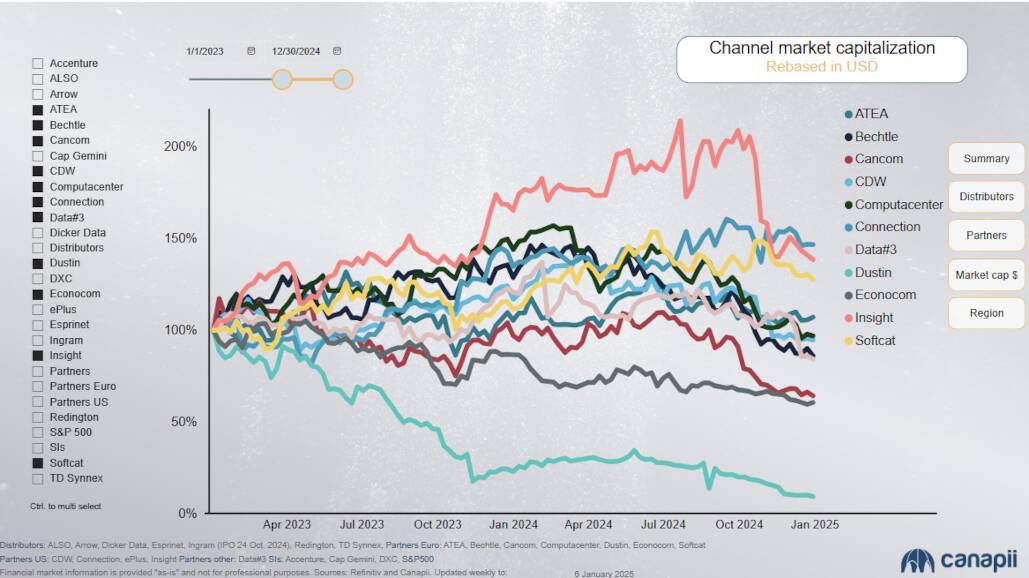
"To put this into words, had you invested $100 in the S&P500 on Jan 1 2024 you would have had $126 as of Jan 6. Had you invested $100 in the publicly quoted channel partners over the same period you would have had $82. So, I know the partner CEOs try to sound positive but can you imagine the conversations in their boardrooms this year?"
Brazier's last point at the Channel Forum in Berlin was about the wider tech industry on this side of the pond, and it's perhaps a prescient one. He reckons the industry in Europe has missed the tech boat and every office worker in the region is paying a €100-a-month "tax" to American companies for a right to work.
"And with the arrival of AI, that €100 a month is simply going to go further up."
At this stage in the evolution of GenAI, "virtually nothing of it benefits the channel. The channel has been excluded," he said. And he is entirely correct.
The AI industry is dominated by hyperscalers investing in AI infrastructure, and AI startups which then use their expanding datacenters and so on to run their services. Tech is eating itself. Customer spending on AI is currently a fraction of the amount big tech is lavishing on big bets that the technology will take off.
So if the AI bubble bursts, will the channel care? The knock-on effects will be felt far and wide, just as happened in the dotcom bust. ®
此内容由惯性聚合(RSS阅读器)自动聚合整理,仅供阅读参考。 原文来自 — 版权归原作者所有。