


AI is already turning against you. We can fix it.
AI is about to take over the world, according to Google and Oxford researchers. I was amused to see a Vice article (Sept 13, 2022) summarizing the findings:
A longstanding question in the field is whether a superintelligent AI could break bad and take out humanity, and researchers from the University of Oxford and affiliated with Google DeepMind have now concluded that it’s “likely” in new research.
. . . The paper envisions life on Earth turning into a zero-sum game between humanity, with its needs to grow food and keep the lights on, and the super-advanced machine, which would try and harness all available resources to secure its reward and protect against our escalating attempts to stop it. “Losing this game would be fatal,” the paper says.
I’ve been hearing this sort of thing for years. When I spoke with Oxford’s Toby Ord on the April 20, 2020 Techtonic, I voiced my skepticism about AI-takes-over-world scenarios, while Ord gave it odds of 1 in 10 (!). I just think that there are plenty of present risks – gaping inequality, climate change, predatory monopolies – that are worth addressing first.
On the other hand, one could argue that AI is already taking over the world, just not in the form of “2001” HAL-style omniscient robots. Instead – as writers like Charlie Stross have pointed out for years – unethical corporate behemoths in Silicon Valley and elsewhere are the very embodiment of our AI fears. Their “growth at any cost” mission is squashing industry after industry, and it’s all dependent on their use of AI.
But that’s not what Google and Oxford are warning us against. Of course, their report on the risks of metastasizing AI can’t state the truth of the matter, which is that Google itself, and other Big Tech companies, are the very monsters we need to defeat before it’s too late. Instead, Google presents the problem as a high-tech sci-fi quandary – the robots take over the food supply! – which leaves only one company that can come to our aid. It’s a neat trick, presenting a toxic sludge company as the only possible hero who can fight the Sludge Monster.
The reality is very different. I’ll state it as clearly as I can: predatory Big Tech monopolies, using intrusive surveillance and AI, are a growing danger. And they’re coming for you.
Reason #365 to dump Microsoft
As I covered on my Labor Day Techtonic episode on workplace surveillance (Sept 5, 2022), Microsoft is advancing in its ability to spy on you, your employer, and entire industries. The current version of Microsoft 365 – the package including Word and Excel – is larded down with spyware, with tracking turned on by default.
Researcher Wolfie Christl posted a thread (Nov 24, 2020) describing the problem:
A new feature to calculate ’productivity scores’ turns Microsoft 365 into an full-fledged workplace surveillance tool . . . Showing data on individuals can be turned off, but it’s activated by default. This normalizes extensive workplace surveillance in a way not seen before. . . .
In addition, Microsoft lures companies into sharing employee data with Microsoft in order to show them how their numbers compare to the numbers of other organizations.
As a result, Microsoft gets access to a massive stack of employee data across many organizations.
As Cory Doctorow explained in an Aug 21 post, Microsoft is not merely interested in tracking worker productivity. Instead, Microsoft is positioned to extract operational data from other companies for its own gain. Doctorow writes:
Microsoft will spy on your competitors and sell you access to their metrics. It’s wild, but purchasing managers who hear this pitch seem completely oblivious to the implication of this: that Microsoft will also spy on you and deliver your metrics to your competitors.
Even wilder is the further implication: that Microsoft might use the data its product gathers on your business – every keystroke made by every worker in the entire company! – to compete with you.
Conclusion: Anyone selling your company a surveillance system has the ability to surveil you – whether you’re a new hire, a middle manager, or the CEO itself. Your data goes into their AI system and eventually comes back, weaponized, against you.
Another conclusion: The old phrase “I have nothing to hide” is dangerously out-of-date. These days it equates to, “I have nothing that I’d like to protect from exploitation by the world’s most powerful companies.” Who today would say such a thing?
Amazon does it, too
Microsoft isn’t the only company doing this. Amazon has been under investigation for years, due to its illegal use of third-party seller data. With its full access to all operational and sales data on its platform, and a lack of any meaningful regulation (or, for that matter, ethics) to hold it back, Amazon has used sellers’ data to create products that compete with those same sellers.
The Wall Street Journal covered this as far back as April 2020. From Amazon Scooped Up Data From Its Own Sellers to Launch Competing Products: “Contrary to assertions to Congress, employees often consulted sales information on third-party vendors when developing private-label merchandise.” Amazon employees themselves corroborated the complaints of small-business owners on the platform.
A perfect example comes from Peak Design, a small business whose camera bag was copied by Amazon for its cheapo Basics brand. Peak Video created a video using humor to shame Amazon, showing the two bags side by side. I searched Amazon today for the copycat bag and couldn’t find it, which suggests – as often happens – that only bad PR can force a Big Tech company to make a change, while still not addressing the root problem.
The most recent revelation is that Amazon bullies third-party sellers into keeping prices high for consumers. From the Wall Street Journal: California Sues Amazon, Alleging Antitrust Violations Inflated Prices and Stifled Competition (September 14, 2022):
Third-party merchants that offer their products on Amazon’s marketplace make up the majority of the company’s product sales, according to the complaint. California alleges that Amazon requires them to sign agreements that penalize them for offering their products at cheaper prices on competing sites such as Walmart or Target. Those who don’t comply may get pushed lower in Amazon’s search results or be disqualified from being featured in the site’s “buy box,” the suit alleges, and may even be suspended or removed.
A better way
The trajectory we’re on is not sustainable. The world’s most powerful companies are gaining access to everyone’s private information – both of individual citizens and of all the companies using their platforms. Google, Amazon, and Microsoft have already shown their interest in using this data for their own private gain. They’re not slowing down.
A better way exists, and that’s to switch our tech usage over to companies, nonprofits, and decentralized networks that actually treat users – both individual and corporate – with respect. I’ve listed dozens of options at Good Reports, and more are surely on the way, as independent teams begin to embrace a new ethic of building trustworthy software that doesn’t trick or exploit people.
But there’s more to do. Users need help choosing better technology, installing and configuring that tech, and learning to use it over the long run. And creators – those designing and developing software – need to embrace this new ethic and these new tools, in order to counteract the growing influence of the toxic giants.
I’m looking forward to pitching in, advising teams on how to use better tech – whether that means switching to better platforms, or helping them in what they’re creating. (Drop me an email if I can help your team.)
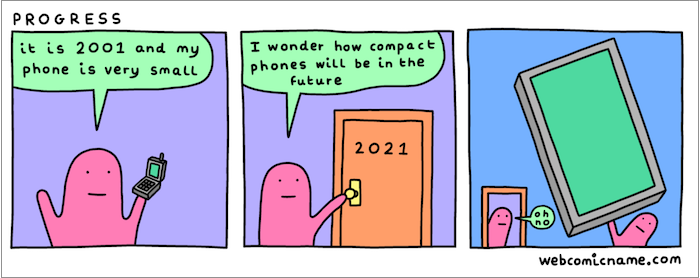
Speaking of progress in tech . . . (Source)
Until next time,
-mark
Mark Hurst, founder, Creative Good – see official announcement and join as a member
Email: mark@creativegood.com
Read my non-toxic tech reviews at Good Reports
Listen to my podcast/radio show: techtonic.fm
Subscribe to my email newsletter
Sign up for my to-do list with privacy built in, Good Todo
Twitter: @markhurst
- – -