
惯性聚合 高效追踪和阅读你感兴趣的博客、新闻、科技资讯
阅读原文 在惯性聚合中打开

推荐订阅源

V2EX - 技术
V2EX - 技术
Threat Intelligence Blog | Flashpoint
T
Threat Research - Cisco Blogs
T
The Exploit Database - CXSecurity.com
S
Schneier on Security
S
Securelist
P
Privacy & Cybersecurity Law Blog
Scott Helme
Scott Helme
T
Threatpost
C
Cybersecurity and Infrastructure Security Agency CISA
L
LINUX DO - 热门话题
Cyberwarzone
Cyberwarzone
Cisco Talos Blog
Cisco Talos Blog
量子位
博客园 - Franky
cs.CL updates on arXiv.org
Latest news
Latest news
T
Troy Hunt's Blog
N
News | PayPal Newsroom
Google Online Security Blog
Apple Machine Learning Research
N
Netflix TechBlog - Medium
小众软件
小众软件
P
Palo Alto Networks Blog
Spread Privacy
Spread Privacy
C
Cyber Attacks, Cyber Crime and Cyber Security
C
Check Point Blog
aimingoo的专栏
aimingoo的专栏
WordPress大学
WordPress大学
L
Lohrmann on Cybersecurity
L
LINUX DO - 最新话题
D
Darknet – Hacking Tools, Hacker News & Cyber Security
钛媒体:引领未来商业与生活新知
钛媒体:引领未来商业与生活新知
The Last Watchdog
The Last Watchdog
S
Security @ Cisco Blogs
P
Privacy International News Feed
Last Week in AI
Last Week in AI
Microsoft Security Blog
T
Tailwind CSS Blog
博客园_首页
云风的 BLOG
云风的 BLOG
V
Vulnerabilities – Threatpost
D
DataBreaches.Net
Recent Announcements
酷 壳 – CoolShell
酷 壳 – CoolShell
CTFtime.org: upcoming CTF events
罗磊的独立博客
Engineering at Meta
Engineering at Meta
Forbes - Security
Forbes - Security
T
Tenable Blog

Creative Good

Changing the address of this RSS feed Protecting elders and kids from predatory tech The garbage on our screens How it’s going in tech – without ethics AI isn’t meant for us Starlink bestows, or forces, the digital age on an Amazonian tribe Microsoft Recall should make you consider Linux Google goes bananums for AI Creative Good: Apple made a terrible mistake: it told the truth To resist the robots, get a typewriter Big Tech’s corruption was 25 years in the making Creative Good: China and TikTok Surviving the customer experience winter The gaping void in San Francisco, New York, and Cambridge Vision Pro, unscrambled, is “I Poison VR” Resisting Silicon Valley’s cult of “more” The airplane blowout came from our rotten Big Tech economy Creative Good: Instagram’s unmentionable problem Marc Andreessen is right – love doesn’t scale Facial recognition and the end of privacy – with Kashmir Hill The Luddites warned us about Google Celebrating 25 years of this newsletter – and an announcement Creative Good: Surveillance spreading Disaster alerts reveal a better way to design tech Don’t throw technology at it Creative Good: AI is spackle Hacks of the ultra-rich, as revealed by Bruce Schneier and Josh O'Kane Why car companies (still) ignore customers A walk around world raises questions about tech Three things you should listen to An addiction machine for our age Rejecting the Apple Vision Pro What you missed about Google and Amazon Why customers don’t want chat bots The giant brain suck of 2023 My 26-hour delay on Delta Air Lines Is AI a demon or what Creative Good: AI plus whatever ChatGPT’s dangers are starting to show Creative Good: A Simple Desultory Techtonic A picture of the future Sassy AIs are not the problem AI is creating the Play-Doh internet Who’s responsible for fixing tech? How Google profits from criminal activity ChatGPT’s drawbacks, and how to respond A new year to make tech better A few more inspiring people Why we can’t trust Apple Bonfire of the vanity project As cities embrace surveillance, we can resist A future for people doing good work A Halloween update on Big Tech Creative Good: Moralists, unite Creative Good: A song about surveillance AI is already turning against you. We can fix it. Waking up to the genetic surveillance state another reason to join Creative Good Creative Good: A “what now?” moment Creative Good: A most welcome decline An “internet for the people” or a plastic beach Our last chance in tech Jennifer Egan and a Forum update Creative Good: Citizenship and smartphones Celebrating one year of the Creative Good community Creative Good Forum Walking away from tech Where to go after Twitter An alternative to Amazon, and avoiding data brokers God, death, and tech with Sasha Stiles The web as monopolized surveillance space Human rights and digital spycraft Designing for deceit in Silicon Valley Bandcamp risks becoming an Epic failure The restart of history Why to resist Amazon by cancelling your Prime account Concentration of power is the problem We said ‘never again.’ Now look at Xinjiang Facebook patents and the comet in Don’t Look Up I founded Creative Good 25 years ago today – and learned a few things Are Facebook and Google criminal enterprises? My predictions for Apple’s smart glasses Creative Good Forum The banality of tech Big questions, answered by Big Tech Smiling in the metaverse Big Tech’s latest misbehavior calls for action Facebook’s laughable response to the whistleblower Get your community organization off of Facebook. Now. Voice surveillance must die The fall of Facebook Why we might transform computers into ‘tiles’ Explaining the last 20 years What to do when the storm arrives Public libraries are better than Google WeWork and waste How to prove vaccine status – with privacy We can’t trust tech, from A(pple) to Z(oom) On resisting emperors and their delusions Cameras and con games: Silicon Valley’s demented fun house
Where are the customers' chats?
2023-02-24 · via Creative Good

Where are the customers’ chats?

The 1940 book “Where Are the Customers’ Yachts?” by Fred Schwed, a classic work about investing, starts with an anecdote. A first-time visitor to Manhattan is being shown around Wall Street:

When the party arrived at the Battery, one of his guides indicated some handsome ships riding at anchor. He said, “Look, those are the bankers’ and brokers’ yachts.”

“Where are the customers’ yachts?” asked the naive visitor.

I’ve been thinking about that anecdote recently while observing the froth about ChatGPT and other AI generators. My two recent columns describe my reaction: that AI generators are turning the internet into glop (see AI is creating the Play-Doh internet) while being portrayed, falsely, as sentient beings with personalities (see Sassy AIs are not the problem). But there’s another aspect of the media coverage worth noting, and that’s what hasn’t happened.

In all of the ChatGPT coverage, I haven’t seen why this is a good idea for customers: I mean the users, patients, students, citizens, consumers, and all others who are on the receiving end of this technology. We’ve heard about all of the handsome profits available to the Big Tech giants, and AI startups, for adopting and promoting AI chat technology. But that leaves an obvious question. If you’ll excuse a bit of wordplay, I’d like to ask: Where are the customers’ chats?

I’m serious. Everything in the hype around ChatGPT seems to center on what this means for corporations: “think of the margins, no more need to pay for researchers, writers, or editors!” Or, for articles taking the flip side: “time to freak out if you’re a researcher, writer, or editor!” All of which may be valid, but the discussion is limited to how the tools will change life inside the corporation (fatter bonuses for execs, more pink slips for employees). No one mentions the customers.

When evaluating a new technology, it’s a dangerous oversight to forget customers (i.e., users, patients, students, etc.). Yet it happens. It’s typical of the tech industry to launch tools, products, whole platforms without a thought toward the user: my book Customers Included (2nd edition) offers plenty of examples. But the problem has grown worse in recent years as Big Data, algorithms, and now AI generators have captured the imagination of Silicon Valley. The Platonic ideal of digital tech these days is a predictable, controllable, fully automated system in which customers are, at best, a detail to be slotted in and manipulated for the benefit of the growth of the machine.

And that brings us to ChatGPT and other AI generators. We hear all about what the tool can do (write an essay, a limerick, some song lyrics), but not much about the reasons customers might want to use a chat tool. It’s the why that’s missing.

I know, I know, “customers don’t know what they want.” And “if we asked customers wanted they wanted, they’d say a faster horse.” I’ve heard it all (and I wrote about it in the book). My response, though, is that even with the most out-of-the-box new innovations, customers were pretty clear on the benefits early on. For example, the iPhone – totally disruptive of Nokia phones, blah blah blah – it took users about a minute to realize that it solved some urgent pain points (better address book, better voice mail, and so on). I just don’t see this happening, yet, with ChatGPT.

Let’s set aside the stories bemoaning the ability of high school students to auto-generate their essay on “The Great Gatsby.” Those stories are usually a prelude to a pitch for yet more technology – watermarks allowing detection of ChatGPT glop – or, worse, more surveillance of students. All of which leads right back to enriching the Silicon Valley robbers.

Instead, I mean: where is the good experience in ChatGPT? Along the three dimensions of good experience – utility, meaning, and fun – where is ChatGPT serving some greater good? Where is the joy of discovery, the relief of a pain removed, the emotion from an authentic connection? Once we get past the parlor tricks of limericks and song lyrics, what remains – for us, the users? I haven’t heard about it from anyone I’ve spoken to, and I certainly haven’t seen it covered in the press.

This is a problem. Microsoft just invested $10 billion in this idea to bolt it onto its Bing search engine. And Google is obsessed with playing catch-up to add AI to its search. Neither company seems to be investing in what users really want in a search engine, which is a simple, useful tool that doesn’t steal their data or self-preference its own products. Google is too committed to surveilling and exploiting users on its pay-to-play wasteland of a search engine to make those improvements. So it turns to AI chat.

I know that AI generated tools are good for the owners and investors of major tech corporations. AI chat is going to make them a lot of money, and they’ll enjoy buying “handsome ships riding at anchor” with their winnings. What I want to know is, where are the customers’ chats?
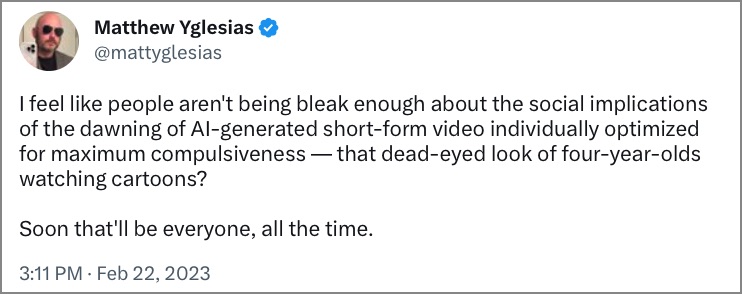
Matt Yglesias Twitter post on AI-generated videos creating a dead-eyed look in viewers

Until next time,

-mark

Mark Hurst, founder, Creative Good – see official announcement and join as a member
Email: mark@creativegood.com
Read my non-toxic tech reviews at Good Reports
Listen to my podcast/radio show: techtonic.fm
Subscribe to my email newsletter
Sign up for my to-do list with privacy built in, Good Todo
On Mastodon: @markhurst@mastodon.social

- – -

LET’S MAKE TECH BETTER: JOIN US.

Mission

Creative Good creates good experiences — for our consulting clients, our Good Todo users, our newsletter readers, and all of our fans.

Contact

Creative Good, 2808 Broadway #17, New York, NY 10025 USA
Phone: +1.646.543.3530
Email: emailus@creativegood.com