
惯性聚合 高效追踪和阅读你感兴趣的博客、新闻、科技资讯
阅读原文 在惯性聚合中打开

推荐订阅源

博客园 - 司徒正美
大猫的无限游戏
大猫的无限游戏
腾讯CDC
J
Java Code Geeks
博客园 - 【当耐特】
Microsoft Azure Blog
V
Visual Studio Blog
人人都是产品经理
人人都是产品经理
博客园 - Franky
博客园 - 聂微东
阮一峰的网络日志
阮一峰的网络日志
美团技术团队
云风的 BLOG
云风的 BLOG
freeCodeCamp Programming Tutorials: Python, JavaScript, Git & More
U
Unit 42
雷峰网
雷峰网
B
Blog RSS Feed
博客园_首页
量子位
F
Fortinet All Blogs
罗磊的独立博客
H
Hackread – Cybersecurity News, Data Breaches, AI and More
酷 壳 – CoolShell
酷 壳 – CoolShell
C
Check Point Blog

Latest from Live Science in News

'Kraken' octopus that lived at the time of the dinosaurs was a 62-foot-long apex predator of the ocean Artemis II heat shield aced its blistering reentry, ghostly underwater photo reveals Scientists invent artificial neurons that 'talk' to real brain cells, paving way to better brain implants 'What are the odds': Superbright comet and exploding fireball meteor form near-perfect X over European castle Meet AGI CPU — a specialist processor that engineers believe will power the next wave of AI Egyptian mummy has part of the 'Iliad' in its abdomen, archaeologists discover Artemis moon landing could face long delay while NASA waits for next-generation spacesuits Gene therapy improves hearing in 90% of patients with inherited deafness in largest trial of its kind Oil spills from Iran war may contaminate water and food supply and threaten protected wildlife refuge NASA's Curiosity rover finds a surprising number of giant 'dragon scales' littered across Mars Watch an AI-powered table tennis robot beat elite players NASA shuts off another Voyager 1 instrument as humanity Florida is facing its most intense drought in 15 years. Here's how it got so bad and how long it will last. Neanderthal toddlers grew faster than modern humans, probably because of the harsh environment they evolved in 'Nations need to prepare now': Key Atlantic ocean current is much closer to collapse than scientists thought New blood test aims to spot liver scarring before it paves the way to cancer A giant 'shadow' has been creeping across Mars for 50 years — and scientists aren't sure why Bruce the parrot is missing his upper beak —‬ but that hasn't stopped him from becoming an undefeated… Scientists identify main cause of extreme nausea and vomiting in pregnancy Naked mole rats wage bloody wars of succession to choose a new queen — but one colony did something scientists… Lyrid meteor shower 2026: See spring's first rain of 'shooting stars' peak in moonless skies $3 million prize goes to duo whose research led to first sickle cell CRISPR therapy 700-year-old mummy from Bolivia contains earliest confirmed evidence of strep throat bacteria in the Americas New pain-relief opioid could be much less addictive than morphine, rodent study finds Experimental drug doubles one-year survival in pancreatic cancer Science news this week: Physicists witness faster-than-light darkness pinpricks, humans are still evolving, and some… Archaeologists discover perfectly circular ancient Egyptian temple that may have been used for sacred water rituals 2 supermassive black holes may collide 100 years from now ‪—‬ and Earth would feel it Anglo-Saxon burial holds an older sister cradling her little brother after they both died 1,400 years ago, possibly of… Colorado River may have pooled and spilled over to form the Grand Canyon, solving a long-standing mystery ‪—‬…
Western states face above-normal wildfire threats this su...
2026-04-09 · via Latest from Live Science in News
A helicopter drops water over a raging wildfire.
New research from the National Interagency Coordination Center predicts where wildfires might occur in the western US. (Image credit: PATRICK T. FALLON via Getty Images)

Every state in the West is expected to face an above-normal threat of wildfire this summer, according to the latest projections, released Wednesday by the National Interagency Coordination Center.

The government-run center publishes monthly reports predicting fire risk for the four months ahead, and the change since the March outlook is staggering. The agency denotes elevated risk in red on its maps, and the June forecast from March 2 showed a small swath of rouge in the Southwest. But, citing an ongoing snow drought, rapid snowmelt, and a recent unprecedented heat wave, the latest maps feature red spilling across the Southwest and into the Rockies, Pacific Northwest, and northern California.

June typically sees snow lingering in many mountain ranges and snowmelt wetting the landscape, he said. Not this year.

The latest outlook reports that the snow melt-off in the Four Corners region came "not just several weeks or months earlier than normal, but also four to six weeks earlier than the previously recorded earliest melt-off dates." The recent heat wave also desiccated the West. Albuquerque, for example, recorded its earliest ever 90-degree reading on March 21, more than six weeks sooner than its previous earliest date, in 1947. The daily average of 73.1 degrees Las Vegas recorded in March would have broken the city's April record.

Image

1

of

2
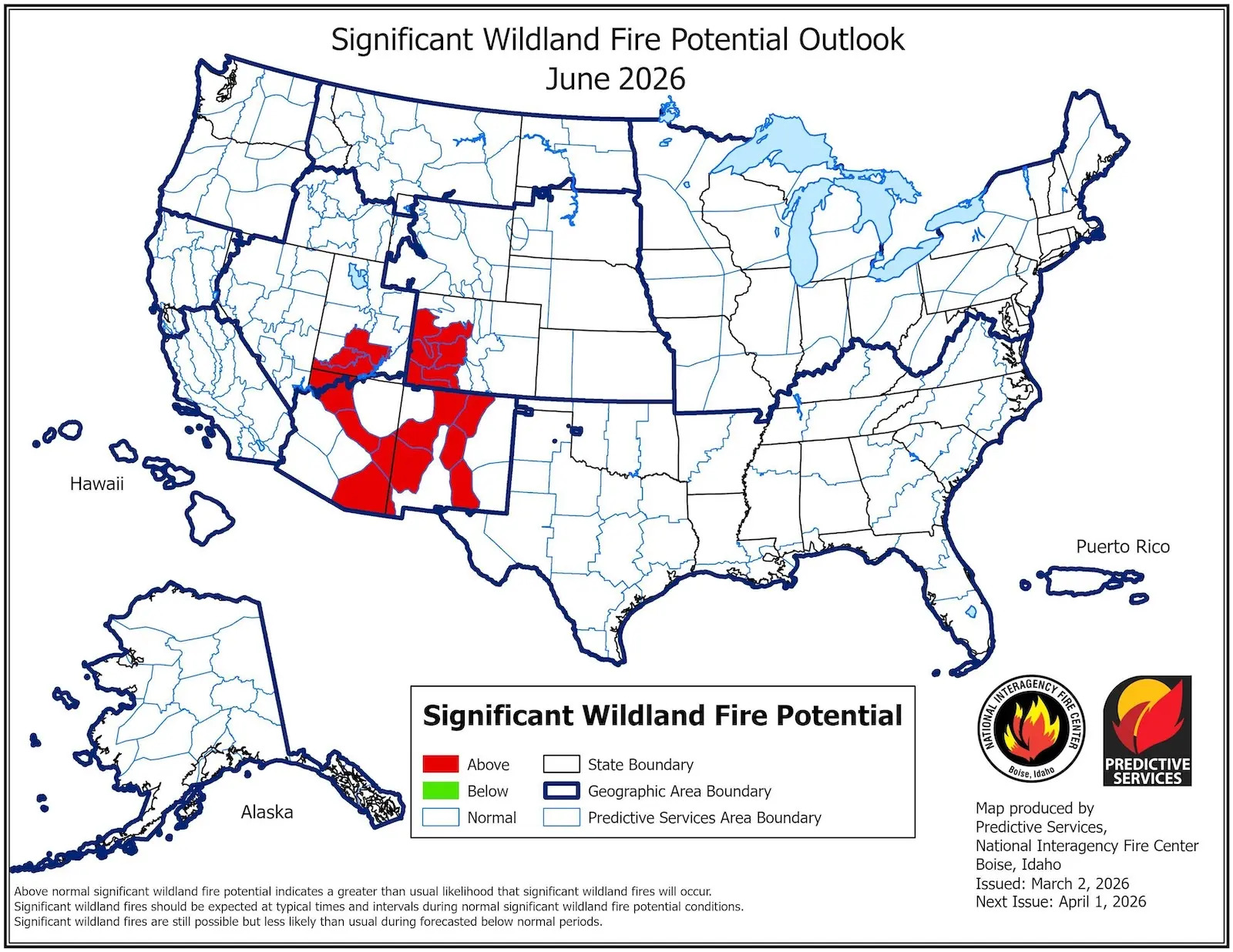
A map of the continental US in white, with red areas showing increased fire concern.
(Image credit: National Interagency Coordination Center)

Projections for June wildland fire risk from the National Interagency Coordination Center released on March 2, 2026 (left image) and updated on April 1, 2026 (right image).


Overall, there's been less snowpack and higher temperatures than pretty much any winter on record. It's a situation that climatologists have said would be virtually impossible without climate change, and the maps reflect that reality.

"It doesn't mean that all of these areas are going to burn," said Alastair Hayden, professor at Cornell University and a former division chief in the California Governor’s Office of Emergency Services. Last year, for example, the Pacific Northwest saw an above-normal risk but was largely spared. Local patterns, such as wind and precipitation, play a major role, too. "But, when I look back at the forecast, fires usually tend to be in one of these locations."

Get the world’s most fascinating discoveries delivered straight to your inbox.

The one notable spot on the latest maps that seems safe for now is Southern California, though that's because the fire season there doesn't usually start until later in the summer, or even into fall. There are also surprising splotches of red, like in Florida, which is experiencing a drought. But the West is by far the largest area of concern. "Keep an eye on July," said Hurteau. "The Fourth of July is the single highest ignition day of the year."

The sheer expanse of land that could be at risk simultaneously worries Hurteau. "Our fire suppression apparatus is in part dependent on the whole region not being on fire at the same time," he said. Fire crews count on being able to hop from hot spot to hot spot. If there are too many at once, resources could run thin.

RELATED STORIES

The number of acres across the country that have burned through March is already 231 percent of the 10-year average. A wet spring, however, could change everything. It recently rained in Albuquerque where Hurteau is based, and, if it continues, the fire risk could go down dramatically. That's what happened last year.

"I'm sure that's what all the fire people are hoping for too, because that would be nice," said Hurteau. "But hope is not a great strategy."

This story was originally published by Grist. Sign up for Grist’s weekly newsletter here.

Tik Root covers climate solutions and economics at Grist. He started his career as a freelance journalist in Yemen, and has since covered everything from Al Qaeda to the Olympics for outlets such as National Geographic, The New York Times, and The Atlantic, among others. He previously worked at The Washington Post and Scripps News. Tik lives in Vermont with his wife and son.

You must confirm your public display name before commenting

Please logout and then login again, you will then be prompted to enter your display name.