


The Blood Meridian book is often called the greatest American novel of the 20th century. Many readers also call it one of the most brutal books ever written. Blood Meridian, Cormac McCarthy’s 1985 novel, sits at the edge of what fiction can do. It is historical and philosophical at the same time. It is precise in detail but elusive in meaning. This article breaks down the Blood Meridian book – what the story is, why it is difficult, and whether it is worth reading. It also answers the question film lovers keep asking: why has no one managed to adapt it? Full spoilers ahead.
Blood Meridian PREMISE
If you want to understand what the Blood Meridian book is about, the short answer is this: a teenage boy joins a gang of scalp hunters on the Texas-Mexico border. The novel follows their campaign of violence across the American West.
But Blood Meridian is not driven by plot structure alone. It is driven by presence, philosophy, and a single terrifying figure. It builds a world where violence is constant and meaning is unstable.
The Kid is the novel's central figure. He is a teenage runaway from Tennessee, born in 1833, who drifts west as a young man.
He has no backstory foundation to speak of. Cormac McCarthy gives us only fragments. There is no access to his thoughts. We only see what he does.
He is not innocent. He fights and kills. But he is not fully consumed by violence either. That small resistance becomes central to the novel.
The Kid functions less as a hero and more as a lens — the reader moves through the world alongside him, not inside him.
The gang is based on real history. John Joel Glanton led a group of scalp hunters in the 1840s. The state of Chihuahua paid for Apache scalps. Glanton's gang took the contract. They soon began killing anyone they could profit from.
The Kid joins them. The novel follows their movements across deserts, towns, and borderlands. The violence is constant. It is described with a strange calm.
Judge Holden in Blood Meridian is the novel's true center. He is one of the most disturbing figures in American literature.
He is enormous. He is hairless. He speaks many languages. He draws, dances, and lectures. He also murders without hesitation.
His philosophy defines the novel: war is the highest human act. To dominate another being is to give meaning to existence. He wants to see, record, and control everything.
The YouTube channel, Like Stories of Old, had plenty to say about Judge Holden in their investigation of the Blood Meridian book adaptation:

McCarthy's prose strips away the interior life that most novels rely on. The Judge is the only of the book Meridian characters who explains himself — and what he says is terrifying precisely because it is coherent.
The Blood Meridian book's plot unfolds in three stages. This section stays with events rather than interpretation.
The Kid leaves Tennessee at fourteen. He drifts through the South and into Texas. He survives through chance and aggression. He joins a militia led by Captain White. The group enters Mexico and is attacked by Comanche warriors in a sudden and overwhelming scene.
The Kid survives. He is later arrested and ends up in a prison in Chihuahua. After his release he encounters Glanton's gang. Judge Holden is already with them.
The middle of the Blood Meridian book is long and deliberate. The gang moves across the borderlands collecting scalps. They begin by targeting Apache groups. They soon kill anyone. Villages are destroyed. Travelers are ambushed.
Judge Holden moves through these events. He observes, records, and kills. His speeches become more frequent.
The gang takes control of a ferry crossing on the Colorado River. They terrorize anyone who passes. The Yuma people attack. Most of the gang dies.
Years pass. The Kid becomes the man. He is older but still drifting. He meets Judge Holden again in Fort Griffin. The Judge has not changed. He accuses the man of weakness.
The man goes to an outhouse. The Judge follows. Something happens inside. It is not shown. A witness reacts with horror. The Judge returns to the dance. The novel ends.
Is there any surprise to why The Blood Meridian book is one of the most studied works in American literature?
Book meridian characters
The Blood Meridian book's characters are less about personal arcs and more about what they represent. The novel's power comes from a small group of figures who shape its structure.
Take a look at the key characters below:
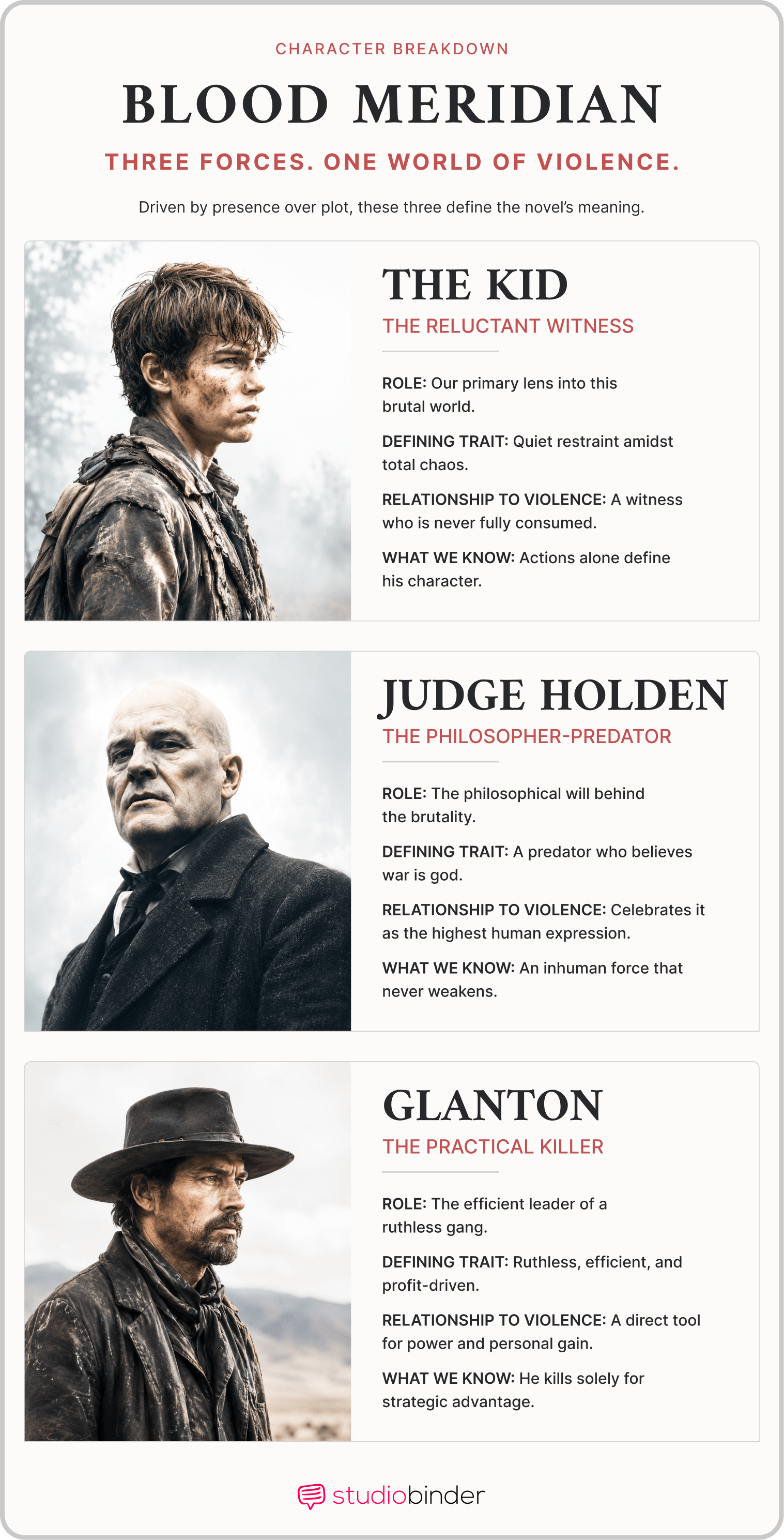
The Kid is not a traditional protagonist. He has no clear arc and no interior monologue.
What defines him is restraint. He does not fully give in to the violence around him. That hesitation is the fault line Blood Meridian's Judge Holden fixates on.
He is not driving the story in the usual way. The novel is shaped more by what happens around him than by his own decisions.
Judge Holden in Blood Meridian dominates the novel.
He is described as physically unusual, possibly inhuman. He never seems to weaken or change.
He believes war defines all human life. He teaches this through speech and action.
Glanton leads the gang. He is violent, practical, and effective. He kills for profit and control. Unlike the Judge, he does not try to justify what he does.
THE DEPRAVITY
The Blood Meridian book's themes do not arrive with labels and this is why it has influenced so many writers, filmmakers and storytellers for decades. They emerge through action, repetition, and tone. The novel presents its ideas through what happens and what the narrative refuses to judge.
The Blood Meridian book does not treat violence as an exception. It treats it as constant.
Cormac McCarthy sets the novel during real events tied to westward expansion. This is not a symbolic landscape. It is historical.
The Glanton Gang is not framed as uniquely evil. They are shown as part of a system. They are hired, paid, and protected. The violence they carry out is organized.
That is the shift the novel forces. Violence is not random. It is structured. It has purpose. It produces results.
The prose reinforces this. There is no change in tone when violence appears. A massacre is described with the same rhythm as a sunset. That lack of distinction matters. Most narratives signal horror. This one does not. The reader is left without guidance.
The effect builds over time. The repetition of violence without commentary begins to feel deliberate. It suggests that what we are seeing is not an anomaly. It is the norm.
Blood Meridian's Judge Holden does not just act. He explains. He gives the novel its clearest argument.
He claims that all human activity leads back to conflict. War is not one part of life. It is the structure beneath it. He does not present this as opinion. He presents it as fact. His speeches are calm and controlled. He teaches rather than argues. That tone makes the content harder to reject.
He also links knowledge to control. He records what he sees in a ledger. Then he destroys it. To know something is to claim it. To claim it is to dominate it. This extends his idea of war. Conflict is not only physical. It is intellectual. It is about who defines reality.
Cormac McCarthy does not provide a counterargument. No character defeats the Judge in debate or in action. That absence matters. The novel does not resolve the argument. It leaves it in place.
The ending does not close the argument. It sharpens it.
The Kid shows small resistance throughout the novel. He hesitates. He refuses certain acts. These moments are brief. They are not framed as heroic. They are easy to miss.
The Judge sees them clearly. He names them as failures.
By the end, that resistance has not changed the outcome. The Kid dies. The Judge continues.
The final image is the Judge dancing. Alive and unchanged. The world has not altered him.
That creates two readings. One is that resistance means nothing. The other is that it is the only meaningful act, even if it fails. The novel supports both. It does not choose.
Few books have divided readers the way the Blood Meridian book has.
THE CHALLENGE
The Blood Meridian book is known for its difficulty. That difficulty comes from clear choices in style and structure.
Several factors work together to slow the reader down:
The Blood Meridian book rewards readers who are willing to sit with its difficulty.
McCarthy's prose style in Blood Meridian is unlike anything else in American fiction. Understanding what prose can do at its most extreme helps explain why this novel lands the way it does.
THE MASTERPIECE
The reputation of the Blood Meridian book rests on several strengths.
First, the prose is distinct. It draws on Biblical rhythm and historical detail. Every blood meridian review returns to the same quality: McCarthy writes violence with the cadence of scripture, and that contrast is what makes it devastating.
Second, the novel is grounded in real events. The violence is not invented. It reflects documented history.
Third, it refuses comfort. There is no moral resolution. The ending offers no relief.
Harold Bloom placed it alongside major works in the American canon. The argument is that Blood Meridian, Cormac McCarthy's most extreme novel, confronts history without softening it — and that the refusal to offer consolation is itself a moral position.
Blood meridian film
The problem with making a Blood Meridian film is not one thing. It is a combination of form, character, and tone. Each one becomes harder when translated to film. Take a look below to give you an idea of why it's extremely tough to shoot a Blood Meridian film:
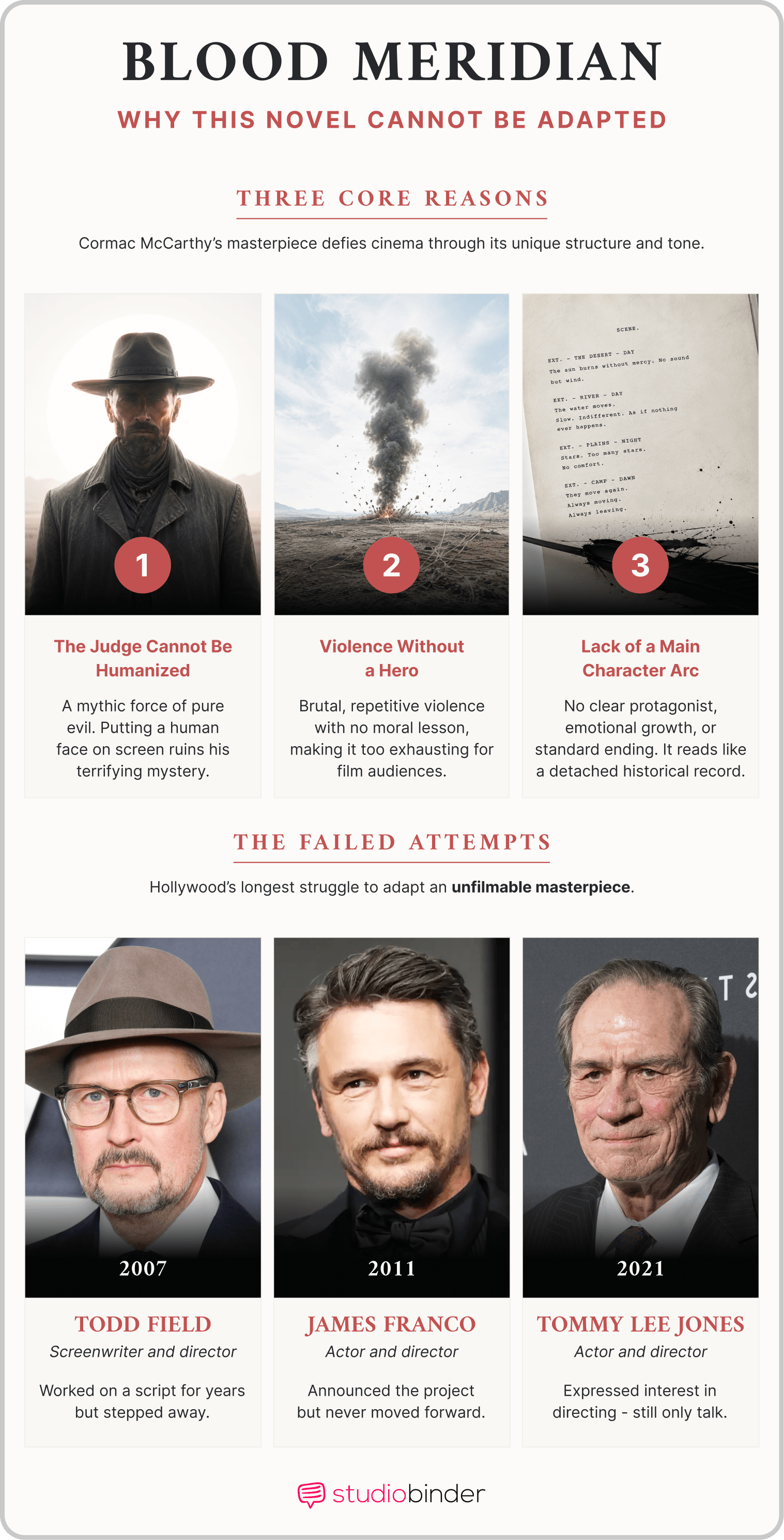
Several serious filmmakers have tried to adapt the Blood Meridian book into a Blood Meridian film. None have succeeded.
Todd Field developed the project for years. He is known for controlled, character-driven films like Tár. His approach leaned toward restraint. Reports suggest the project stalled because the material resisted that control. The novel does not build around character psychology in a way that suits his style.
James Franco also pursued an adaptation. His version moved closer to literal translation. That approach creates a different problem. The novel's scale and violence become difficult to stage without either reducing them or turning them into spectacle.
No wonder so many fans believe the Blood Meridian book is unfilmable:

There have been other expressions of interest in shooting a Blood Meridian film, including from Tommy Lee Jones. The pattern is consistent. Filmmakers are drawn to the material, but development stops before production. This suggests a structural issue. It is not about talent or intent. It is about fit.
Blood Meridian's Judge Holden is the central problem for any director attempting an adaptation of the Blood Meridian book.
On the page, he is never fully defined. He is described as enormous, hairless, and learned. But the novel never confirms what he is. He may be human. He may not be. That uncertainty is what makes him work.
When you read Blood Meridian, you build the Judge in your own mind. His size, his voice, his presence are all slightly unstable. That instability creates tension.
A Blood Meridian film would remove that. An adaptation has to cast him. The moment that happens, the Judge becomes fixed. No matter how strong the performance, it will be one version. Every other possibility disappears.
Scale is the second problem. In the novel, the Judge feels larger than the world around him. He moves through events without being affected by them. On screen, scale is literal. An actor can be tall and imposing. He cannot feel limitless in the same way.
The third problem is speech. The Judge's philosophy is carried through long, controlled monologues. In prose, this works because the reader controls the pace. In film, those speeches become extended monologues that slow the film down or risk feeling theatrical. Shorten them and the character loses depth. Keep them and the rhythm of the film breaks.
The final issue is tone. The Judge is not written as a typical villain. He is calm, precise, and often persuasive. He is not framed as someone to reject. Film tends to push characters toward clarity. A villain is shaped so the audience knows how to respond. The Judge resists that.
Dive deep into the the most terrifying character in history:

The directors who attempted Blood Meridian all faced the same question at the planning stage: how do you stage a character whose power comes from being undefined? A shot list forces every visual decision into the open — which is exactly the problem.
The violence is another core issue. In the book, violence is constant. It appears without warning and without emphasis. It is described in the same tone as everything else. That tone is crucial — it removes the sense that violence is exceptional.
Film cannot do this. Every depiction of violence becomes a moment. A cut gives it shape. A sound cue gives it weight. A camera angle gives it focus. Even if a director tries to present violence neutrally, the medium itself creates emphasis.
This is the most disturbing American novel for a reason:

There is also the question of scale. The novel does not build to a few major events. It sustains violence across its entire length. To match that on screen would require long stretches of sustained brutality. That raises both practical and ethical limits. If the violence is reduced, the story changes. If it is shown in full, it risks becoming unwatchable or exploitative.
The book does not guide the reader. It does not tell you how to feel. It does not offer relief.
Film almost always does. Even the most restrained films use rhythm, camera framing, and sound to shape the audience's response. A Blood Meridian film adaptation would need to resist its own tools — to avoid guiding the audience while still holding their attention. That is a narrow path. No existing attempt has found a way through it.
Pre-production planning is where adaptation decisions become permanent. A shot list is one of the first places a director has to answer: what does this scene actually look like?
Trusted by over 1M creatives
Shot lists that turn vision into action
From first draft to final take, plan, organize, and execute every shot with confidence.

THE CONCLUSION
The Blood Meridian ending explained is simple in structure but unclear in detail. The final section leaves key events off the page.
Years after the fall of the gang, the Kid is now an adult. He is referred to as the man. He is still drifting through the West. He has not settled, and he has not changed in any clear way.
He meets Judge Holden again in Fort Griffin. Judge Holden appears unchanged in Blood Meridian's final act — still enormous, still calm, still certain.
They speak. The Judge accuses the man of weakness. He claims the man failed to commit fully to the world as it is. That small resistance is framed as betrayal.
The man goes to an outhouse. The Judge follows. What happens inside is not described. A witness opens the door and reacts with horror. The implication is that the Judge has killed him.
After this, the Judge returns to the dance. He says he will never die. The novel ends without confirming what the Judge is or explaining what happened in the outhouse. Both remain open.
Above all, the Blood Meridian book remains as relevant today as when it was first published.
The Blood Meridian book follows a teenage runaway known as the Kid. He joins a historical scalp-hunting gang on the Texas-Mexico border. The story tracks their violence across the region, with Judge Holden at the center. What Blood Meridian is about beneath that surface is harder to summarize: it is a novel about violence as a structural force in human history.
Yes. The novel is difficult due to its style, language, and structure. It avoids standard dialogue formatting and uses dense vocabulary. The violence is also extreme and sustained. Most readers find the first hundred pages the steepest part.
It is known for its prose and its refusal to soften history. The novel presents violence without moral framing. That approach, combined with its grounding in real historical events, is what has shaped its reputation.
Judge Holden is the central figure in the Blood Meridian book. He is physically unusual and possibly inhuman. He presents a philosophy in which war defines all human activity. He is never defeated in debate or in action, and the novel does not resolve what he represents.
No. Several attempts have been made, including by Todd Field and James Franco, but none have reached production. The challenges are structural rather than legal — the novel's form resists the tools film relies on.
Blood Meridian, or The Evening Redness in the West was published in 1985 by Random House.
Blood Meridian is Cormac McCarthy at his most extreme. If this was your first encounter with his work, the style can feel overwhelming — and that is partly the point. Other Cormac McCarthy books take similar ideas and shape them in more accessible forms. That contrast makes Blood Meridian easier to understand in hindsight.
Start with a wider view of his output, then move to a film adaptation that shows how his themes translate — or don't — to the screen. Let's explore the best Blood Meridian adaptation's ending next, No Country for Old Men.
此内容由惯性聚合(RSS阅读器)自动聚合整理,仅供阅读参考。 原文来自 — 版权归原作者所有。