
惯性聚合 高效追踪和阅读你感兴趣的博客、新闻、科技资讯
阅读原文 在惯性聚合中打开

推荐订阅源

博客园 - 叶小钗
Cyber Security Advisories - MS-ISAC
Microsoft Security Blog
罗磊的独立博客
大猫的无限游戏
大猫的无限游戏
美团技术团队
让小产品的独立变现更简单 - ezindie.com
钛媒体:引领未来商业与生活新知
钛媒体:引领未来商业与生活新知
aimingoo的专栏
aimingoo的专栏
腾讯CDC
WordPress大学
WordPress大学
Apple Machine Learning Research
F
Fortinet All Blogs
G
Google Developers Blog
MongoDB | Blog
MongoDB | Blog
Microsoft Azure Blog
小众软件
小众软件
Engineering at Meta
Engineering at Meta
博客园_首页
B
Blog RSS Feed
D
Docker
M
MIT News - Artificial intelligence
爱范儿
爱范儿
I
InfoQ

JPost.com - Archaeology | The Jerusalem Post

What was the Qumran sect's mysterious calender used for? | The Jerusalem Post Ancient structure near Stonehenge may have inspired its solstice alignment | The Jerusalem Post Ancient tablet found at Roman fort bears Greek curse against enemies | The Jerusalem Post Archaeologists unearth ancient Byzantine-era city in Egypt’s Dakhla Oasis | The Jerusalem Post Ancient mosaics, coins to go on display in new exhibit in northern Israel | The Jerusalem Post Archaeologists find inscriptions of pharaohs, ancient deities in Egyptian temple | The Jerusalem Post Italy buys famed Etruscan tomb, displays it in Rome museum | The Jerusalem Post New AI project aims to uncover origins of the Dead Sea Scrolls | The Jerusalem Post Site of Alexander the Great’s battle with Persians under historic protection | The Jerusalem Post Previously unknown Iron Age grave found ahead of construction in Germany | The Jerusalem Post Collector finds rare Hebrew-inscribed Moroccan mortar in Jerusalem's Old City | The Jerusalem Post Stone from Tel Eton may hold evidence of ancient religious reforms, study claims | The Jerusalem Post Complete text of carbonized Herculaneum scroll unlocked for first time | The Jerusalem Post Study: New identification technique pushes back timeline of human fire use | The Jerusalem Post Over 3,000 artifacts from Stone Age to WWII found in Netherlands valley | The Jerusalem Post American family repatriates four ancient artifacts to Egypt | The Jerusalem Post Remains of Queen Elisenda, 24 others unearthed in Barcelona for study | The Jerusalem Post Two ancient statues uncovered during Israel Railways excavations near Haifa | The Jerusalem Post Marble bust believed to depict Roman goddess of love found during excavations at Alicante beach Ancient Greco-Roman cemetery unearthed at archaeological site in Egypt's Nile Delta Ancient jars unearthed at biblical Shiloh days before annual wine festival WATCH: A Paleolithic time capsule: Rare prehistoric cave discovered near highway outside of Haifa Ancient water reservoirs discovered at Red Sea's Port of Aydhab site near Egypt-Sudan border Collection of ancient Egyptian, Greek, Roman-era artifacts discovered at Egypt’s Heracleopolis First near-complete ancient Egyptian funerary set discovered at Heliopolis necropolis site WATCH: Norway recovers Chinese porcelain, European-made goods from 18th-century shipwreck Neanderthals' ancient toolkit included hammers, blades made from rhino teeth, study finds Evidence of ancient Native American life uncovered near Cape Canaveral Space Force Station Rare, intact ancient Roman burial unearthed during excavations in eastern Croatia - report Plaster-making technique attributed to Romans used at Motza some 8,000 years earlier, study shows
CT scans reveal age, authenticity of child mummy housed i...
2026-04-24 · via JPost.com - Archaeology | The Jerusalem Post

“We are still working on the mummy," said Professor Agata Kubala in a statement, as an "X-ray revealed the presence of an object on the chest, which may be a papyrus containing the boy’s name.”

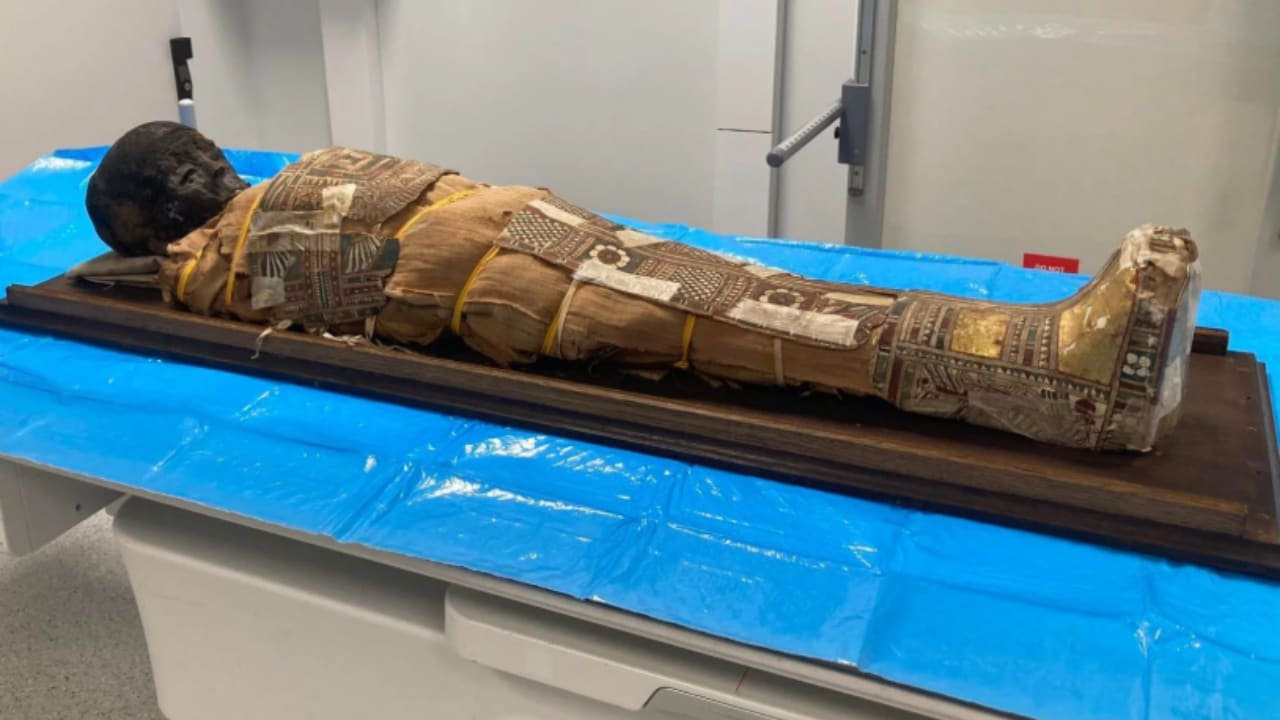
Examination of the mummy using the Canon Aquilion Prime ST  Computed Tomography at the Stefan Cardinal Wyszy´ nski Provincial Specialist  Hospital in Lublin, April 23, 2026.
Examination of the mummy using the Canon Aquilion Prime ST Computed Tomography at the Stefan Cardinal Wyszy´ nski Provincial Specialist Hospital in Lublin, April 23, 2026.
(photo credit: Marzena Ożarek-Szilke/University of Wrocław)
ByMIRIAM SELA-EITAM

The age and sex of an ancient Egyptian child mummy has been figured out by researchers in Poland, according to a recent study published in Digital Applications in Archaeology and Cultural Heritage.

Using CT scans of the mummy’s tissues and dental development, researchers determined that the mummy belonged to a boy around 8 years old.

The child’s brain had been removed through his nasal cavity, researchers found. Additionally, the absence of a mummification incision on the abdomen indicated that most of the internal organs, including the heart, were either not preserved or removed per rectum.

His eyes, though, are still preserved, and researchers were able to spot his optic nerves in the scans. The torso had been padded with loosely rolled fabric rather than the traditional resin, and the skull was left unfilled.

The front of the child’s head and neck were partially unwrapped, and covered in a noticeable layer of dark embalming residue, though the study added that “the head is still covered in at least four layers of bandages at the back.”
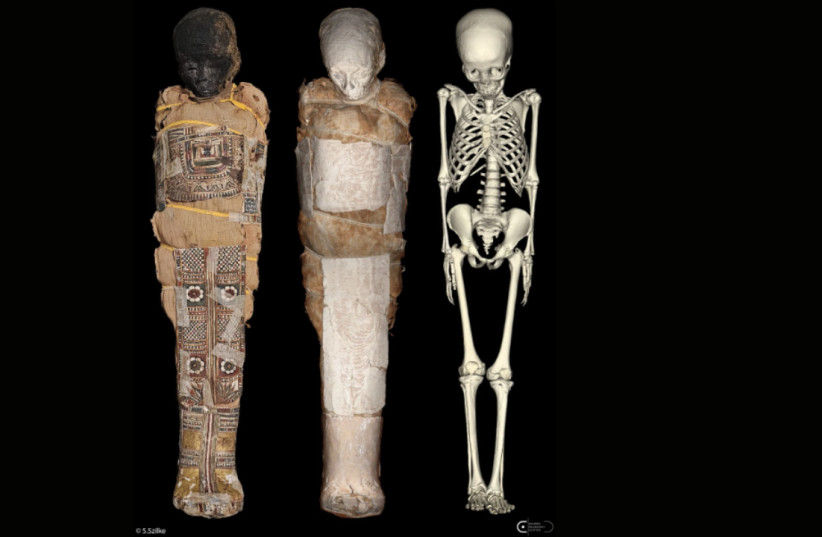
Current state of preservation of the mummy (L), 3D visualisation of the mummy: VR (C), and segmentation of the skeleton (R), April 23, 2026.
Current state of preservation of the mummy (L), 3D visualisation of the mummy: VR (C), and segmentation of the skeleton (R), April 23, 2026. (credit: Marzena Ożarek-Szilke/University of Wrocław)

The child's face may have also been originally covered in a mummy mask.

Several missing toes and damage to two of the mummy’s vertebrae and the surrounding tissue from “likely due to historical display practices,” researchers noted in the study.

“This is not the end of the research,” said Professor Agata Kubala in a statement from the University of Wrocław. “We are still working on the mummy," as an "X-ray revealed the presence of an object on the chest, which may be a papyrus containing the boy’s name.”

Origins of the mummy are unknown

Studies of the mummy began in 2023 at the request of the Metropolitan Archbishop of Wroclaw, Józef Kupny. Before that, no in-depth examinations of the mummy had been completed using paleoradiology.

The mummy was first brought to Wrocław in 1914 by Cardinal Adolf Bertram upon being appointed the city's bishop. Later, Bertram donated it and the rest of his collection to the local Museum of the Diocese.

Bertram was a collector of antiquities and a close friend of Wilhelm Pelizaeus, a wealthy German businessman who sponsored archaeological excavations in southern Egypt in the early 1900s.

As such, it is believed Bertram may have acquired the mummy through his connection to Pelizaeus, though the exact circumstances and its site of origin are unknown. Further, any museum records that would’ve aided in pinpointing exactly where they came from were destroyed during World War II in 1945.

However, analysis of the mummy's cartonnage (the decorated casing of painted plaster and linen that encloses it) points strongly to the Kom Ombo or Aswan regions of Upper Egypt, dating to the Ptolemaic period. The cartonnage's distinctive chequered patterns, lotus flowers, and rosettes match those found on other mummies excavated at Kom Ombo.

Further, the precise fit of the catonnage around the child's body confirmed to researchers that the mummy is most likely real and not a forgery, such as those that flooded the European market during the 19th century.