


When we read about this new malware tactic, or that novel social engineering approach, it’s easy to forget that there are scammers out there making a living from ancient methods.
Recently, one of our researchers received this variation on the good old Nigerian advance-fee scam.
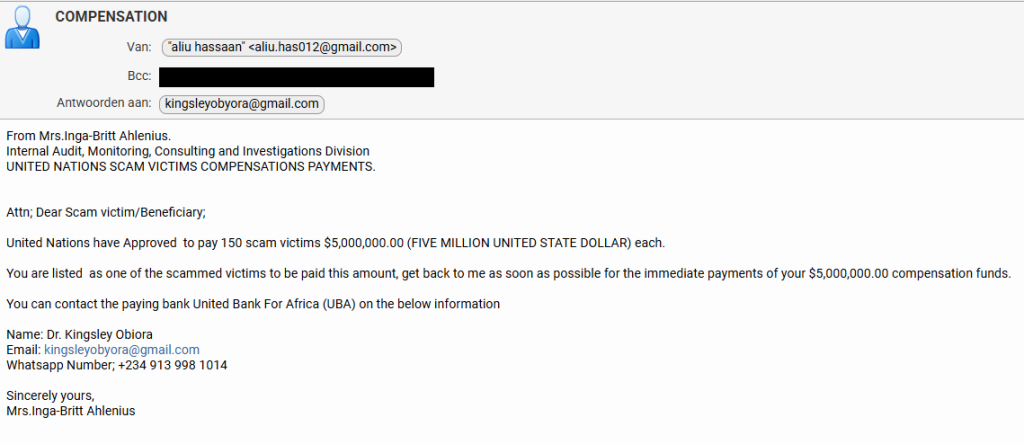
From: Mrs.Inga-Britt Ahlenius.
Internal Audit, Monitoring, Consulting and Investigations Division
UNITED NATIONS SCAM VICTIMS COMPENSATIONS PAYMENTS.Attn; Dear Scam victim/Beneficiary;
United Nations have Approved to pay 150 scam victims $5,000,000.00 (FIVE MILLION UNITED STATE DOLLAR) each.
You are listed as one of the scammed victims to be paid this amount, get back to me as soon as possible for the immediate payments of your $5,000,000.00 compensation funds.
You can contact the paying bank United Bank For Africa (UBA) on the below information
Name: Dr. Kingsley Obiora
Email: kingsleyobiora@gmail.com
Whatsapp Number, +234 913 998 1014 Sincerely yours,
Mrs.Inga-Britt Ahlenius

Scam or legit? Scam Guard knows.
The scammers got a few details right. Anyone looking up the names in the email will find that they exist and are associated with the mentioned organizations.
Inga–Britt Monica Stigsdotter Ahlenius is a Swedish auditor, public servant and former Under-Secretary-General for the United Nations.
The name “Inga‑Britt Ahlenius” has been reused across many such 419‑style advance‑fee scams, sometimes claiming she is a UN fund monitoring agent or under‑secretary general distributing tens of millions in “compensation” or “unclaimed funds.”
Kingsley Obiora is a Nigerian economist who served as the Deputy Governor of Economic Policy at the Central Bank of Nigeria from 2020 to 2023. Which lends a degree of credibility to the Nigerian country code (+234) in the number they want us to contact by WhatsApp.
So, we decided to put our “friend” Tess to work once again. Loyal readers will remember how Tess almost fell for a task scammer. So maybe she’s eligible for that five-million-dollar compensation.
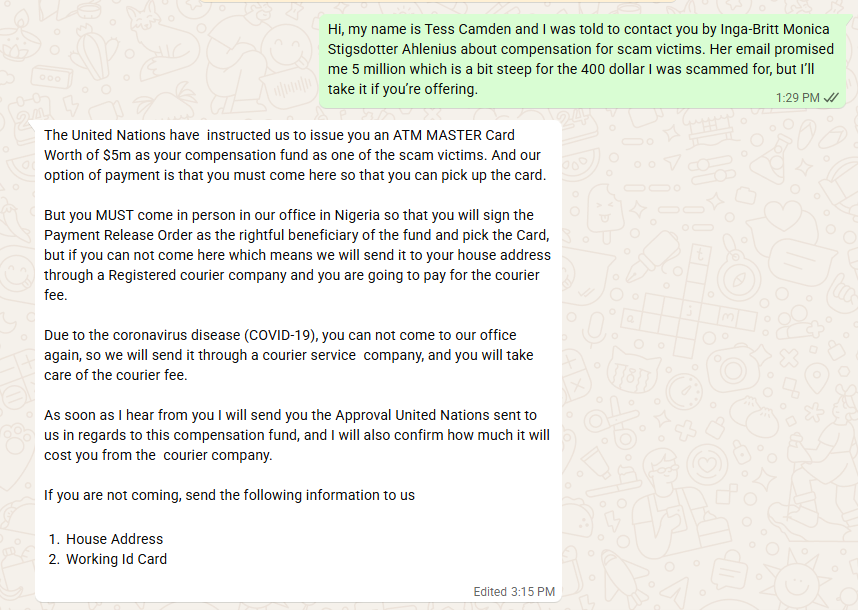
They came right to the point. We’d have to pay a courier fee to get our $5 million dollar ATM card. And I’m pretty sure that if we agreed to pay that, additional costs would swiftly follow. Once you’ve invested a bit of money, you’re likely to keep going since you don’t want to lose what you’ve already paid.
So, I offered to pick up the ATM card in person. Always wanted to see Nigeria.
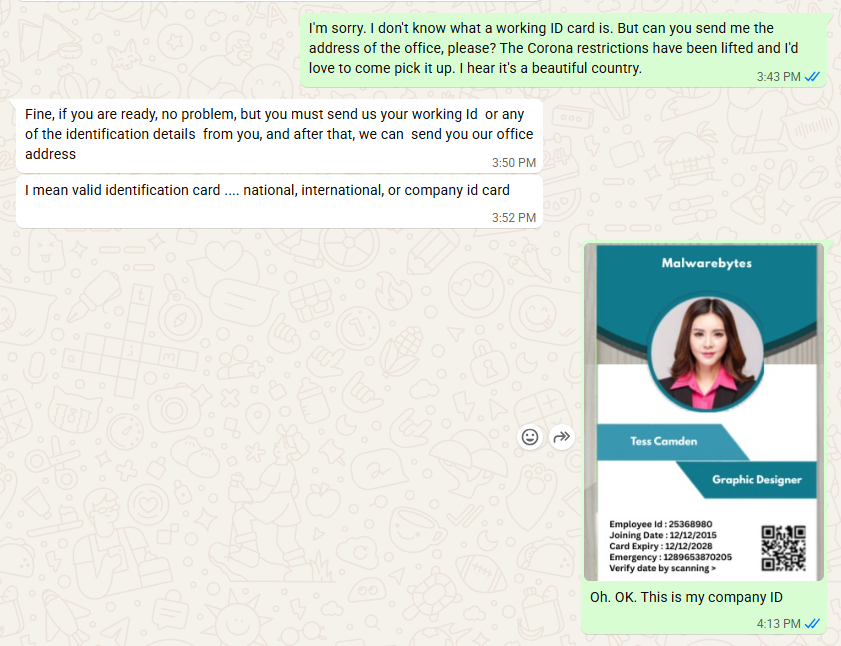
For a while I thought they saw through my bluff. Maybe I shouldn’t have disclosed just yet that I work for Malwarebytes. But it quickly became clear they trusted me about as much as I trusted them.
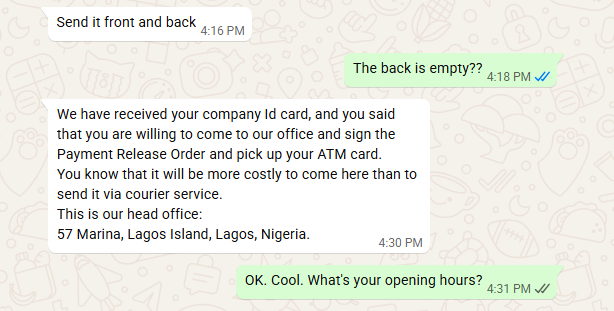
I’ll play along as long as I can, but after giving me the physical address of the UBA bank in Lagos, Nigeria, they started to make it more difficult to pick up the ATM card in person.
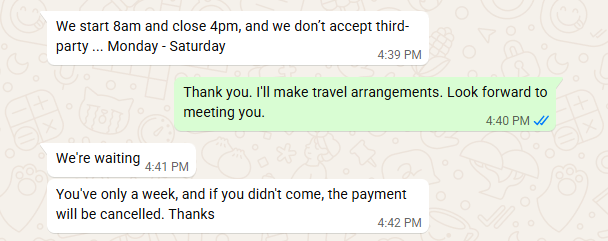
A week is not a long time to arrange a trip to Nigeria, so I tried to get an idea of how much the “courier” would set me back before they gave up on me.
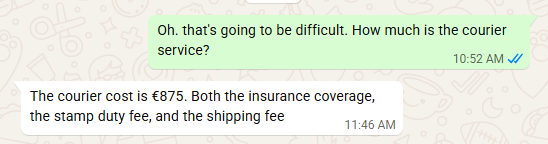
I didn’t expect it to be that much, to be honest. Maybe they thought they could raise the price since I contemplated to pick it up in person. Or they just wanted to get rid of me. You’d expect them to charge maybe €75 for the courier and then come up with €200 for stamp duty and €600 for insurance later on.
Consequences are real
It’s easy to laugh at talk of five‑million‑dollar ATM cards, but campaigns like this still make money. Behind every “Dear Scam victim/Beneficiary” is someone who is lonely, in debt, or simply overwhelmed by official‑sounding language. Once they’ve paid the first “courier fee,” the sunk‑cost effect kicks in, and it becomes harder and harder to walk away.
This is especially true for people who have already been victims of scams, who are clearly the target here.
How to stay safe
Tess’ efforts have helped us highlight the red flags in this type of scam:
- Receiving news of a huge payout out of the blue should definitely trigger the “too good to be true” alarm bells.
- For important communications, free webmail and WhatsApp are rarely the official contact channels.
- Scammers apply pressure to act quickly and ask you to pay a fee before you receive anything.
- They often use vague job titles and ask you to keep things quiet.
- Odd language and capitalization can be a clue, although AI is making these less common.
Any one of these signs is a reason to stop and delete the email. Together, they spell out a classic advance‑fee scam.
For Tess this was a safe experiment: no money lost, just a few evenings spent sparring with a “UN compensation officer” on WhatsApp. For the people these criminals really want to reach, the stakes are much higher.
If you, or someone you care about, ever receives a message promising life‑changing money in exchange for a small courier fee or processing charge, treat it as a warning sign, not a windfall.
Close the tab, delete the message, and, if in doubt, ask a trusted friend or advisor before you act.
The easiest way to recognize a golden‑oldie scam is still the simplest: if it sounds too good to be true, it probably isn’t true.
Something feel off? Check it before you click.
Malwarebytes Scam Guard helps you analyze suspicious links, texts, and screenshots instantly.
Available with Malwarebytes Premium Security for all your devices, and in the Malwarebytes app for iOS and Android.