


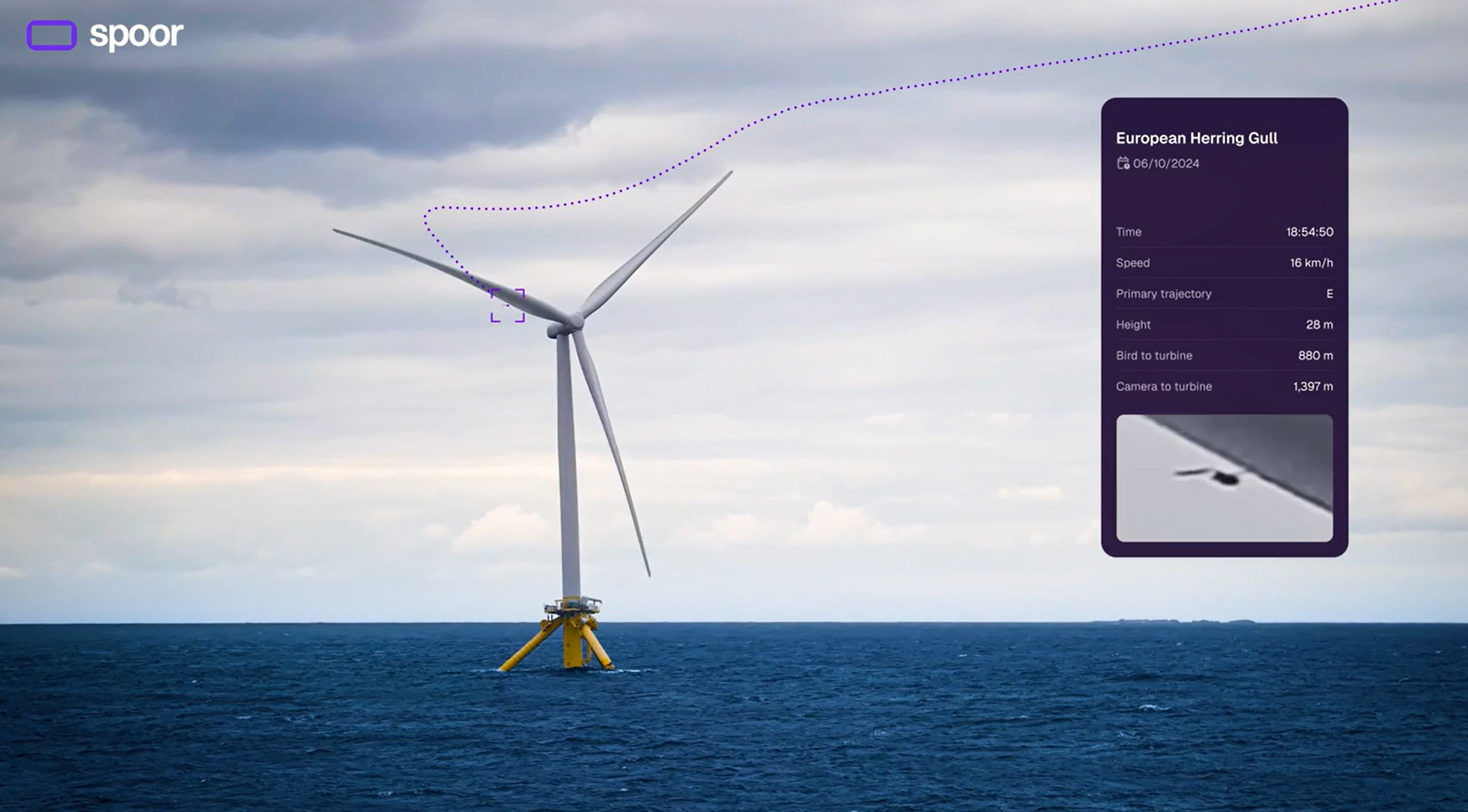
 (Image credit: Spoor)
One of the biggest hurdles facing new wind farms is proving how wildlife interacts with turbines in the real world. Developers and regulators need to understand how wildlife interacts with wind turbines, but much of the current process relies on intermittent surveys carried out by human observers using binoculars or searching sites on foot.
That uncertainty can have real consequences. Projects can face delays while additional surveys are carried out, planning decisions can become more conservative, and mitigation requirements can increase simply because the available data isn’t strong enough to support confident decisions.
Article continues below
In some cases, assumptions fill the gaps where hard evidence is missing, affecting how wind farms are approved, operated, and monitored over time.
This is where Spoor and its AI technology enter the picture. Rather than treating biodiversity monitoring as an occasional task tied to individual projects, the company is building systems that run continuously, collecting data across long periods instead of isolated survey windows.
This takes monitoring from short-term observation to something closer to infrastructure — always running, always recording, and producing data that can be checked and revisited as and when needed.
Spoor's technology relies on high-resolution cameras paired with computer vision models that track bird and bat activity around turbines in real time.
Sign up to the TechRadar Pro newsletter to get all the top news, opinion, features and guidance your business needs to succeed!
Instead of relying on scattered observations, it builds large datasets that can support environmental assessments, guide operational decisions, and help regulators understand how wildlife interacts with wind energy sites in practice.
Rather than focusing on reassurance or perception, the goal is to provide clearer evidence that can support more accurate decision-making across the entire lifecycle of a wind project.
I wanted to find out more, so I spoke to Ask Helseth, Spoor CEO, about the technology behind the system, the data it produces, and how it could change wind farm decision-making.
I learned that birds pose a major risk to wind farms and that the lack of good data was delaying new builds while also posing risks to existing farms. At the time, bird data was lacking and being collected manually using humans with binoculars to observe birds and dogs to find dead ones.
This was in 2021 and AI (computer vision) was becoming powerful enough to be applied with the right investment. The idea was straightforward: use cameras and AI to continuously detect and track birds. This would help us better understand and mitigate the challenges, allowing nature and industry to coexist.
One of the most important findings is that birds avoid turbines far more than the prediction models assume. At Vattenfall's Aberdeen Bay offshore wind farm, we monitored a turbine continuously for 19 months, tracked over 2,000 bird flights, and recorded zero confirmed collisions.
The original environmental impact assessment had predicted roughly 8.5 collisions per turbine per year. The actual observed rate was several orders of magnitude lower.
That does not mean collisions never happen, but it tells us that the precautionary assumptions built into current collision risk models may be significantly overestimating the real impact at many sites.
That has direct consequences for how wind farms are consented and operated.
Our primary market is offshore and onshore wind energy. We work with developers during the permitting phase, where bird data feeds into environmental impact assessments, and with operators during the life of the project, where it supports compliance, mitigation and re-consenting.
Our customers include Ørsted, RWE, Vattenfall, Equinor and TotalEnergies. Generally, we see that the industry is interested in having facts on the table when it comes to their impact (or lack thereof) on birds.
Without facts, assumptions can take over and they are usually not correct.
The data feeds into several decision points across the project lifecycle. During permitting, it goes into the environmental impact assessment and the collision risk model, which determine the consent conditions a project must operate under.
Better data means more proportionate conditions, which means less unnecessary curtailment and fewer permitting delays.
During operations the data is used to understand the actual impact and supports adaptive management: if a wind farm is shutting down turbines during certain periods as a precaution, our data can show whether that curtailment is proportionate to actual bird activity, or whether it can be targeted more precisely.
Over the longer term, it builds the evidence base that operators need when their original consent expires and they face re-permitting.
We are already seeing interest from airports, transmission line operators and from the mining sector.
The underlying technology, continuous detection and classification of flying objects from camera footage using computer vision, has applications wherever you need to monitor airborne activity at scale.
Drones are an obvious adjacent use case: our system already detects them incidentally during bird monitoring.
Three things. First, our proprietary training dataset: we have been collecting and curating labelled bird detection data since 2019, with over a million tracked bird observations from real operational sites across multiple countries, species, seasons, and conditions. That dataset is what allows our models to significantly outperform off-the-shelf computer vision.
Second, our detection range and accuracy: we can reliably detect birds with very few pixels on target, which translates to detection ranges of up to 2 kilometres for large birds using off-the-shelf cameras.
Third, we are hardware independent. We work with standard, commercially available cameras rather than proprietary hardware, which keeps deployment costs lower and means we are not locked to a single manufacturer.
The technology is also patent protected.
The main technical challenges are detection at range in variable conditions, managing false positives and false negatives, and operating reliably in harsh natural environments.
For an AI model a lot of stuff can look like a bird and training it on all edge cases is demanding. False positives, where the system flags a cloud or insect as a bird, are managed through weekly manual quality assurance by our in-house ornithologists. Our current precision rate is above 90%.
On the infrastructure side, offshore deployment means dealing with salt spray, power constraints, data transmission from remote locations, and maintaining equipment that may be inaccessible for weeks due to weather.
Today, bird monitoring at wind farms is treated as a project-by-project compliance exercise. Each site commissions its own surveys, produces its own data, and files its own reports. There is no shared infrastructure and very little data flowing between projects or across portfolios. What we are building is a platform that can be deployed across hundreds of turbines and sites, producing standardised, comparable data that feeds into both individual project decisions and industry-wide understanding of how birds interact with wind energy. When monitoring is not a bespoke consultancy engagement but a persistent data layer across a developer's portfolio, it changes what is possible in terms of cumulative impact assessment, adaptive management at scale, and the speed at which regulators can evaluate new projects.
Yes. The Sky Intelligence Platform is designed as a software platform, not just a video monitoring tool. The data we produce, detections, species classifications, flight paths, height distributions, is structured and accessible through the platform.
Integration with wind farm control systems, including SCADA, can enhance the product. We are also exploring how our data can be enriched by complementary sources to provide a more complete operational picture.
We process video on-site using dedicated edge computing hardware co-located with the cameras inside the turbine. The cameras stream continuously to these processing units, which run our detection and tracking algorithms in real time.
Only the processed outputs, detection logs, classifications, metadata, and flagged video clips, are transmitted back to our cloud platform.
Follow TechRadar on Google News and add us as a preferred source to get our expert news, reviews, and opinion in your feeds. Make sure to click the Follow button!
And of course you can also follow TechRadar on TikTok for news, reviews, unboxings in video form, and get regular updates from us on WhatsApp too.
Désiré has been musing and writing about technology during a career spanning four decades. He dabbled in website builders and web hosting when DHTML and frames were in vogue and started narrating about the impact of technology on society just before the start of the Y2K hysteria at the turn of the last millennium.
You must confirm your public display name before commenting
Please logout and then login again, you will then be prompted to enter your display name.
此内容由惯性聚合(RSS阅读器)自动聚合整理,仅供阅读参考。 原文来自 — 版权归原作者所有。