


Ask a security vendor what a unified platform delivers, and you will hear about efficiency. Fewer consoles. Fewer agents. Fewer alerts to chase. The claim is reasonable; however, it has been repeated so often that it has become true in the way "exercise is good for you" is true. It is also about as useful when you are building a budget case.
What has been missing is quantitative proof. Not the assumption-stacked kind that produces a suspiciously round ROI multiple, but the unglamorous accounting: Which hours come back, from which tasks, and what are they worth to an organization that cannot hire its way out of security challenges.
Finally, the numbers are in.
AimPoint Group set out to quantify the financial impact and ROI of a unified security platform and an MDR service. In this case, they interviewed the person primarily responsible for cybersecurity at four organizations running the Bitdefender GravityZone platform and Bitdefender MDR: a manufacturer, a non-profit, a local government, and an engineering services firm, ranging from 250 to 1,800 employees. Each fits the profile of a lean team, where those in IT and security wear multiple hats.
Managers estimated savings compared with what their organizations were doing before GravityZone. AimPoint normalized the results to a 1,000-employee organization at $75 per hour of fully loaded compensation. Scale to your own headcount as needed.
Exposure management, including patching, produced the single largest block of recovered prevention time for the teams in this research.
Prevention work is the easiest thing to defer and often the most expensive thing to have deferred. Scanning, patching, fixing misconfigurations, and prioritizing remediation is relentless, and on a lean team, it is the first thing to slip when something louder happens. Today, it is more important than ever; reducing your attack surface is essential to slow down machine-speed, AI-enabled attacks and reduce the burden on your detection and response layers.
The managers interviewed reported saving an average of 7.1 hours per week per 1,000 employees, or $27,716 annually. They attributed most of that to automated patch management.
The AimPoint financial impact study revealed that higher-fidelity detections and utilizing a single console cut monitoring and investigation time by an average of 8.1 hours weekly.
The alert problem is not always an alert problem. It is a signal-to-noise problem compounded by an analyst forced to pull context from four or five systems, assembling it by hand, and deciding under pressure whether it means anything.
There was also something related, without a dollar figure:
Interviewees reported that investigation and containment now conclude far faster, shrinking the window an attacker has to move laterally and exfiltrate data. That benefit never appears in a savings column, but it's real and significant.
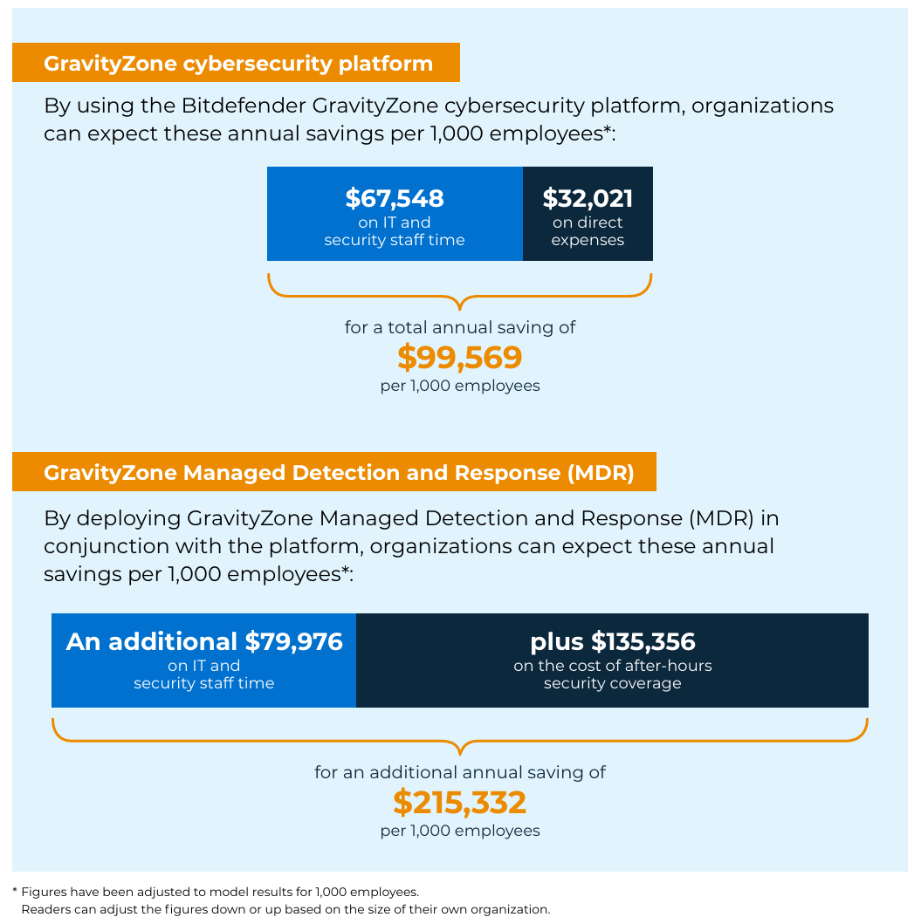
If you are in finance, you’ll really appreciate this line item. When organizations implemented the GravityZone unified security platform, they reported phasing out standalone vulnerability management, patching, SIEM, and EDR products. The average identified savings was $32,021 annually in eliminated direct expense per 1,000 employees.
In total, the organizations AimPoint interviewed found they could quantify average savings of $99,569 per year because they switched to Bitdefender GravityZone.
The Financial Impact Assessment goes into greater detail and covers additional savings. One example is cyber insurance: all four managers said GravityZone reduced their premiums by demonstrating recommended controls to underwriters.
The AimPoint study asked Bitdefender GravityZone Managed Detection and Response customers to quantify the savings resulting from subscribing to MDR.
MDR monitoring, triage, investigation, and containment saved an average of 20.5 hours weekly and saved the organizations $79,976 annually. Avoiding after-hours staffing accounted for a further $135,356 in savings.
This is because somewhere between 35% and 40% of incidents require response during or near non-business hours. For a lean team, the usual result is designating someone on call, which works exactly as well as you would expect: alerts arriving by text at 2 a.m., missed while sleeping, answered the next morning.
Subscribing to MDR flips this challenge on its head, resulting in significant savings.
In total, Bitdefender MDR contributed to $215,332 in average annual savings. Combine that with the GravityZone unified security platform savings of $99, 569 and the total financial impact is $314,901 per 1,000 employees, according to the Financial Impact Assessment.
Some things may be worth more than money, because they are priceless. Every manager mentioned reduced stress and pressure after moving to the GravityZone unified security platform and the Bitdefender MDR service.
They identified relief from the fear that one missed alert becomes a seven-figure incident, and they reported gratitude that evenings and weekends belong to them again. You can’t assign a dollar value to these things, but reduced burnout and turnover among security staff is critical, especially for lean teams that cannot easily absorb a departure.
Interestingly, none of the organizations that consolidated their security cut headcount. They took their significant savings in dollars, time, and sanity and redeployed the recovered hours to neglected security work and valuable IT projects that had been waiting. Several managers said the reallocated work was worth considerably more than the hourly math implies.
The full study, including the complete appendix of savings by category, is available here: Financial Assessment, GravityZone Platform and MDR.
此内容由惯性聚合(RSS阅读器)自动聚合整理,仅供阅读参考。 原文来自 — 版权归原作者所有。