Banks’ legacy core systems were built to prioritize stability, accuracy and scale, and they still deliver on those goals. But as banks attempt to modernize, digitize and incorporate artificial intelligence (AI) into everyday operations, those same systems are increasingly limiting what institutions can do and how fast they can do it.
“Legacy core is an impediment to innovation,” PYMNTS CEO Karen Webster noted during a recent conversation with Kathleen Pierce-Gilmore, senior vice president and global head of issuing solutions at Visa, as part of the “The Edit” series. What has changed, Pierce-Gilmore said, is how visible and costly that constraint has become.
AI Turns Infrastructure Into a Business and Risk Issue
Artificial intelligence (AI) has raised the stakes for infrastructure decisions. AI depends on timely, governed access to data — something with which legacy, batch-based environments struggle.
“If you don’t have well understood, well-managed, well-governed data, it’s going to be really hard to use AI,” Pierce-Gilmore said.
In many banks, data is fragmented across systems, limiting real-time use. Pierce-Gilmore referred to those silos as “data prisons,” where information is trapped inside infrastructure and cannot easily be mobilized for analytics, personalization or compliance.
Advertisement: Scroll to Continue
That limitation affects far more than customer experience. It also shapes how banks evidence controls, monitor activity and respond to regulatory inquiries in an AI-driven environment.
Regulatory expectations are tightening just as banks attempt to move faster. AI adds new complexity to long-standing requirements around data usage, transparency and governance.
Pierce-Gilmore noted that regulators themselves are still working through how to oversee emerging technologies. That uncertainty makes infrastructure choices more consequential, not less. Banks must be able to explain how data flows through systems, how decisions are made and how controls are enforced, even as AI models evolve.
The result is a compressed timeline. Banks are no longer debating whether modernization is necessary. They are deciding how to modernize without increasing risk or creating new forms of technical debt.
“I do think there is a greater sense of urgency than ever,” Pierce-Gilmore said.
Unlocking Data Enables Real-Time, Compliant Engagement
Unlocking data embedded inside infrastructure allows banks to move from static processes to real-time engagement. When events can be consumed as they occur, banks can respond with timely alerts, personalized offers and more accurate risk management.
Pierce-Gilmore offered a straightforward example: a cardholder pays down a balance and immediately sees available credit update, receives a relevant alert and is presented with a promotion tied to that action.
“You can do that in a much more seamless and relevant way if you’ve got the data at the time that it’s happening,” she said.
Batch processing makes those experiences difficult. Real-time event streaming makes them possible, and also auditable.
Future-Proofing Is Now a Requirement
Infrastructure decisions made today must accommodate technologies and regulations that do not yet exist. Pierce-Gilmore stressed that banks can no longer modernize with a fixed end state in mind.
“We just don’t know today how data is going to be used or how additional layers of technology are going to be built out,” she said.
That uncertainty places a premium on modularity and configurability. Systems must be flexible enough to adapt as AI use cases expand and as regulators clarify expectations, without locking banks into rigid architectures that become the next generation of legacy.
Speeding Innovation’s Time to Market
One of the most acute challenges banks face is time. Many institutions want to launch new products or experiences but face technology queues that stretch multiple years.
Pierce-Gilmore described scenarios where issuers are “desperate to get a new product to market” but are blocked by core system backlogs. Waiting for full modernization is often not an option.
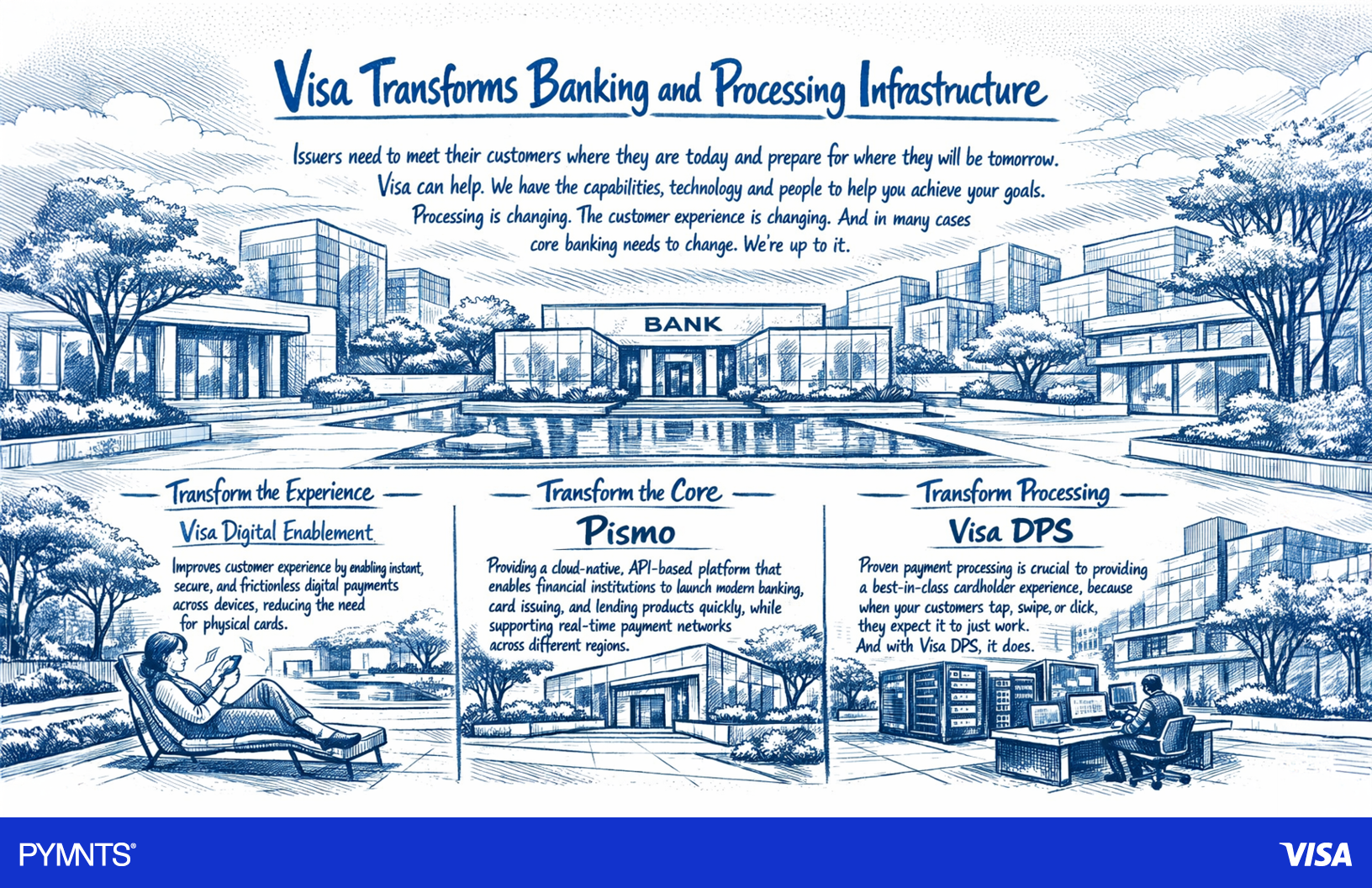
Visa’s approach allows banks to move forward without ripping out existing infrastructure. Capabilities can be deployed on a standalone basis or layered alongside existing systems, enabling faster launches while deeper transformation continues in parallel.
Why Pismo Matters More Than Ever
Pismo sits at the center of that strategy. Its real-time event streaming and flexible issuing capabilities allow banks to modernize incrementally, aligning infrastructure changes with immediate business priorities.
Rather than forcing banks into an all-or-nothing transformation, Pismo supports targeted progress—whether launching a new digital product, improving servicing or enabling real-time engagement.
Crucially, Pismo also supports operational readiness. Real-time infrastructure only delivers value if banks can consume and act on events across servicing, risk and compliance functions.
Visa’s Modular, Ecosystem-Scale Approach
Visa’s infrastructure strategy reflects its scale across tens of thousands of issuers globally. Rather than selling isolated features, the focus is on modular components that can be combined to deliver measurable outcomes.
“Our clients don’t want to buy features and functionality,” Pierce-Gilmore said. “They want to buy outcomes.”
That approach allows Visa to act as what Pierce-Gilmore termed a force multiplier, applying lessons learned across markets and regulatory regimes to help banks modernize more efficiently and responsibly.
A Clear Direction of Travel
Legacy cores may still keep banks running, but the ability to unlock data, operate in real time and adapt to AI and regulatory change will determine which institutions can compete—and which remain constrained by the systems they rely on most.
Pierce-Gilmore weighed in confidence. “I would put my whole life savings on the modernization of infrastructure,” she said.
PYMNTS CEO Karen Webster is one of the world’s leading experts in payments innovation and the digital economy, advising multinational companies and sitting on boards of emerging AI, healthtech and real-time payments firms, including a non-executive director on the Sezzle board, a publicly traded BNPL provider. She founded PYMNTS.com in 2009, a top media platform covering innovation in payments, commerce and the digital economy. Webster is also the author of the NEXT newsletter and a co-founder of Market Platform Dynamics, specializing in driving and monetizing innovation across industries.



