惯性聚合 高效追踪和阅读你感兴趣的博客、新闻、科技资讯
阅读原文 在惯性聚合中打开

推荐订阅源

Jina AI
Jina AI
宝玉的分享
宝玉的分享
Last Week in AI
Last Week in AI
Help Net Security
Help Net Security
让小产品的独立变现更简单 - ezindie.com
人人都是产品经理
人人都是产品经理
奇客Solidot–传递最新科技情报
奇客Solidot–传递最新科技情报
GbyAI
GbyAI
博客园_首页
freeCodeCamp Programming Tutorials: Python, JavaScript, Git & More
MongoDB | Blog
MongoDB | Blog
Cyber Security Advisories - MS-ISAC
L
LINUX DO - 最新话题
PCI Perspectives
PCI Perspectives
博客园 - 三生石上(FineUI控件)
V2EX - 技术
V2EX - 技术
Spread Privacy
Spread Privacy
T
Tor Project blog
量子位
阮一峰的网络日志
阮一峰的网络日志
S
SegmentFault 最新的问题
小众软件
小众软件
博客园 - 叶小钗
Threat Intelligence Blog | Flashpoint
Blog — PlanetScale
Blog — PlanetScale
H
Help Net Security
Y
Y Combinator Blog
N
News | PayPal Newsroom
K
KPMG report finds enterprise disconnect between AI and its ROI | CIO
T
Tenable Blog
Scott Helme
Scott Helme
G
GRAHAM CLULEY
大猫的无限游戏
大猫的无限游戏
aimingoo的专栏
aimingoo的专栏
IT之家
IT之家
Schneier on Security
F
Fortinet All Blogs
Martin Fowler
Martin Fowler
T
Threat Research - Cisco Blogs
博客园 - 司徒正美
Application and Cybersecurity Blog
钛媒体:引领未来商业与生活新知
钛媒体:引领未来商业与生活新知
Attack and Defense Labs
Exploit-DB.com RSS Feed
The Last Watchdog
The Last Watchdog
L
LangChain Blog
C
Check Point Blog
Google Online Security Blog
V
Visual Studio Blog
Latest news
Latest news

Adactio: Links

Who Will Save the Internet From Disappearing? From human hands. HTMX and Web Components Instead of React The Descent — What Happened to the Frontend While You Weren't Watching Abject Praise - Infrequently Noted Talk: Let Jeffrey Zeldman Presents - Memories Can’t Wait—or, How I Learned to Keep Worrying About the Web - State of the Web The AI Resist List Notes & Narratives Show your hands honor for the strange power they bring you The golden rule of Customizable Select Storied Colors How building an HTML-first site doubled our users overnight The Field Guide to CSS Grid Lanes Happy Monday everyone, and let's talk about gender and ethnicity ratios at tech events. AI and the Rise of Mediocrity The value is in the difficulty - Annotated Tito as Gaeilge Three things about data Native Apps Should Be Avoided Whenever Possible — No One's Happy WebKit Features for Safari 26.5 I knew my writing students were using AI. Their confessions led to a powerful teaching moment | Micah Nathan Better Browser Caching with No-Vary-Search Google’s Prompt API The Boring Internet Reminder: You Can Stitch Together Lots of Little HTML Pages With Navigations For Interactions Netizen | Derek Sivers Anti-work Let’s Use the Nonexistent ::nth-letter Selector Now | CSS-Tricks Two Paradigms for Enhancing HTML Tags It's Not AI. It's FOMOnetization. The end of responsive images Alistair Davidson / validation-enhancer · GitLab Never Lose Form Progress Again :: Aaron Gustafson Expansion artifacts No-stack web development Design and Engineering, As One · Matthias Ott Conference organising in 2026 AI Might Be Our Best Shot At Taking Back The Open Web | Techdirt The AI Great Leap Forward they told me the internet was forever Web Day Out - 12 March 2026 Bruce Lawson's personal site Progressive Web Components What we think is a decline in literacy is a design problem | Aeon Essays The End : Focal Curve Flood fill vs. the magic circle Web of State of the Browser Day Out SXSW 02006 Working with agents doesn't feel like flow — Bill de hÓra HTML Video Poster Image: Enable Responsive Images and ALT Text for Poster
Your ‘App’ Could Have Been a Webpage (so I fixed it for you…)
2026-07-11 · via Adactio: Links

Why is this an “app”?

This summer, the kids’ performing arts school are singing and dancing in a show at Disneyland. We’re all very excited, but my excitement, at least, was muted a little when I was told to install the “Travelbound” app in order to get access to the itinerary, travel arrangements, and accommodation details.

Fuck that noise. This should have been a webpage. Why do you want me to install a(nother) shitty app just to tell me something that could have been a (smaller, faster, more universally-accessible) document?

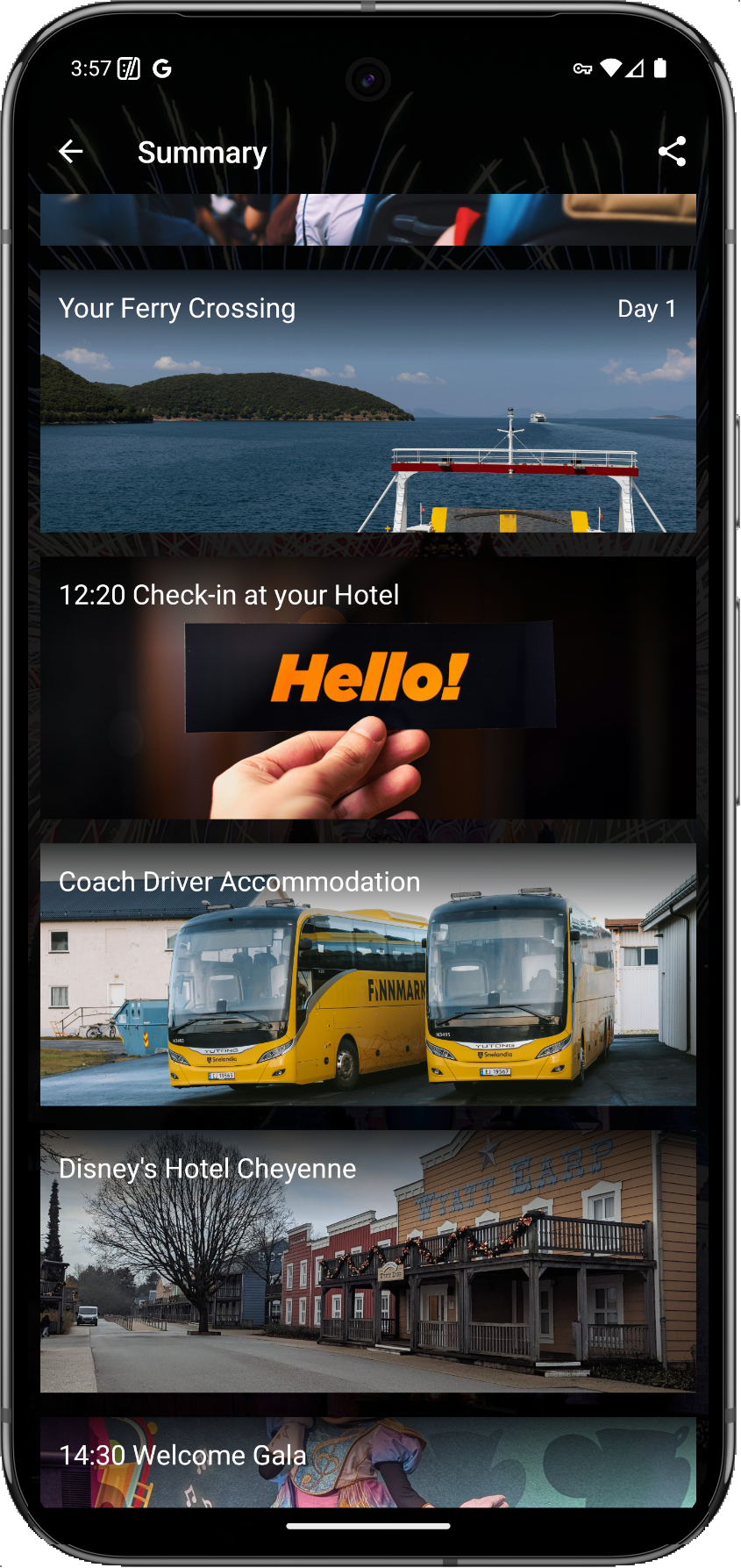
Screenshot of an Android app showing a summary itinerary: times for a 'ferry crossing', 'check in at your hotel', 'coach driver accommodation', 'disney's hotel cheyenne', and 'welcome gala', each with an attractive but generic photo.
I’m not remotely exaggerating. This app is literally text, images, and links to PDF files, delivered via the Web.

There only seem to be two things that this “app” does, that a webpage might not have, and they’re both anti-features:

  1. It reports tracking data associated with your Google Account back to the developers.
  2. It shows you advertisements (which they call “inspirations”) for other trips organised by the same agency.

Fuck. Everything. About. That.

A webpage would have been so much better. Unlike this app, a webpage can be…1

  • Copy-pastable
  • Printable
  • Saveable
  • Bookmarkable
  • Searchable
  • Usable on virtually any device
  • (Potentially) more-accessible

I’m annoyed enough… that I’m going to “fix” this app. Hold my beer.

Intercepting app traffic

It’s been a while since the last time I reverse-engineered an Android app from its network traffic, so I had to brush-up on the best way. Here’s what I ended up doing.

  1. Created a new virtual device in Android Studio’s Virtual Device Manager.
  2. Tested adb shell was working and used rootAVD to root it: ./rootAVD.sh system-images/android-33/google_apis_playstore/x86_64/ramdisk.img.2
  3. Performed a cold boot, ran Magisk, and tweaked its settings to automatically grant su access to any app that asked.3
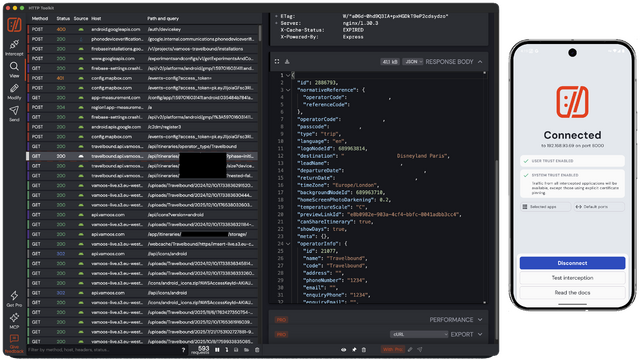
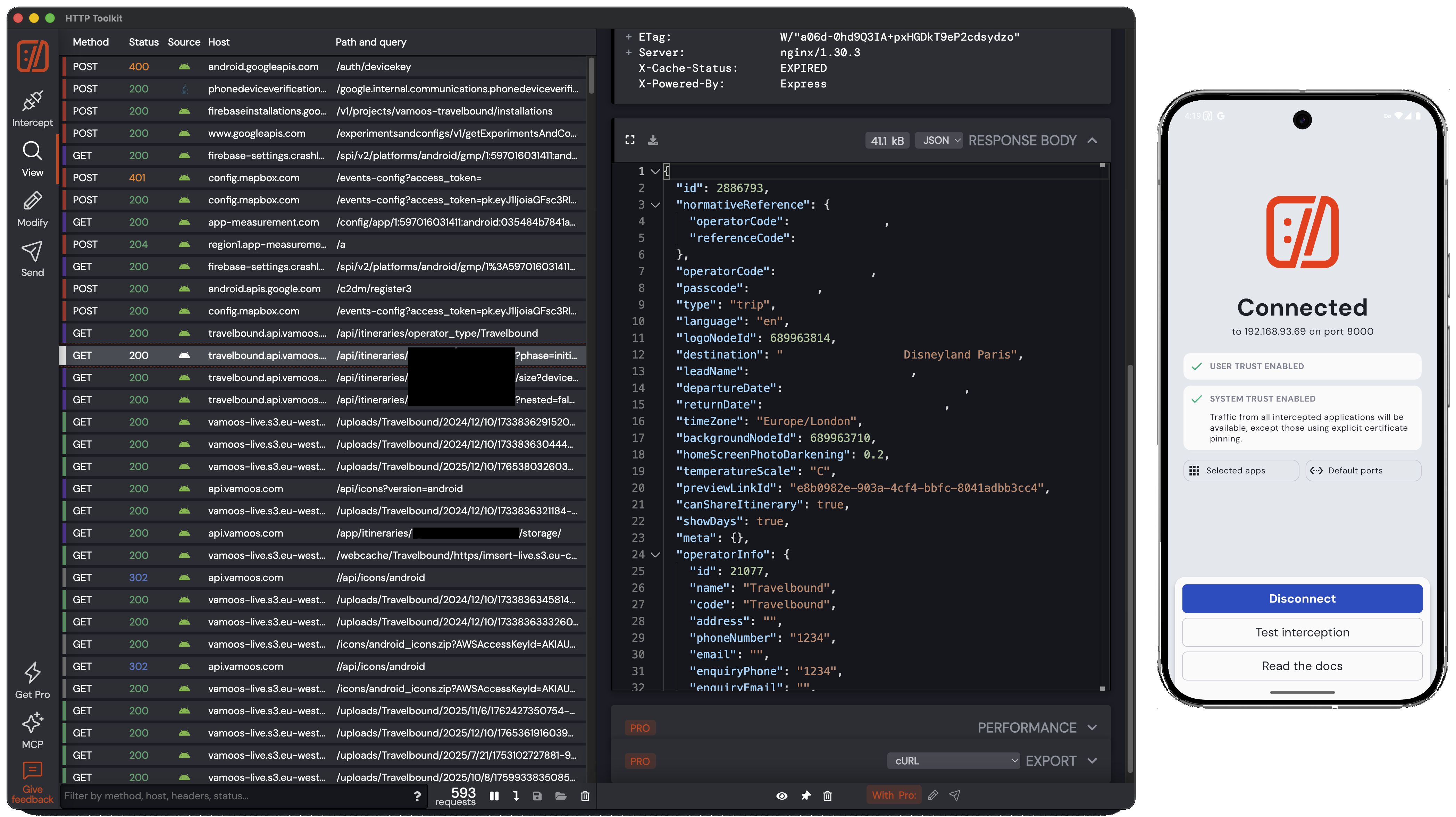
Screenshot showing the HTTP Toolkit application running on both MacOS and an emulated Android mobile, with User Trust and System Trust enabled.
All your traffic are belong to me. At this point, it’s just like running Wireshark or TCPdump.
  1. Ran HTTP Toolkit and told it to intercept AVD traffic. It installed a (fake) VPN provider, routing the phone’s traffic through the proxy.4
  2. Installed the Travelbound app from the Play Store.
  3. Configured HTTP Toolkit to proxy only the Travelbound app (more signal, less noise).

With only a couple of minutes experimentation I discovered that the app works by concatenating the username and password5 and using it in a URL of the form:

https://travelbound.api.vamoos.com/api/itineraries/{username}-{password}

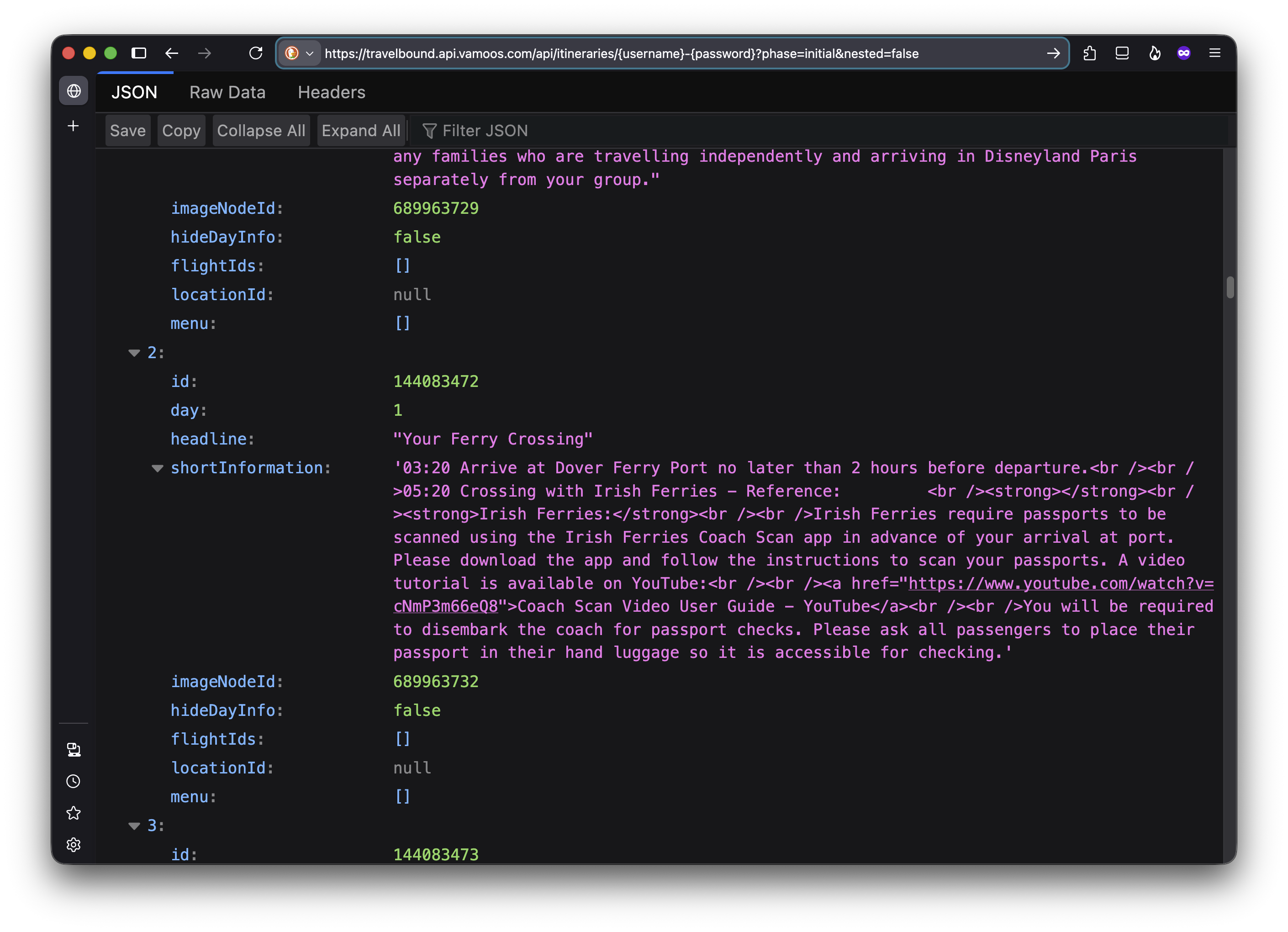
This returns a pile of JSON which, with a little interpretation, can be seen to represent all of the content the app “shows”. E.g., there’s:

  • an array containing each leg of the itinerary,
  • an array containing all of the “inspirations” advertisements to show you,
  • a cross-referenced array containing all of the files (images etc.) that are referenced by the other sections, etc.
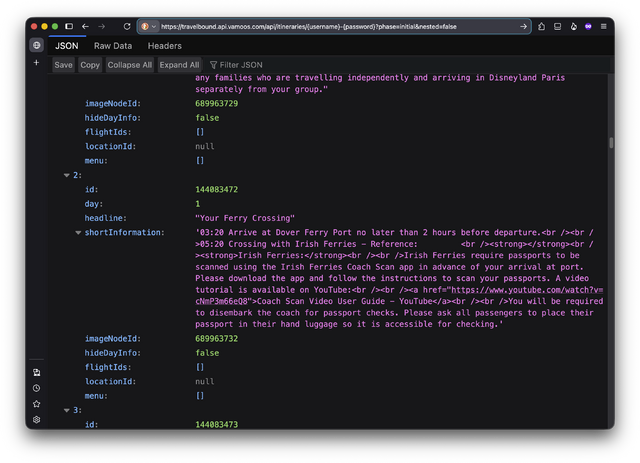
Firefox showing a JSON document, focussing on a section about 'Your Ferry Crossing' with some accompanying HTML.
They’re clearly producing HTML code anyway… so again, I ask: why isn’t this a webpage?

A little experimentation showed me that the S3 image URLs were being delivered with moderately-short expiration times, so the JSON needs re-fetching periodically even if the content hasn’t been changed.6

Turning it into something better

Now I had everything I needed to make something… better. I wrote a Ruby script that runs on a Cron schedule to pull the latest JSON and use it to build a HTML page.

I chose to have it completely skip over the “inspirations” (“overlayRows” in the data schema) and just list:

  1. the items from the itinerary and
  2. all of the files not referenced by the inspirations nor itinerary, (a lazy way to collate the PDF download links).

Then I hosted the page, protected by a password: the same one my tour group were given in the first place. I included the raw JSON it used in <details> elements so it can be checked if e.g. there are bits of the schema I didn’t see but that might appear later.
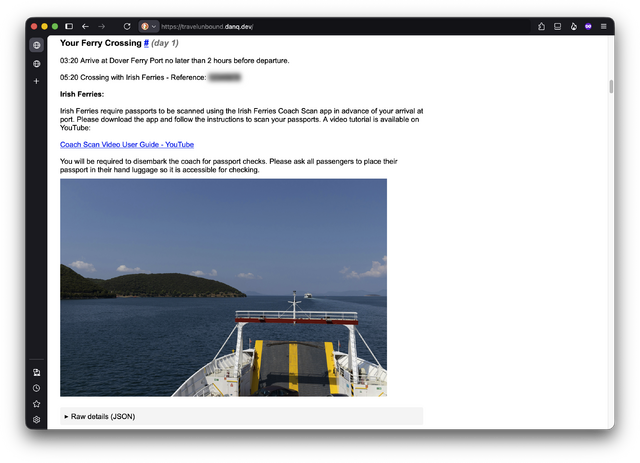
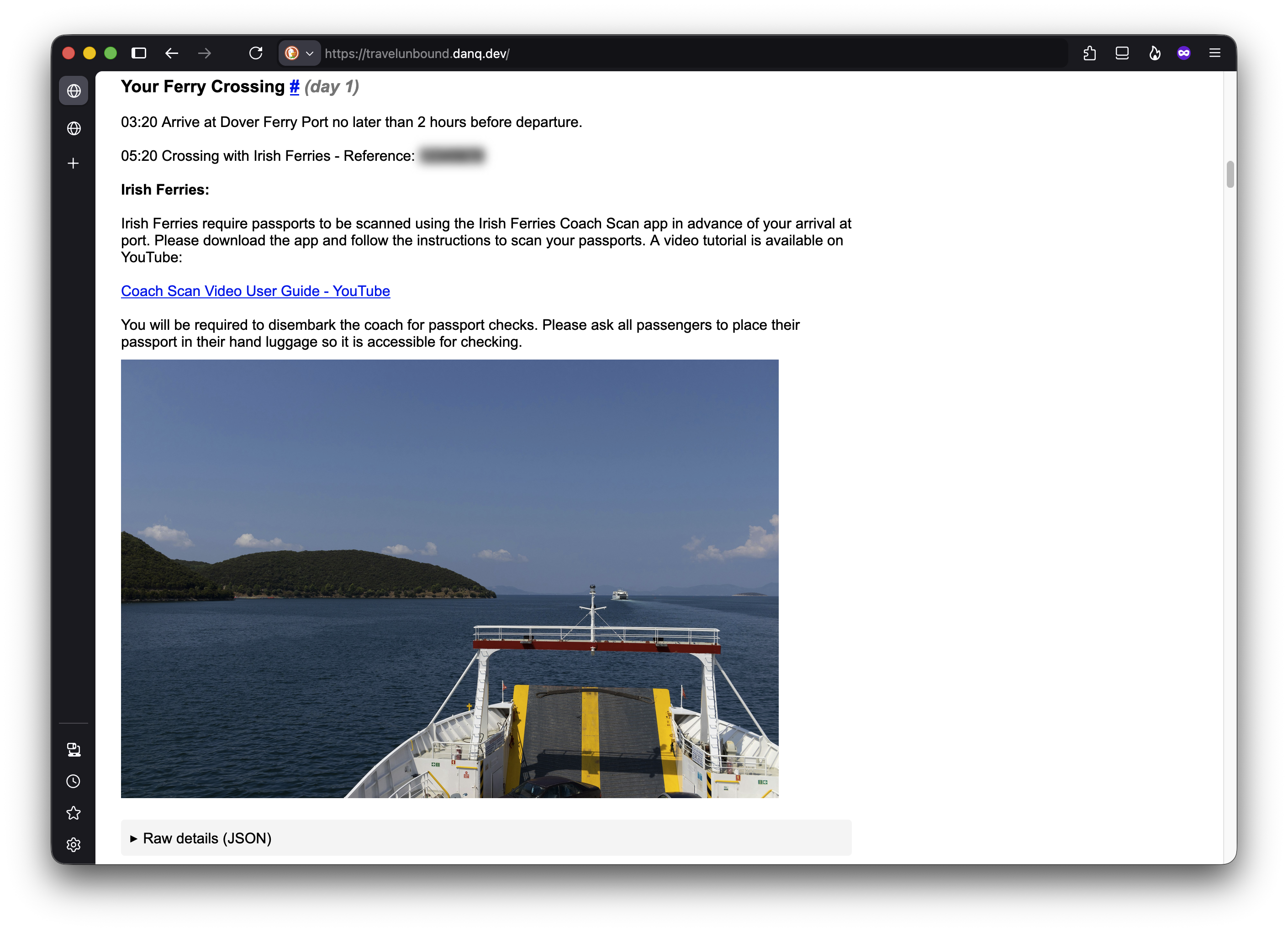
Screenshot of a simply-styled web page showing the same information about the ferry, along with a photo from its deck.
My web page isn’t as “pretty” as the app from which it “borrows” its information. But it’s a fraction of the size and gets all of the Web’s standard features for free.

Some people like an “app”, and that’s… fine, I guess. But some apps could have been a webpage. And especially where, like this one, the content they deliver is already written in HTML and delivered over HTTP… they should be a webpage, right?

I can’t understand how we got to this place with “app culture”! Software companies are happy to make their lives harder (and more expensive: deploying to the big app stores isn’t free!), in order to deliver HTML content to fewer people and with fewer features7 than if they just published directly to the Web in the first place!

There are (some) tasks for which an “app” is absolutely the right choice of medium. Travelbound is not one of them.

But at least I (and the rest of our group, whom I’ve shared it with) now get the choice about how we access this content. Either a 43MB app (ballooning to 124MB when it’s finished downloading extra content) with tracking and advertisements… or a 0.05MB web page (with an optional extra 35MB of images) that provides more features and works on more devices. I know which one I’ll be using!
× × × ×