
惯性聚合 高效追踪和阅读你感兴趣的博客、新闻、科技资讯
阅读原文 在惯性聚合中打开

推荐订阅源

大猫的无限游戏
大猫的无限游戏
K
Kaspersky official blog
Apple Machine Learning Research
B
Blog
aimingoo的专栏
aimingoo的专栏
M
MIT News - Artificial intelligence
小众软件
小众软件
云风的 BLOG
云风的 BLOG
腾讯CDC
CTFtime.org: upcoming CTF events
Hugging Face - Blog
Hugging Face - Blog
S
SegmentFault 最新的问题
Stack Overflow Blog
Stack Overflow Blog
量子位
S
Secure Thoughts
G
GRAHAM CLULEY
C
CXSECURITY Database RSS Feed - CXSecurity.com
人人都是产品经理
人人都是产品经理
雷峰网
雷峰网
T
Threat Research - Cisco Blogs
cs.CL updates on arXiv.org
Cisco Talos Blog
Cisco Talos Blog
G
Google Developers Blog
爱范儿
爱范儿
OSCHINA 社区最新新闻
OSCHINA 社区最新新闻
有赞技术团队
有赞技术团队
Threat Intelligence Blog | Flashpoint
Martin Fowler
Martin Fowler
The GitHub Blog
The GitHub Blog
Google DeepMind News
C
Cisco Blogs
D
Darknet – Hacking Tools, Hacker News & Cyber Security
博客园 - 聂微东
宝玉的分享
宝玉的分享
H
Hackread – Cybersecurity News, Data Breaches, AI and More
N
Netflix TechBlog - Medium
Forbes - Security
Forbes - Security
Engineering at Meta
Engineering at Meta
S
Security Affairs
Help Net Security
Help Net Security
博客园 - 三生石上(FineUI控件)
AWS News Blog
AWS News Blog
博客园 - 叶小钗
Recent Commits to openclaw:main
V2EX - 技术
V2EX - 技术
Hacker News: Ask HN
Hacker News: Ask HN
Project Zero
Project Zero
H
Heimdal Security Blog
W
WeLiveSecurity
C
Check Point Blog

CSS Wizardry

Front-End’s Missing Metric: The TBT Window Meet Your Users Where They Are with Obs.js Better Browser Caching with No-Vary-Search font-family Doesn’t Fall Back the Way You Think What Is CSS Containment and How Can I Use It? When All You Can Do Is All or Nothing, Do Nothing Obs.js: Context-Aware Web Performance for Everyone Low- and Mid-Tier Mobile for the Real World (2025) The Fastest Site in the Tour de France Making Sense of the Performance Extensibility API Why Do We Have a Cache-Control Request Header? HTML Is Not a Programming Language… Build for the Web, Build on the Web, Build with the Web Licensing Code on CSS Wizardry A Layered Approach to Speculation Rules Designing (and Evolving) a New Web Performance Score Core Web Vitals Colours The Ultimate Contract Templates for Tech Consultants: Protect Your Business and Get Paid Optimising for High Latency Environments Cache Grab: How Much Are You Leaving on the Table? blocking=render: Why would you do that?! Correctly Configure (Pre) Connections The Three Cs: 🤝 Concatenate, 🗜️ Compress, 🗳️ Cache What Is the Maximum max-age? How to Clear Cache and Cookies on a Customer’s Device The Ultimate Low-Quality Image Placeholder Technique Core Web Vitals for Search Engine Optimisation: What Do We Need to Know? The HTTP/1-liness of HTTP/2 In Defence of DOM­Content­Loaded Site-Speed Topography Remapped Why Not document.write()? Speeding Up Async Snippets Critical CSS? Not So Fast! Measure What You Impact, Not What You Influence Optimising Largest Contentful Paint Measuring Web Performance in Mobile Safari Site-Speed Topography Speed Up Google Fonts Real-World Effectiveness of Brotli Performance Budgets, Pragmatically Lazy Pre-Browsing with Prefetch Making Cloud.typography Fast(er) Time to First Byte: What It Is and How to Improve It Self-Host Your Static Assets Tips for Technical Interviews Cache-Control for Civilians ITCSS × Skillshare What If? CSS and Network Performance The Three Types of Performance Testing Getting to Know a Legacy Codebase Image Inconsistencies: How and When Browsers Download Images Identifying, Auditing, and Discussing Third Parties My Digital Music Setup Measuring the Hard-to-Measure Finding Dead CSS The Fallacies of Distributed Computing (Applied to Front-End Performance) Ten Years Old Relative Requirements Airplanes and Ashtrays Performance and Resilience: Stress-Testing Third Parties Refactoring Tunnels Little Things I Like to Do with Git Writing Tidy Code Configuring Git and Vim Base64 Encoding & Performance, Part 2: Gathering Data Base64 Encoding & Performance, Part 1: What’s Up with Base64? Code Smells in CSS Revisited Typography for Developers Moving CSS Wizardry onto HTTPS and HTTP/2 Ack for CSS Developers A New Year, a New Focus Preparing Vim for Apple’s Touch Bar Choosing the Correct Average CSS Shorthand Syntax Considered an Anti-Pattern CSS Wizardry Newsletter Nesting Your BEM? Improving Perceived Performance with Multiple Background Images Continue Normalising Your CSS Pure CSS Content Filter Pragmatic, Practical, and Progressive Theming with Custom Properties Refactoring CSS: The Three I’s Speaker’s Checklist: Before and After Your Talk Improving Your CSS with Parker The Importance of !important: Forcing Immutability in CSS Mixins Better for Performance Managing Typography on Large Apps White October Events Workshop Partnership BEMIT: Taking the BEM Naming Convention a Step Further Travelling Like You Want to, When You Have To Contextual Styling: UI Components, Nesting, and Implementation Detail Subtleties with Self-Chained Classes Cyclomatic Complexity: Logic in CSS Immutable CSS Can CSS Be Too Modular? More Transparent UI Code with Namespaces When to use @extend; when to use a mixin The Specificity Graph CSS Wizardry Ltd.: Year 1 in review CSS Guidelines 2.0.0
Bandwidth or Latency: When to Optimise for Which
Harry Roberts · 2019-01-31 · via CSS Wizardry

Written by on CSS Wizardry.

Table of Contents

Independent writing is brought to you via my wonderful Supporters.

  1. Use Large Request Rows
  2. The Time Column
  3. Important Considerations

When it comes to network performance, there are two main limiting factors that will slow you down: bandwidth and latency.

Bandwidth is defined as…

…the maximum rate of data transfer across a given path.

Generally speaking, increased bandwidth is only particularly useful when you’re transferring or downloading large files. If you’re streaming video, the difference between a 2Mb1 connection and a 20Mb connection will surely be appreciated. If you’re browsing the web—with most pages constructed of much smaller files—then the same change in bandwidth may not be felt quite as much.

Latency is defined as…

…how long it takes for a bit of data to travel across the network from one node or endpoint to another.

Where bandwidth deals with capacity, latency is more about speed of transfer2. As a web user—often transferring lots of smaller files—reductions in latency will almost always be a welcome improvement.

So, although it is widely accepted that, at least for regular web browsing, latency is the bigger bottleneck3, it still pays to be aware of whether it is latency or indeed bandwidth that is slowing down a particular file.

In this quick post, I want to share a little DevTools tip that I go through in my performance workshops: a simple way to quickly and roughly work out whether your assets would benefit most from an increase in bandwidth or a reduction in latency, which actually brings me onto my first point:

It’s something of a misnomer to use phrases like increase in bandwidth and reduction in latency. We don’t really have the ability to simply ‘increase bandwidth’—although that would be nice!—so what we’re really looking to do is reduce the amount of transfer. Similarly, there isn’t much we can do to really ‘reduce latency’, but we can avoid latency by perhaps moving our assets closer to the client (e.g. a CDN) or mitigating network overhead (e.g. with Resource Hints).

Use Large Request Rows

In order to make use of this little tip, we’re going to need to enable Large Request Rows (1) in Chrome’s Network panel. This will then double up the height of each entry in out waterfall chart, thus displaying a little more detail (2).
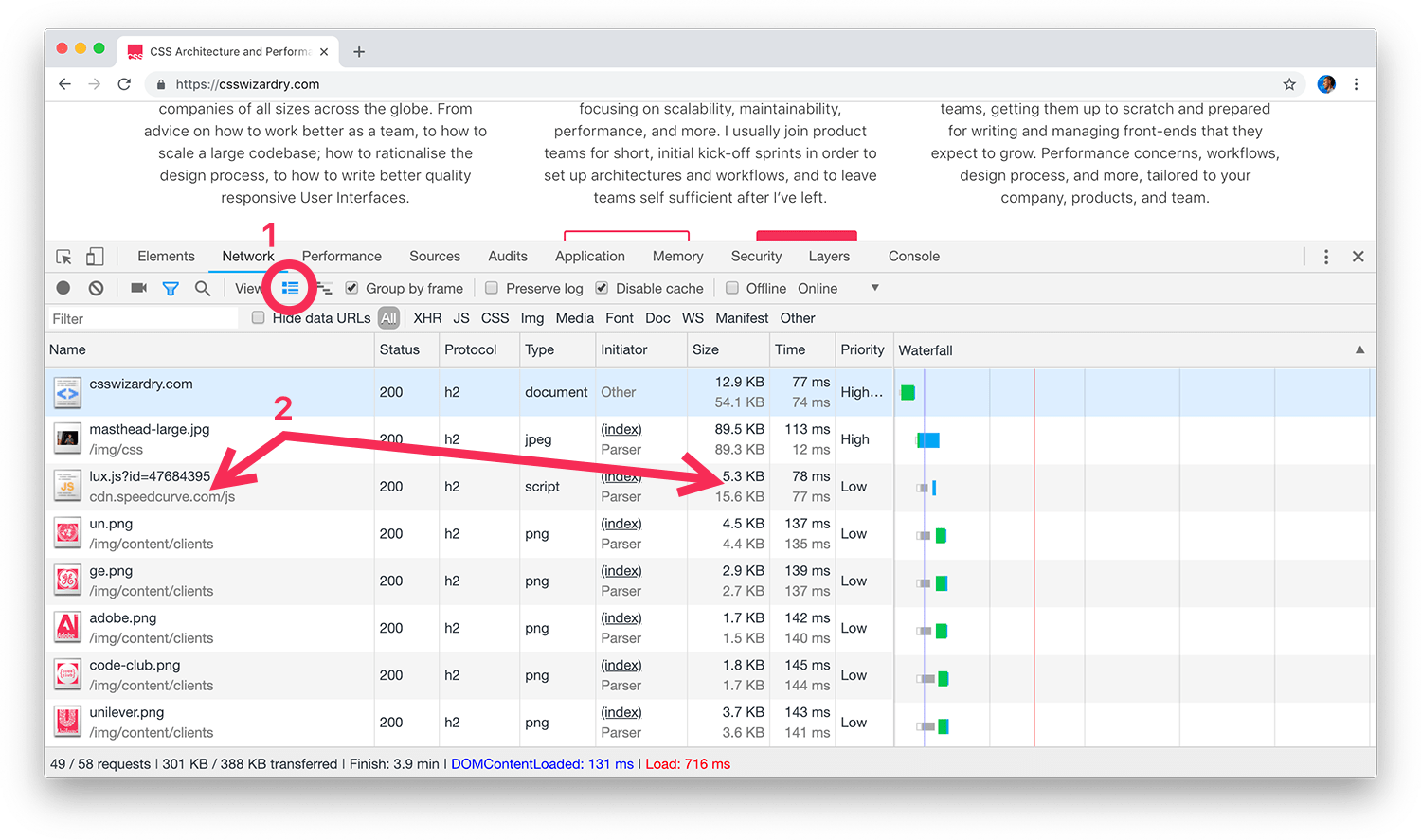
Screenshot showing a waterfall chart for CSS Wizardry’s homepage
View full size/quality (404KB)

Why this isn’t the default view, I will never know—there is so much useful extra information here!

  • In the Name column: As well as seeing the name of the resource, we now also see either its full file path or its domain (if applicable). This allows me to quickly and easily ascertain whether a resource is a first or third party.
  • In the Size column: We now get presented with two values. The top, darker number is the number of KB that were transferred over the wire; the lower, lighter number shows the number of KB that were persisted to disk. A large difference between these two numbers suggests that Gzip or Brotli was present, or a smaller difference might show the overhead of HTTP headers and cookies.
  • In the Time column: The top value is total time taken from dispatching the request to having downloaded the entire response. The second value is the amount of that time spent on network negotiation (resource scheduling, connection overhead, TTFB). This lower number is effectively your latency. This is the column we want to focus on for this article.

The Time Column

There are a lot of different phases involved in getting from the point of requesting a file until we’re able to begin downloading it. Once resources have been discovered, their outgoing requests may need to be scheduled, the browser might need to perform a DNS lookup to determine the resource’s origin’s IP address, we’ll then need to open up a TCP connection to that origin, hopefully we’re running over a secure connection that will incur some TLS negotiation, and then once we’re on the server we deal with Time to First Byte (TTFB)4, which includes time spent on the server and the time taken for the first byte of data to traverse the network and end up back on the machine.

That’s a lot of work, and with smaller files, it may be unsurprising to learn that negotiating all of that network overhead can often take longer than the content download itself.

N.B. This waterfall is merely an example for example’s sake—please don’t read too much into any of the actual numbers here. It’s for illustrative purposes only.

Let’s take another look at our screenshot above. Focus on the first entry, the HTML payload for csswizardry.com. In its Time cell you’ll see a total duration of 77ms, and a latency value of 74ms. Subtracting the bottom from the top value gives us 3ms. It took only 3ms to download this file, yet 74ms to negotiate the network.

Put another way, latency cost us 24.6× more than bandwidth for this resource. By far the biggest limiting factor here was latency.

Put another other way, reducing the size of this file is unlikely to make it arrive any sooner. This isn’t a file whose size we should look to optimise.

Look at the second entry, masthead-large.jpg. Taking its total value of 113ms and subtracting its latency of (a very miniscule!) 12ms, we’ll see that 101ms was spent downloading this file.

Put another way, bandwidth cost us 8.4× more than latency. This is a resource where a reduction in filesize would lead to quicker delivery.

Looking at the next entry, lux.js from SpeedCurve, we’ll see a total time of 78ms and a latency count of 77ms. Just one millisecond to download this file—amazing! Reducing its size is really going to make so little difference.

Finally, looking at the last five image requests, we see that all of their latency times sit around 140ms while their download times are at 2ms. If I wanted to speed up the delivery of these images, I am unlikely to get any real gains through optimising them further.

Important Considerations

The waterfall I used as a demo was exactly that—a demo. It’s vital that you run your own tests several times and across a range of different network conditions to assess how key resources respond.

A good rule of thumb to remember is that, for regular web browsing, improvements in latency would be more beneficial than improvements in bandwidth, and that improvements in bandwidth are noticed more when dealing with larger files.


Frequently Asked Questions

What is the difference between latency and bandwidth?

Bandwidth is the amount of data that can be transferred over a connection, while latency is how long it takes data to travel from one point to another. Bandwidth is about capacity; latency is about delay.

Which matters more for web performance: latency or bandwidth?

For most day-to-day web browsing, latency is often the bigger bottleneck because pages are made up of many relatively small requests, each of which pays network overhead before download even begins.

When should I optimise for bandwidth?

Optimising for bandwidth matters most when you are transferring larger files, such as images, video, or other heavy assets where download time dominates overall request time.

When should I optimise for latency?

Optimising for latency matters most when requests are small and network negotiation takes longer than the actual download, which is very common on the web.

How can I tell whether a request is bandwidth-bound or latency-bound?

A quick way is to compare total request time with the network-overhead time shown in Chrome DevTools’ large request rows. If most of the time is spent negotiating the request, latency is the bottleneck; if most of it is spent downloading bytes, bandwidth is the bottleneck.