
惯性聚合 高效追踪和阅读你感兴趣的博客、新闻、科技资讯
阅读原文 在惯性聚合中打开

推荐订阅源

WordPress大学
WordPress大学
Security Latest
Security Latest
C
Cisco Blogs
P
Palo Alto Networks Blog
Know Your Adversary
Know Your Adversary
Project Zero
Project Zero
C
Cyber Attacks, Cyber Crime and Cyber Security
NISL@THU
NISL@THU
Exploit-DB.com RSS Feed
S
Secure Thoughts
P
Privacy International News Feed
V
Vulnerabilities – Threatpost
D
Docker
Google Online Security Blog
K
KPMG report finds enterprise disconnect between AI and its ROI | CIO
Recent Announcements
T
The Exploit Database - CXSecurity.com
G
Google Developers Blog
Schneier on Security
小众软件
小众软件
爱范儿
爱范儿
GbyAI
GbyAI
J
Java Code Geeks
T
Tailwind CSS Blog
Cisco Talos Blog
Cisco Talos Blog
The Hacker News
The Hacker News
D
DataBreaches.Net
Blog — PlanetScale
Blog — PlanetScale
TaoSecurity Blog
TaoSecurity Blog
MyScale Blog
MyScale Blog
B
Blog RSS Feed
Cyberwarzone
Cyberwarzone
有赞技术团队
有赞技术团队
Martin Fowler
Martin Fowler
C
CXSECURITY Database RSS Feed - CXSecurity.com
S
Securelist
L
Lohrmann on Cybersecurity
cs.CL updates on arXiv.org
Y
Y Combinator Blog
S
Schneier on Security
Latest news
Latest news
Apple Machine Learning Research
博客园 - 叶小钗
F
Fortinet All Blogs
M
MIT News - Artificial intelligence
PCI Perspectives
PCI Perspectives
V
V2EX
V2EX - 技术
V2EX - 技术
O
OpenAI News
W
WeLiveSecurity

CSS Wizardry

Front-End’s Missing Metric: The TBT Window Meet Your Users Where They Are with Obs.js Better Browser Caching with No-Vary-Search font-family Doesn’t Fall Back the Way You Think What Is CSS Containment and How Can I Use It? When All You Can Do Is All or Nothing, Do Nothing Obs.js: Context-Aware Web Performance for Everyone Low- and Mid-Tier Mobile for the Real World (2025) The Fastest Site in the Tour de France Making Sense of the Performance Extensibility API Why Do We Have a Cache-Control Request Header? HTML Is Not a Programming Language… Build for the Web, Build on the Web, Build with the Web Licensing Code on CSS Wizardry A Layered Approach to Speculation Rules Designing (and Evolving) a New Web Performance Score Core Web Vitals Colours The Ultimate Contract Templates for Tech Consultants: Protect Your Business and Get Paid Optimising for High Latency Environments Cache Grab: How Much Are You Leaving on the Table? blocking=render: Why would you do that?! Correctly Configure (Pre) Connections The Three Cs: 🤝 Concatenate, 🗜️ Compress, 🗳️ Cache What Is the Maximum max-age? How to Clear Cache and Cookies on a Customer’s Device The Ultimate Low-Quality Image Placeholder Technique Core Web Vitals for Search Engine Optimisation: What Do We Need to Know? The HTTP/1-liness of HTTP/2 In Defence of DOM­Content­Loaded Site-Speed Topography Remapped Why Not document.write()? Speeding Up Async Snippets Critical CSS? Not So Fast! Measure What You Impact, Not What You Influence Optimising Largest Contentful Paint Measuring Web Performance in Mobile Safari Site-Speed Topography Speed Up Google Fonts Real-World Effectiveness of Brotli Lazy Pre-Browsing with Prefetch Making Cloud.typography Fast(er) Time to First Byte: What It Is and How to Improve It Self-Host Your Static Assets Tips for Technical Interviews Cache-Control for Civilians Bandwidth or Latency: When to Optimise for Which ITCSS × Skillshare What If? CSS and Network Performance The Three Types of Performance Testing Getting to Know a Legacy Codebase Image Inconsistencies: How and When Browsers Download Images Identifying, Auditing, and Discussing Third Parties My Digital Music Setup Measuring the Hard-to-Measure Finding Dead CSS The Fallacies of Distributed Computing (Applied to Front-End Performance) Ten Years Old Relative Requirements Airplanes and Ashtrays Performance and Resilience: Stress-Testing Third Parties Refactoring Tunnels Little Things I Like to Do with Git Writing Tidy Code Configuring Git and Vim Base64 Encoding & Performance, Part 2: Gathering Data Base64 Encoding & Performance, Part 1: What’s Up with Base64? Code Smells in CSS Revisited Typography for Developers Moving CSS Wizardry onto HTTPS and HTTP/2 Ack for CSS Developers A New Year, a New Focus Preparing Vim for Apple’s Touch Bar Choosing the Correct Average CSS Shorthand Syntax Considered an Anti-Pattern CSS Wizardry Newsletter Nesting Your BEM? Improving Perceived Performance with Multiple Background Images Continue Normalising Your CSS Pure CSS Content Filter Pragmatic, Practical, and Progressive Theming with Custom Properties Refactoring CSS: The Three I’s Speaker’s Checklist: Before and After Your Talk Improving Your CSS with Parker The Importance of !important: Forcing Immutability in CSS Mixins Better for Performance Managing Typography on Large Apps White October Events Workshop Partnership BEMIT: Taking the BEM Naming Convention a Step Further Travelling Like You Want to, When You Have To Contextual Styling: UI Components, Nesting, and Implementation Detail Subtleties with Self-Chained Classes Cyclomatic Complexity: Logic in CSS Immutable CSS Can CSS Be Too Modular? More Transparent UI Code with Namespaces When to use @extend; when to use a mixin The Specificity Graph CSS Wizardry Ltd.: Year 1 in review CSS Guidelines 2.0.0
Performance Budgets, Pragmatically
Harry Roberts · 2020-01-09 · via CSS Wizardry

Written by on CSS Wizardry.

Table of Contents

Independent writing is brought to you via my wonderful Supporters.

  1. Targets vs. Safeguards
  2. The Last Two Weeks
  3. Example Performance Budgets
    1. Under Budget
    2. On Budget
    3. Over Budget
  4. Your Turn

One of the key tools that performance engineers have at their disposal is the Performance Budget: it helps us—or, more importantly, our clients—ensure that any performance-focused work is monitored and maintained after we’ve gone.

By establishing an acceptable threshold, be that based on RUM data, bundle analysis, image weight, milestone timings, or any other suitable metric, we can be sure that new or unrelated bodies of work do not have a detrimental impact on the performance of our site.

The difficulty, however, lies in actually defining those thresholds. This post is for anyone who has struggled with the question, But what should our budgets actually be?!

Targets vs. Safeguards

When faced with the task of setting a brand new budget, it can feel daunting—almost paralysing—trying to find a value that is both attainable but effective. Is it too ambitious? Is it not ambitious enough? Is it going to be really difficult to hit? Or do we risk making it so easy to achieve that it’s almost pointless? How do we know? How long will it take to find out?

Here’s the thing: most organisations aren’t ready for challenges, they’re in need of safety nets. Performance budgets should not be things to work toward, they should be things that stop us slipping past a certain point. They shouldn’t be aspirational, they should be preventative.

Time and again I hear clients discussing their performance budgets in terms of goals: We’re aiming toward a budget of 250KB uncompressed JavaScript; we hope to be interactive in 2.75s. While it’s absolutely vital that these goals exist and are actively worked toward, this is not part of your budgeting. Your budgeting is actually far, far simpler:

Our budget for [metric] is never-worse-than-it-is-right-now.

The Last Two Weeks

Whatever monitoring you use (I adore SpeedCurve and Treo), my suggestion for setting a budget for any trackable metric is to take the worst data point in the past two weeks and use that as your limit. Load times were 7.2s? You’re not allowed to get any slower than that. JS size was 478KB? You can’t introduce any more without refactoring what’s already there. 68 third party requests? You can’t add any more.

Then, every two weeks, you revisit your monitoring and one of three things can happen:

  1. Your new worst-point is better than the last one: This is the best outcome! Let’s say you went from a 7.2s load time and now your worst value is 6.8s—well done! Now your budget gets updated to 6.8s and your job is to not regress beyond that.
  2. Your new worst-point is the same as the last one: This is still good news—we haven’t regressed! But we haven’t improved, either. In this scenario, we don’t need to do anything. Instead, we just leave the budget as it was and hope we can continue on the same path.
  3. Your new worst-point is worse than the last one: Uh oh. This is bad news. Things have slipped. In this scenario, we do not alter the budget. We can’t increase budgets unless there is a very valid and agreed reason to do so. Instead, we double down on solving the problem and getting back on track.

By constantly revisiting and redefining budgets in two-weekly snapshots, we’re able to make slow, steady, and incremental improvements. But the key thing to remember is that we can’t ever increase a performance budget; we can’t change the test just to make it passable. We can maintain or decrease one, but we can’t increase it, because that would completely undermine them.

Example Performance Budgets

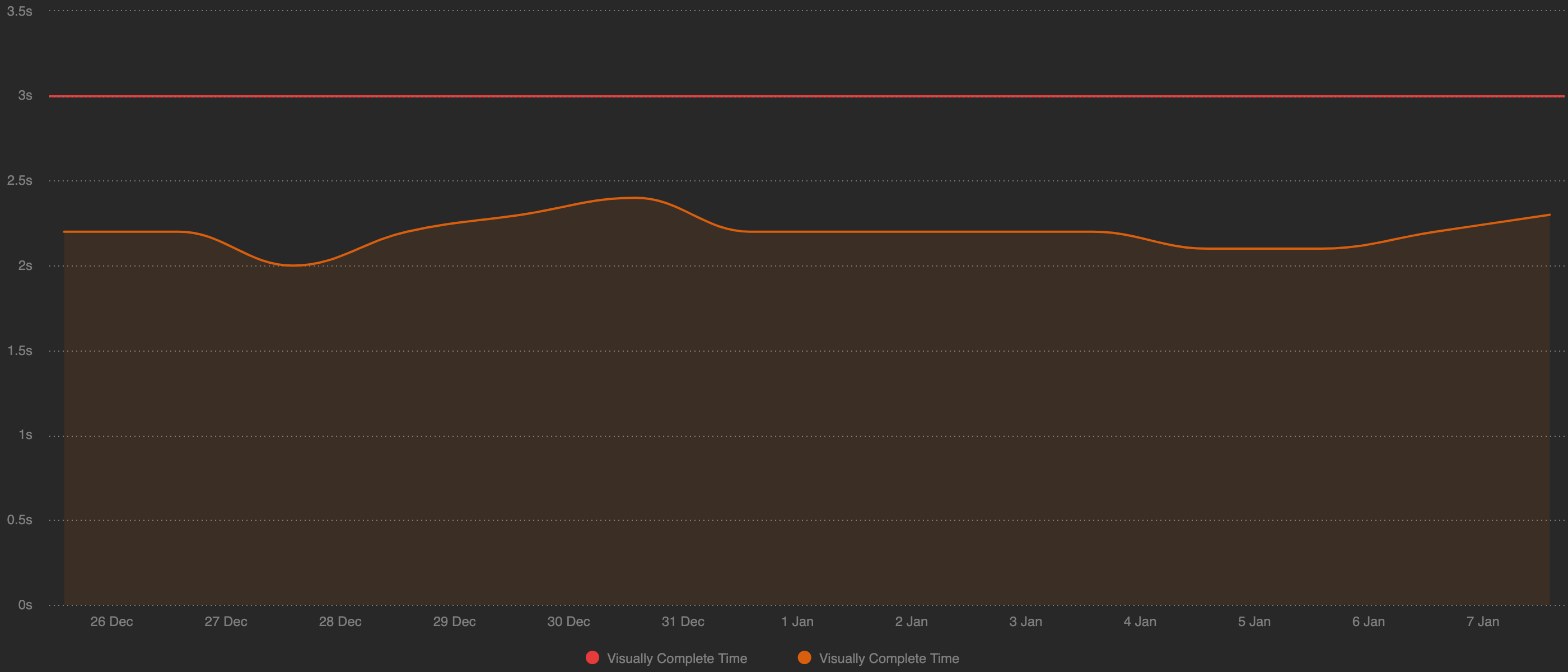
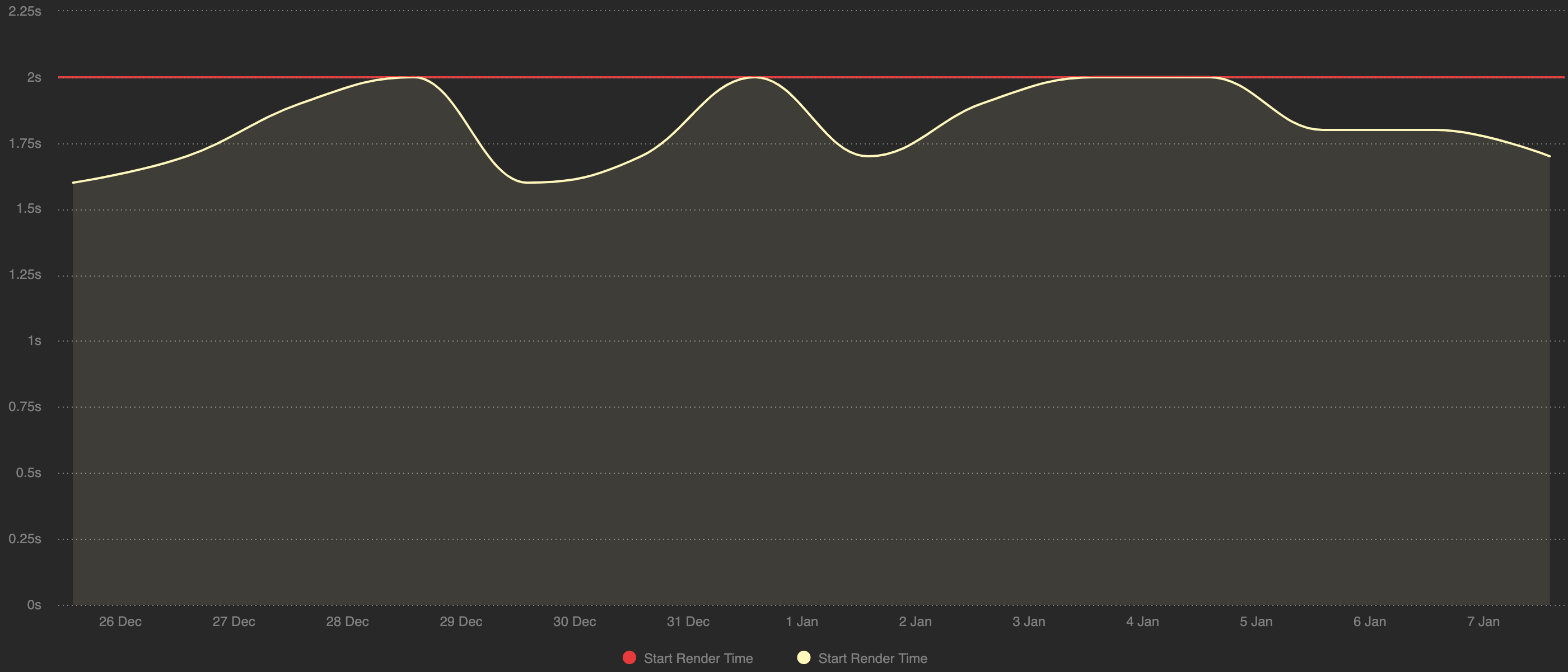
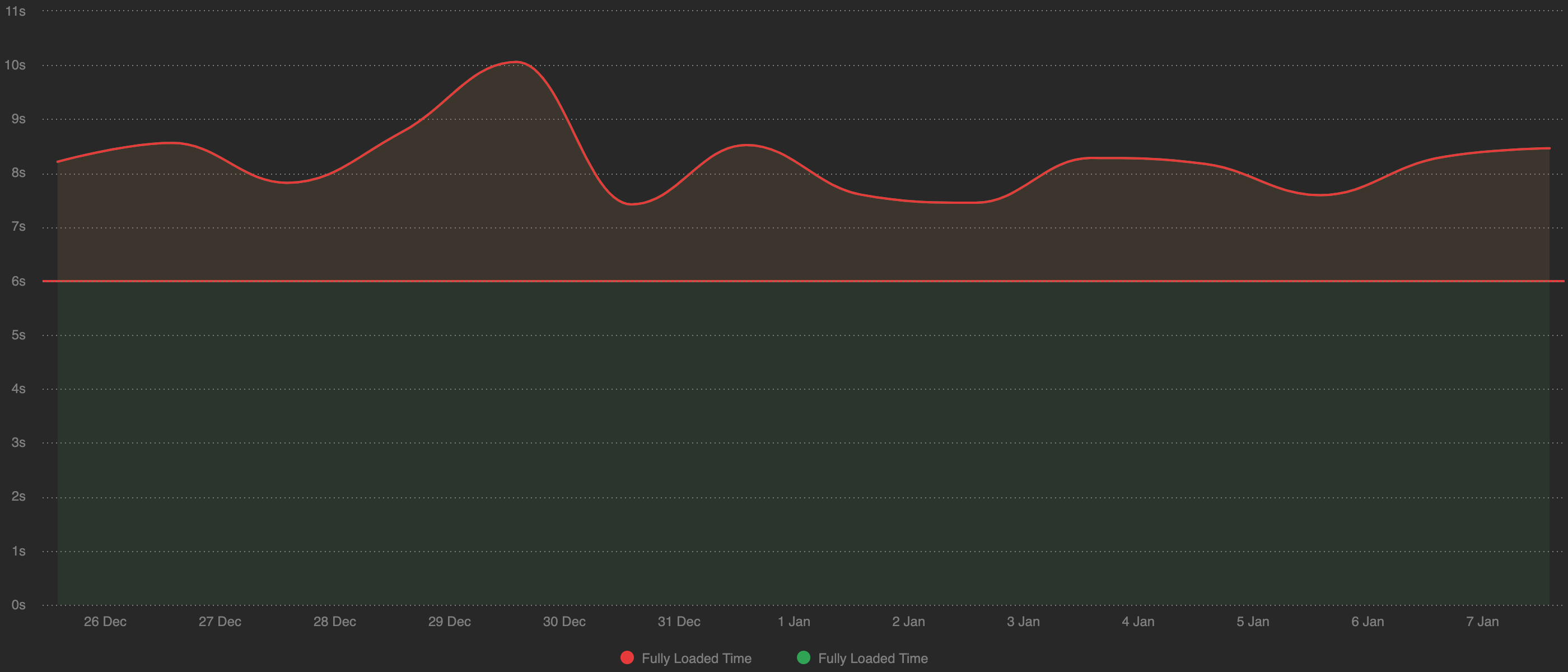
The following SpeedCurve charts respectively show the Visually Complete, Start Render, and Fully Loaded budgets for CSS Wizardry over a 3G Galaxy S4 from the UK.
Under Budget

Well under budget for Visually Complete every single day. (View full size.)

I’ve set a Visually Complete budget of 3s, but I’m doing far better than that every single day across the last fortnight. The slowest Start Render in that period was 2.4s, so I need to update my budget accordingly and maintain the new maximum for the next two weeks before revisiting once more.
On Budget

Hitting the Start Render threshold four days out of 14. (View full size.)

With an allotted budget of 2s for Start Render, I find that on most days I am actually quite nicely under budget, which is great news. That said, on four occasions I am just nudging the line. This means that I need to be mindful over the next two weeks, but do not need to update anything. This budget is probably quite sensibly set as it’s clearly attainable, but is on the verge of needing some proactive input to keep within the bounds.
Over Budget

Completely overshooting the Fully Loaded budget every day. (View full size.)

Uh oh. I’m completely overshooting my Fully Loaded time every single day, and sometimes by up to four seconds. I can’t reset the budget (unless it’s decided that for some reason 6s was completely incorrect in the first place) but I do have some work to do. Clearly I have decided that load times are important enough to be monitored, so I need to roll up my sleeves and get to work fixing things.

Your Turn

Setting performance budgets doesn’t need to be complex or confusing, you simply need some existing data, some monitoring, and to remember that budgets and targets are two different things. Don’t make life difficult by treating performance budgets as aspirations.