
惯性聚合 高效追踪和阅读你感兴趣的博客、新闻、科技资讯
阅读原文 在惯性聚合中打开

推荐订阅源

WordPress大学
WordPress大学
Security Latest
Security Latest
C
Cisco Blogs
P
Palo Alto Networks Blog
Know Your Adversary
Know Your Adversary
Project Zero
Project Zero
C
Cyber Attacks, Cyber Crime and Cyber Security
NISL@THU
NISL@THU
Exploit-DB.com RSS Feed
S
Secure Thoughts
P
Privacy International News Feed
V
Vulnerabilities – Threatpost
D
Docker
Google Online Security Blog
K
KPMG report finds enterprise disconnect between AI and its ROI | CIO
Recent Announcements
T
The Exploit Database - CXSecurity.com
G
Google Developers Blog
Schneier on Security
小众软件
小众软件
爱范儿
爱范儿
GbyAI
GbyAI
J
Java Code Geeks
T
Tailwind CSS Blog
Cisco Talos Blog
Cisco Talos Blog
The Hacker News
The Hacker News
D
DataBreaches.Net
Blog — PlanetScale
Blog — PlanetScale
TaoSecurity Blog
TaoSecurity Blog
MyScale Blog
MyScale Blog
B
Blog RSS Feed
Cyberwarzone
Cyberwarzone
有赞技术团队
有赞技术团队
Martin Fowler
Martin Fowler
C
CXSECURITY Database RSS Feed - CXSecurity.com
S
Securelist
L
Lohrmann on Cybersecurity
cs.CL updates on arXiv.org
Y
Y Combinator Blog
S
Schneier on Security
Latest news
Latest news
Apple Machine Learning Research
博客园 - 叶小钗
F
Fortinet All Blogs
M
MIT News - Artificial intelligence
PCI Perspectives
PCI Perspectives
V
V2EX
V2EX - 技术
V2EX - 技术
O
OpenAI News
W
WeLiveSecurity

Bryan Robinson's Blog

Does our technology still work for us? Product pricing, dev bad habits, and the role of the pit of success Astro Server Island for latest Bluesky post (heavily cached!) Type-safe environment variables in Astro 5.0 New Website, but really is it? Netlify Durable Cache: Caching for a third-party world Introducing the Hygraph Astro Content Loader Integrating Astro.js Starlight Documentation into a Next.js Project Using Proxies Jamstack is meaningless 😱 Book Release: Eleventy by Example – Learn 11ty with 5 in-depth projects 11ty Second 11ty: Creating Template Filters 11ty Second 11ty: Global Data files (JS and JSON) 11ty second 11ty: The Render Plugin Part 1 Help needed: Netlify Frontend environment variables with Astro.js Quick experiment with the Slinkity 11ty plugin Creating a dynamic color converter with 11ty Serverless Using 11ty JavaScript Data files to mix Markdown and CMS content into one collection How to show your template code in 11ty blog posts New City, New Job, New Content Using Nunjucks Climbing the 11ty Performance leaderboard with Cloudinary, critical CSS and more Three JAMstack movements to watch in 2020 Create a Codepen promo watermark with no additional HTML, CSS or JS 3 underused CSS features to learn for 2020 Use CSS Subgrid to layout full-width content stripes in an article template Adapt client-side JavaScript for use in 11ty (Eleventy) data files CSS Gap creates a bright future for margins in Flex as well as Grid Create your first CSS Custom Properties (Variables) Use CSS Grid to create a self-centering full-width element Creating an 11ty Plugin - SVG Embed Tool Now offering design and code reviews at PeerReviews.dev Routing contact-form emails to different addresses with Netlify, Zapier and SendGrid Create an Eleventy (11ty) theme based on a free HTML template Client work and the JAMstack Grid vs. Flex: A Tale of a "Simple" Promo Space Using Eleventy The Tech Barrier to Entry What Can We Learn from CERN Practical CSS Grid - Launching My First Course Build Trust on the Web incorporating User Worries with your User Stories 2019 The Year of Markup-First Development Refactoring CSS into a Sass mixin Starting a new journey with Code Contemporary Dynamic Static Sites with Netlify and iOS Shortcuts Top 3 uses for the ::before and ::after CSS pseudo elements How To: Use CSS Grid to Mix and Match Design Patterns Use CSS ::before and ::after for simple, spicy image overlays Modern CSS: Four Things Every Developer and Designer Should Know About CSS 3 Strategies for Getting Started with CSS Grid CSS Tip: Use rotate() and skew() together to introduce some clean punk rock to your CSS The 5 Stages of Grid Love How To: A CSS-Only Mobile Off Canvas Navigation How To: Use CSS Grid Layout to Make a Simple, Fluid Card Grid Make a More Flexible Cover Screen with CSS Grid Can CSS Grid open up interesting CMS Layout options? Firefox 52 to Introduce New Box-Alignment Values Falling Forward — Rethinking Progressive Enhancement, Graceful Degradation and Developer Morality Start Exploring the Magic of CSS Grid Layout I Converted My Blog to CSS Grid Layout and Regret Nothing Feature Queries are on the Rise CSS Shapes — Let the Text Flow Around You Flexbox -- Let Memorializing Prince and Print vs. The Web I went to Italy and noticed UX fails How to Get Designers to Contribute in Open Source The True Gift of Your Former Code
Let
2019-02-07 · via Bryan Robinson's Blog

In the days before the web was mainstream, it was a place of creation. First for education, then for every random idea that any creator had!

As the web transitioned from a network of educational institutions to the consumer force it is today, the early adopters were technologists… AKA geeks!
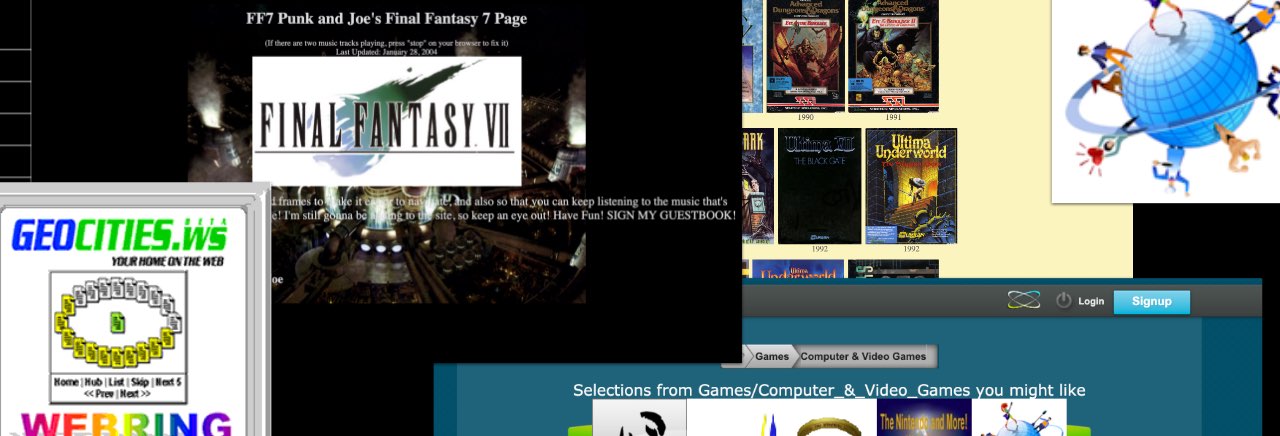
Promo image of various Fan Sites

A hallmark of geek culture is fandom — a deep knowledge of whatever topic interests them. This could be about a book, TV show, movie or band. With this passion comes a desire to share it with the world. Before the internet, there was no clear path. After the web started gaining traction, it was the biggest and easiest megaphone you could want.

It wasn’t always easy to be found, though. There was no search algorithm. Google was not ubiquitous with search. To be found, you needed to be listed on a site that aggregated other sites about your topic.

{% include ad-space.html %}

Enter the Webring

A fairly common way for this to happen was the concept of a “Webring.” A webring was a circular collection of sites around a similar topic. Each would display a badge of membership. This badge would allow for a user to jump to the next or previous site or find a random site in the ring.

Some of these sites are still around. Others perished when Geocities, Tripod and other free(ish) hosts went more commercial.

Back then, if there was something you wanted to publish, you could do it with a little knowledge and a little (or no) money. Since you wrote the code, you could take it with you.

As the commercial viability of the web grew, we saw more and more users become consumers and not creators. Many consumers see websites as black boxes full of magic that they could never understand. Because of this, they would never think to try to create something.

This is a shame. We lost a little piece of the magic of the web when this culture came about.

Not everything has to (or should) be profitable

As we were exploring the new magic of the internet, we often didn’t wonder if our fun side projects would make money. Most of us knew they’d do absolutely nothing. Why make them, then? The act of creation itself is fun!

I wish I still had copies of what I made back then. They were truly horrific, but I had such a good time building them! So, reason number one to build a fan site? It’s fun!

Reason number 2 to build a fan site: sharing something you love with the world is worthwhile. Maybe you’re Orange is the New Black’s biggest fan? Build a site dedicated to it! Did you find all the Koroks in the latest Legend of Zelda? Write about it! By sharing what you love, you become a part of something bigger than yourself. You’re taking part in the conversation online. You’re a part of a new community.

Finally, reason number 3: You’ll learn something. Part of the reason I wrote this post is having watched Steve Gardner’s JAMstackConf talk “Make More Pointless Things.” In the talk, he shows off an a lot of “pointless” things he’s made. All of these things were building blocks for doing bigger and better things. If you’re exploring and not worried about the final “product,” you can afford to do things wrong or weird. You can build for a small use case. You can use new cool technology. All of which will make you better at other things you are doing.

That being said, I have a challenge for all the web professionals out there!

The Fan Site Challenge!

Let’s resurrect the idea of the Fan Site and webring! In the next 2 months, I want you to do one of three things (or all three!).

1. Create a Fan Site.

It doesn’t have to be big or fancy. It just needs to showcase your love of something. Maybe your favorite T.V. show or movie? Maybe your favorite book or comic? It doesn’t matter. Make it something you love and let that be enough.

2. Help someone create a Fan Site

As I mentioned above, the web has become a place of magic to many users. Let’s try to fix that.

Find a friend who is NOT a developer. Help them create a Fan Site.

This can (and probably SHOULD) be as simple as creating and HTML page with some minimal CSS. Let’s not get carried away. Let them experience the joy of writing a little bit in a text editor and seeing it magically become a webpage.

3. Create a webring

Whether you create a webring for a topic of Fan Sites or a webring for your friends’ sites, go collect a list of sites and link them together.

I’ve created a simple lambda function repository if you don’t have a starting point. I’ll write up a blog post on how it all works, but you can find the code here.

If you do one of these three things, I’d love for you to go add your site, your friends’ sites or your webring to that same webring repository I just mentioned. 

Together, we can make the web a place of fun and experimentation again.