
惯性聚合 高效追踪和阅读你感兴趣的博客、新闻、科技资讯
阅读原文 在惯性聚合中打开

推荐订阅源

T
Threatpost
博客园 - 叶小钗
T
The Blog of Author Tim Ferriss
Recent Announcements
D
DataBreaches.Net
The Cloudflare Blog
阮一峰的网络日志
阮一峰的网络日志
罗磊的独立博客
奇客Solidot–传递最新科技情报
奇客Solidot–传递最新科技情报
N
Netflix TechBlog - Medium
Microsoft Azure Blog
Microsoft Security Blog
B
Blog
U
Unit 42
有赞技术团队
有赞技术团队
博客园 - 聂微东
GbyAI
GbyAI
宝玉的分享
宝玉的分享
F
Full Disclosure
freeCodeCamp Programming Tutorials: Python, JavaScript, Git & More
MyScale Blog
MyScale Blog
Jina AI
Jina AI
Martin Fowler
Martin Fowler
IT之家
IT之家
酷 壳 – CoolShell
酷 壳 – CoolShell
D
Docker
P
Proofpoint News Feed
A
About on SuperTechFans
I
InfoQ
博客园 - 【当耐特】
C
Check Point Blog
Threat Intelligence Blog | Flashpoint
P
Privacy & Cybersecurity Law Blog
T
Threat Research - Cisco Blogs
Y
Y Combinator Blog
Project Zero
Project Zero
WordPress大学
WordPress大学
小众软件
小众软件
AWS News Blog
AWS News Blog
博客园 - 司徒正美
T
The Exploit Database - CXSecurity.com
L
LINUX DO - 热门话题
I
Intezer
Engineering at Meta
Engineering at Meta
C
CXSECURITY Database RSS Feed - CXSecurity.com
J
Java Code Geeks
T
Tenable Blog
Cyber Security Advisories - MS-ISAC
Last Week in AI
Last Week in AI
C
CERT Recently Published Vulnerability Notes

CodePen

433: CodePen 2.0 is Backward Compatible with Any Classic Pen or Project 432: Trends of 2026 (So Far) 431: Versions are Deeply Integrated into CodePen Chris’ Corner: Layers of Layers 430: The Wild World of Keyboard Shortcuts in Web Apps Chris’ Corner: Makin’ Stuff 429: Why CodePen Rebuilt Its Realtime Service Chris’ Corner: The Edge, Man 428: Improving The Entire Billing System (is Very Worth It) Chris’ Corner: Design Chris’ Corner: A11Y 427: Next.js and The Journey of SSR 426: Browserslist in CodePen 2.0 Chris’ Corner: Finding Type Chris’ Corner: View Transitions 425: Help Your Users Help You with Debug Logs Chris’ Corner: Check It B4 U Wreck It Chris’ Corner: Import Maps 424: File List Optimization Chris’ Corner: ZIP first? 423: 2.0 Templates Chris’ Corner: URLs 422: Supporting Packages Chris’ Corner: Share What You Do 421: View Control of the 2.0 Editor Chris’ Corner: Design Chris’ Corner: Even Grids Chris’ Corner: Processing 420: What are Blocks? Chris’ Corner: Anchors 419: Why 2.0? Chris’ Corner: Cool Things Chris’ Corner: SVG Tools 418: CodeMirror 6 Chris’ Corner: All Together Now Chris’ Corner: Light & Boxes Chris’ Corner: Lovingly Esoteric CSS Chris’ Corner: Type Chris’ Corner: Two Liners Chris’ Corner: Freshly-Fallen CSS Chris’ Corner: Cloud Four Chris’ Corner: HTML Chris’ Corner: Web Components Chris’ Corner: Kagi Blog Typography 417: Iframe Allow Attribute Saga Chris’ Corner: Cursors Chris’ Corner: Browser Feature Testing 416: Upgrading Next.js & React Chris’ Corner: AI Browsers 415: Babel Choices 414: Apollo (and the Almighty Cache) Google Chrome & Iframe `allow` Permissions Problems Chris’ Corner: Stage 2 413: Still indie after all these years Chris’ Corner: Design (and you’re going to like it) 412: 2.0 Embedded Pens Chris’ Corner: Discontent 411: The Power of Tree-Sitter Chris’ Corner: Word Search 410: Trying to help humans in an industry that is becoming increasingly non-human Chris’ Corner: Little Bits of CSS 409: Our Own Script Injection Chris’ Corner: Terminological Fading 408: Proxied Third-Party JavaScript Chris’ Corner: Simple, Accessible Multi-Select UI 407: Our Own CDN Chris’ Corner: Clever Clever 406: Hot Trends of 2025 Chris’ Corner: Pretty Palettes 405: Elasticsearch → Postgres Search Chris’ Corner: Faces Chris’ Corner: Browser Wars Micro Edition 404: Preventing Infinite Loops from Crashing the Browser Chris’ Corner: Scroll-Driven Excitement 403: Privacy & Permissions Chris’ Corner: AI for me, AI for thee 402: Bookmarks Chris’ Corner: We Can Have Nice Things 401: Outgoing Email Chris’ Corner: Tokens Chris’ Corner: Modern CSS Features Coming Together Chris’ Corner: Liquid Ass Chris Corner: For The Sake of It Chris’ Corner: Type Stuff! Chris’ Corner: Doing a Good Job Chris’ Corner: Design Do’s and Don’ts Chris’ Corner: CSS Deep Cuts Chris’ Corner: GSAP, more like FREESap Chris’ Corner: Reacting Chris’ Corner: Rounded Triangle Boxes and Our Shapely Future Chris’ Corner: Fairly Fresh CSS Chris’ Corner: 10 HTML Hits Chris’ Corner: CSS Powered Componentry Chris’ Corner: The New Web Safe Chris’ Corner: PerformanCSS Chris’ Corner: Color Accessibility Chris’ Corner: onChange Chris’ Corner: Accessible Takes Chris’ Corner: Creative Coding
Chris’ Corner: Type
Chris Coyier · 2026-01-15 · via CodePen

Jake Archibald writes that we should just not use footnotes on the web. Not use footnotes?! I love a good footnote. Or at least, I thought I did. It’s where you can stick some information that provides a bit of extra context, but would be distracting if smashed into the main text. They can even change the tone, like how you can insert a joke where it might not work otherwise.

But it would be hard to read Jake’s full-throated argument against them on the web. They really do jostle you around the page awkwardly, simply because of the nature of the web and typical designs. Jake’s “just use some damn parentheses” is slightly tongue-in-cheek but not without merit.

Personally, I like the ideas that take more advantage of the unique powers of the web. Specifically the alternative that is:

  1. An <aside popover> opened/closed entirely with HTML attributes.
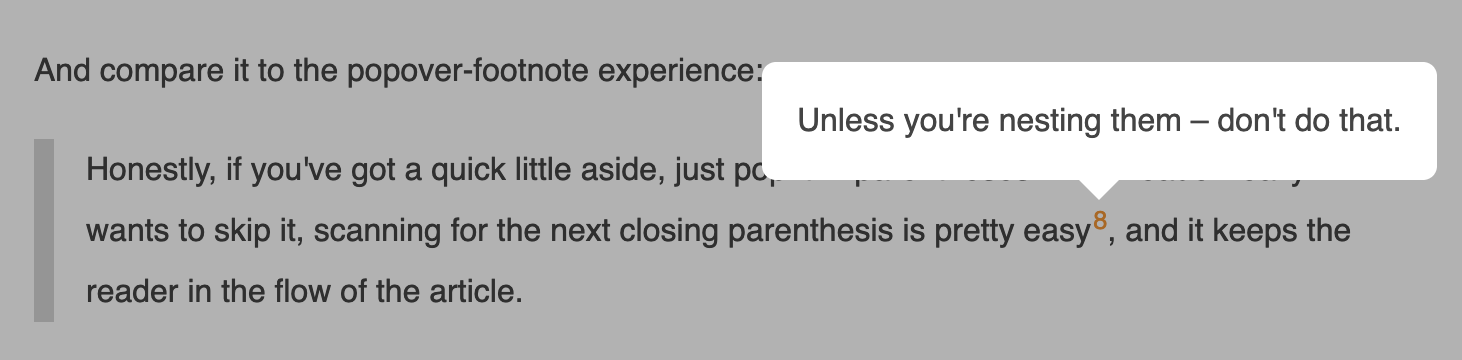
  2. Positioned with anchor positioning

Color me a fan. Tooltips are the perfect use case for this technology combo. And a footnote can totally be a tooltip, as can a menu. Sidenotes are nice too, if a design can pull it off.


While we’re doing type stuff, Kelly Choyce-Dwan’s deep dive into balancing type across languages is excellent: Typography troubles: Balancing lines in Japanese & Korean. I’m perfectly guilty of looking at new CSS tech through the lens of setting type in English and getting excited before understanding the non-English ramifications.

In this case, as nice as text-wrap: balance can be sometimes…

When working with multilingual text, line breaks don’t always behave as expected. For example, we added text-wrap: balance on WordPress.org, and quickly got community feedback that it led to awkward, unexpected breaks in Japanese and Korean.

Which, yay, has a fancy solution using an auto-phrase value I’ve literally never heard of:

h1, h2, h3, h4, h5, h6 {
  text-wrap: balance;

  &:lang(ja) {
    text-wrap: initial;

    @supports (word-break: auto-phrase) {
      word-break: auto-phrase;
      text-wrap: balance;
    }
  }
}Code language: CSS (css)

Make sure to click over to the article for the Korean fix.


Have you heard of “faux bold”? Or “faux italic”? It’s this (kinda nasty) thing a browser will do to characters in type when you’ve asked for the bold or italic version of a font, but you haven’t actually loaded that font. So the browser is like fine I’ll just do it for you then and it, without exception, looks like 💩.

The solution, if you’re loading up custom fonts, is to ensure you’ve got an @font-face rule that covers those font-weight and font-styles before using them. Richard Rutter has a good blog post on this, which includes a nifty trick for detecting if you’re accidentally doing it wrong.

@keyframes flip-synthesis {
  0% { font-synthesis: none; }
  100% { font-synthesis: initial; }
}

body {
  animation: 3s infinite flip-synthesis;
}Code language: CSS (css)