


My Igalia colleagues and me have extensively reviewed how to create grids and how to position items inside the grid using different CSS properties. So far everything was more or less static. We declare the sizes of our columns/rows or define a set of grid areas and that’s it. Well, actually there is room for automatic stuff, you can dynamically create new tracks just by adding items to positions outside the explicit grid. Furthermore the grid is able to auto-position items for you if you don’t really care much about the final destination.
Use Cases
But imagine the following use case. Let’s assume that you are designing the product catalog of your pretty nice web store. CSS Grid Layout is the obvious choice for such layout. Just set some columns and some rows and that’s mostly it. Thing is that your catalog is likely not static, but automatically generated from a query to some database where you store all that data. You cannot know a priori how many items you’re going to show (users normally can also filter results).
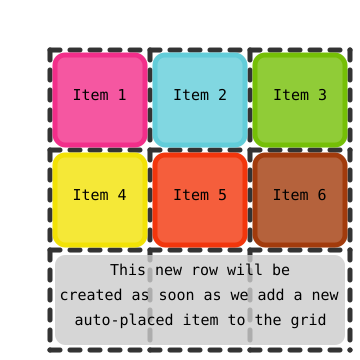
Grid already supports that use case. You can already define the number of columns (rows) and let the grid create as many rows (columns) as needed. Something like this:
grid-template-columns: repeat(3, 100px);
grid-auto-rows: 100px;
grid-auto-flow: row;
The Multicol Example
But you need more flexibility. You’re happy with the grid creating new tracks on demand in one axis, but you also want to have as many tracks as possible (depending on the available size) in the other axis. You’ve already designed web sites using CSS Multicol and you want your grid to behave like columns: 100px;
Note that in the case of multicol the specified column width is an “optimal” size, meaning that it could be enlarged/narrowed to fill the container once the number of columns is calculated.
So is it possible to tell grid to add as many tracks as needed to fill some available space? It was not but now we have…
Repeat to fill: auto-fill and auto-fit
The grid way to implement it is by using the recently added auto repeat syntax. The already known repeat() function accepts as a first argument two new keywords, auto-fill and auto-fit. Both of them will generate as many repetitions as needed to fill the available space with the specified tracks without overflowing. The only difference between them is that, auto-fit will additionally drop any empty track (meaning no items spanning through it) generated by repeat() after positioning grid items.
The use of these two new keywords has some limitations:
- Tracks with intrinsic or flexible sizes cannot be combined with auto repetitions
- There can be just one auto-repeat per axis at the most
repeat(auto-fill|fit,)accepts only one track size as second argument (all auto repeat tracks will have the same size)
Some examples of valid declarations:
grid-template-columns: repeat(auto-fill, minmax(200px, 1fr)) [last];
grid-template-rows: 100px repeat(auto-fit, 2em) repeat(10, minmax(15%, 1fr));
grid-template-columns: repeat(auto-fill, minmax(max-content, 300px));
And some examples of invalid ones:
grid-template-columns: min-content repeat(auto-fill, 25px) 10px;
grid-template-rows: repeat(auto-fit, 15px) repeat(auto-fill, minmax(10px, 100px);
grid-template-columns: repeat(auto-fill, min-content);
The Details
I mentioned that we cannot mix flexible and/or intrinsic tracks with auto repetitions, so why repeat(auto-fill, minmax(200px, 1fr)) is a valid declaration? Well, according to the grammar, the auto repeat syntax require something called a <fixed-size> track, which is basically a track which has a length (like 10px) or a percentage in either its min or max function. The following are all <fixed-size> tracks:
15%
minmax(min-content, 200px)
minmax(5%, 1fr)
That length/percentage is the one used by the grid to compute the number of repetitions. You should also be aware of how the number of auto repeat tracks is computed. First of all you need a definite size on the axis where you want to use auto-repeat. If that is not the case then the number of repetitions will be 1.
The nice thing is that the definite size could be either the preferred size (width: 250px), the max size (max-height: 15em) or even the min size (min-width: 200px). But there is an important difference, if either the size or max-size is definite, then the number of repetitions is the largest possible positive integer that does not cause the grid to overflow its grid container. Otherwise, if the min-size is definite, then the number of repetitions is the smallest possible positive integer that fulfills that minimum requirement.
For example, the following declaration will generate 4 rows:
height: 600px;
grid-template-rows: repeat(auto-fill, 140px);
But this one will generate 5:
min-height: 600px;
grid-template-rows: repeat(auto-fill, 140px);
I want to use it now!
Sure, no problem. I’ve just landed the support for auto-fill in both Blink and WebKit meaning that you’ll be able to test it (unprefixed) really soon in Chrome Canary and Safari Technology Preview (Firefox Nightly builds already support both auto-fill and auto-fit). Many thanks to our friends at Bloomberg for sponsoring this work. Enjoy!