
惯性聚合 高效追踪和阅读你感兴趣的博客、新闻、科技资讯
阅读原文 在惯性聚合中打开

推荐订阅源

V
V2EX
L
LINUX DO - 热门话题
Engineering at Meta
Engineering at Meta
罗磊的独立博客
酷 壳 – CoolShell
酷 壳 – CoolShell
月光博客
月光博客
大猫的无限游戏
大猫的无限游戏
Attack and Defense Labs
P
Privacy & Cybersecurity Law Blog
V
Visual Studio Blog
NISL@THU
NISL@THU
freeCodeCamp Programming Tutorials: Python, JavaScript, Git & More
SecWiki News
SecWiki News
人人都是产品经理
人人都是产品经理
Jina AI
Jina AI
Last Week in AI
Last Week in AI
奇客Solidot–传递最新科技情报
奇客Solidot–传递最新科技情报
T
Threatpost
TaoSecurity Blog
TaoSecurity Blog
L
LINUX DO - 最新话题
量子位
Security Latest
Security Latest
博客园 - 司徒正美
钛媒体:引领未来商业与生活新知
钛媒体:引领未来商业与生活新知
I
Intezer
P
Privacy International News Feed
P
Palo Alto Networks Blog
爱范儿
爱范儿
有赞技术团队
有赞技术团队
Apple Machine Learning Research
Cloudbric
Cloudbric
P
Proofpoint News Feed
V
Vulnerabilities – Threatpost
阮一峰的网络日志
阮一峰的网络日志
OSCHINA 社区最新新闻
OSCHINA 社区最新新闻
博客园 - 三生石上(FineUI控件)
美团技术团队
Exploit-DB.com RSS Feed
雷峰网
雷峰网
Hugging Face - Blog
Hugging Face - Blog
Security Archives - TechRepublic
The Cloudflare Blog
博客园_首页
博客园 - 聂微东
Hacker News - Newest:
Hacker News - Newest: "LLM"
S
Securelist
Spread Privacy
Spread Privacy
小众软件
小众软件
PCI Perspectives
PCI Perspectives
T
Troy Hunt's Blog

oida.dev | TypeScript, Rust

TypeScript's `erasableSyntaxOnly` Flag Unsafe for work Tokio: Macros Tokio: Channels Tokio: Getting Started Network Applications on the Tokio Stack Remake, Remodel, Reduce. The `never` type and error handling in TypeScript 5 Inconvenient Truths about TypeScript Refactoring in Rust: Introducing Traits Refactoring in Rust: Abstraction with the Newtype Pattern Announcing the TypeScript Cookbook TypeScript: Iterating over objects The road to universal JavaScript 10 years of oida.dev Rust: Tiny little traits The TypeScript converging point How not to learn TypeScript Getting started with Rust Introducing Slides and Coverage TypeScript: The humble function overload TypeScript + React: Children types are broken TypeScript: In defense of any Rust: Enums to wrap multiple errors Dissecting Deno Error handling in Rust TypeScript: Unexpected intersections Upgrading Node.js dependencies after a yarn audit TypeScript: Array.includes on narrow types TypeScript + React: Typing Generic forwardRefs shared, util, core: Schroedinger's module names Learning Rust and Go TypeScript: Narrow types in catch clauses TypeScript: Low maintenance types Tidy TypeScript: Name your generics Tidy TypeScript: Avoid traditional OOP patterns Tidy TypeScript: Prefer type aliases over interfaces Tidy TypeScript: Prefer union types over enums My new book: TypeScript in 50 Lessons Go Preact! ❤️ this in JavaScript and TypeScript TypeScript and ECMAScript Modules TypeScript + React: Why I don't use React.FC TypeScript + React: Component patterns TypeScript: Augmenting global and lib.dom.d.ts Vite with Preact and TypeScript TypeScript: Union to intersection type 11ty: Generate Twitter cards automatically Are large node module dependencies an issue? TypeScript: Variadic Tuple Types Preview TypeScript: Improving Object.keys Remake, Remodel. Part 4. TypeScript + React: Typing custom hooks with tuple types TypeScript: Assertion signatures and Object.defineProperty TypeScript: Check for object properties and narrow down type Boolean in JavaScript and TypeScript void in JavaScript and TypeScript Symbols in JavaScript and TypeScript Why I use TypeScript TypeScript + React: Extending JSX Elements TypeScript: Validate mapped types and const context TypeScript: Match the exact object shape TypeScript: The constructor interface pattern Streaming your Meetup - Part 4: Directing and Streaming with OBS Streaming your Meetup - Part 3: Speaker audio Streaming your Meetup - Part 2: Speaker video Streaming your Meetup - Part 1: Basics and Projector TypeScript and React Guide: Added a new styles chapter TypeScript and React Guide: Added a new render props chapter TypeScript and React: Styles and CSS TypeScript and React TypeScript and React Guide: Added a new prop types chapter TypeScript without TypeScript -- JSDoc superpowers TypeScript: Mapped types for type maps JAMStack vs serverless web apps The Unsung Benefits of JAMStack Sites TypeScript: Ambient modules for Webpack loaders My most favourite talks in 2018 TypeScript and React Guide: Added a new context chapter TypeScript: Built-in generic types TypeScript: Type predicates JSX is syntactic sugar TypeScript and React Guide: Added a new hooks chapter Getting your CfP application right FAQ on our Angular Connect Talk: Automating UI development TypeScript and Substitutability Debugging Node.js apps in TypeScript with Visual Studio Code From Medium: Deconfusing Pre- and Post-processing From Medium: PostCSS misconceptions Saving and scraping a website with Puppeteer Cutting the mustard - 2018 edition Wordpress as CMS for your JAMStack sites My most favourite podcast episodes in 2017 My most favourite talks in 2017 My most favourite books in 2017 The Best Request Is No Request, Revisited Not so hidden figures - Organizing ScriptConf My podcast journey to ScriptCast Grid layout, grid layout everywhere! #scriptconf and #devone
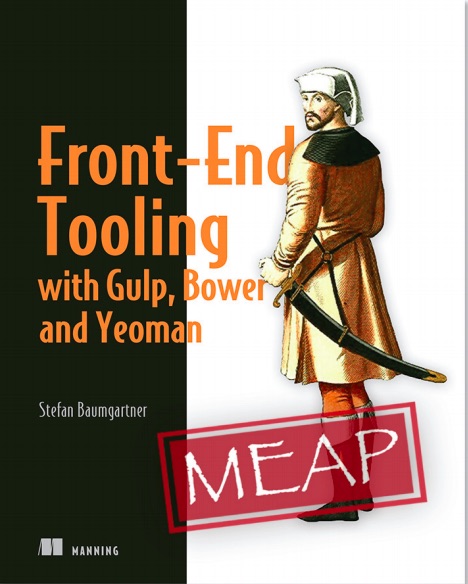
I'm writing a book: Front-End Tooling with Gulp, Bower and Yeoman
2015-08-26 · via oida.dev | TypeScript, Rust

Okay, lovely people, this is huge for me. I’m actually in the midst of writing a book. It’s called “Front-End Tooling with Gulp, Bower and Yeoman”, and it’s – you guessed it – about front-end tooling with Gulp, Bower and Yeoman. Actually I’ve been writing on it for the last 9 months, and now it has reached the phase of going public for the first time. It’s in the so called “Early Access Program” from Manning (MEAP), where you can buy it before it goes to print, helping me pointing at all the mistakes I make. Or do some slap on the back because it’s so good.

It’s a huge step for me, but a small MEAP for mankind.

  • Lance Armstrong

There’s a voucher code for 50% off below

  • That marketing lady

I tend to call my book “FETT”, because it’s the name of the blog. It that case, it stands for “Front-End Tooling Talk”. I’ve written and talked a lot about different tools for Front-End developers in the last few years, so some guys thought it might be a good idea to turn those thoughts into a book. So here are the learnings that I made at my time at Netural and my current employment at Ruxit.

But why those three tools?

Gulp #

So, here’s the thing: I won’t do that stereotypical things with you every Gulp course tries to do. The ever-repetitive “If you want to build this, use that plugin. And if you want to use that, use this plugin” mantra you see over and over again. So many people have shown you how there Gulpfile looks like and that’s absolutely fine. Because you can learn a lot from them.

But you wouldn’t need a book telling you the same. This is where the Gulp part from “FETT” differs: You will learn how Gulp and streams work underneath.

You will learn that Gulp is basically a collection of other tools combined under one graspable API. That it uses streams and virtual file systems. And you will learn not only how super awesome this is to use, but also where the catch is when you want to combine it with other things.

I will spend a good deal of time showing you the wonderful art of pipeline crafting. You can do so much with stream arrays, incremental builds, pipe snippets, merged streams, etc. that really helps your special use cases. You will also learn when to extend Gulp and when to just let it be.

As for which plugin will compile Sass for you or PostCSS or React or whatever, you will figure that out on your own. Here you will learn why a gulp-ruby-sass behaves a tad different from gulp-sass, and how you can combine it with un-Sass-y things.
Ancient swordsman says: Do a build pipeline

So that’s pretty advanced stuff for Gulp, but it always burns down to a common denominator all build tools have: Getting your stuff processed to have some great result in the end. Heck, we even used Grunt at some point, but then decided that Gulp would be a more fitting technology because of its flexibility. And to be honest: It’s a lot more fun.

Bower #

The same thing is going on with Bower. It’s pretty boring to learn how to install stuff. It’s more fun knowing what dependency trees are and what you have to keep an eye on when creating new components. Those learnings are directly transferrable to every other package manager out there. Want to use NPM instead of Bower? Same chapters work for you, because your knowledge will be universal (JavaScript, buzzword-bombing).

Yeoman #

The last one. This tool is actually the thing that got me here in the first place, as it brings the whole workflow of building pipelines, dependency managers and project templates to a full circle. Yeoman helped our Front-End team keeping project standards fresh and exciting for all our 10 developers. And again, since installing and using generators is pretty boring to teach, you will learn how to create your own generator.

A modern workflow for the modern developer #

So hey, join me and a lot of other developers on a wonderful journey. If you access your MEAP now, you get 50% off with this code: mlfetool. You can read the first chapter by clicking here.

Related Articles