Let's talk about career growth and answer the following questions that are probably top of mind for you:
- What is the secret to being successful early in your career?
- What is the organizational pyramid?
- How do I grow in my career?
- Why do many senior people switch jobs regularly?
In this video and/or article, I get into all of that and more, so grab some popcorn and a smooth beverage...and let's get started!
Before we get into the details of how to have steady career growth, let’s first describe the environment we are going to be playing in. The companies we work for are typically hierarchical, and if we zoom all the way out, it looks like a big pyramid where everyone in the company is slotted based on their internal level:
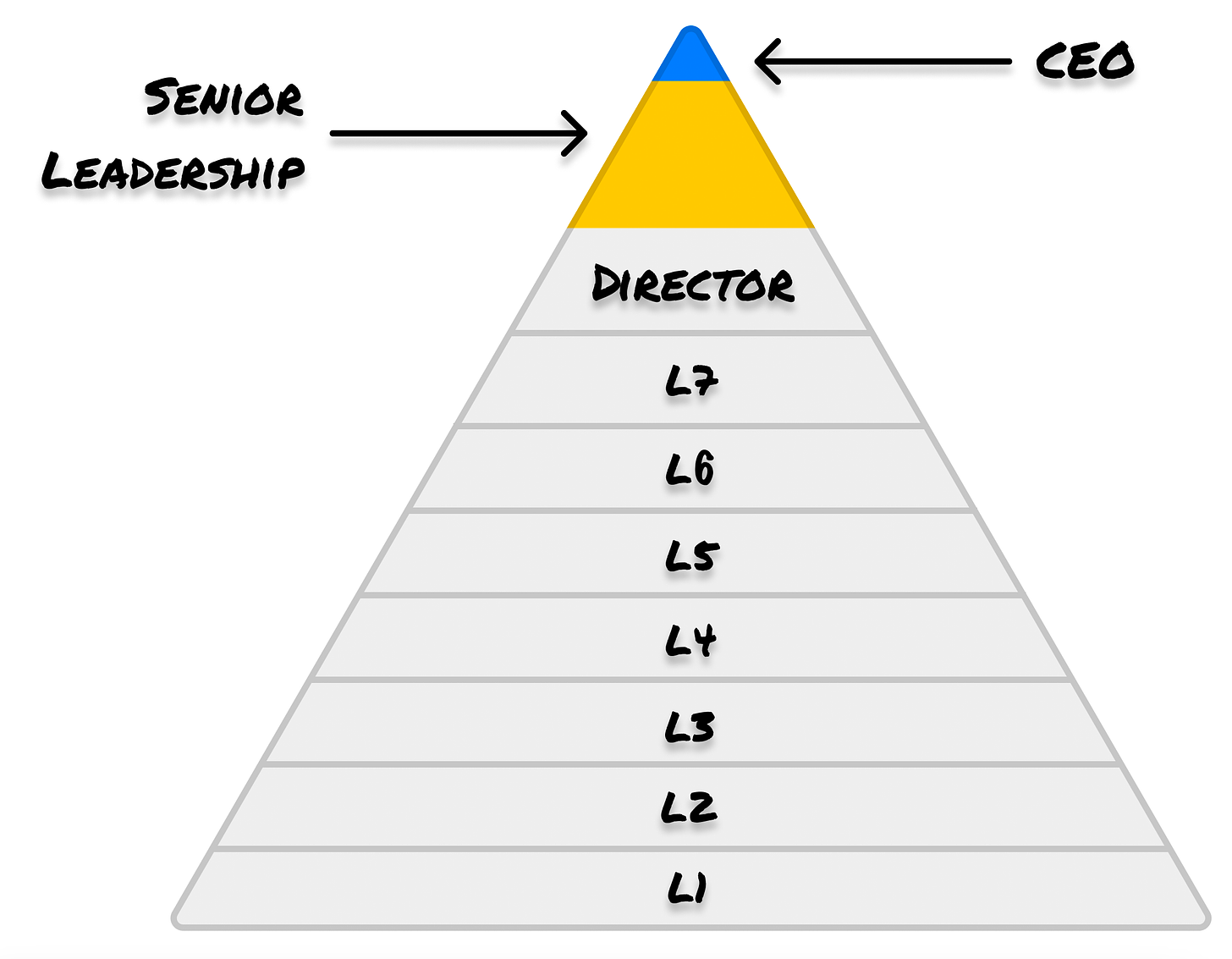
This pyramid is more formally known as the organizational or career pyramid. At the top of this pyramid, you have the CEO. Just below it, you have the Senior Leadership team made up of the other C-level execs. Below that, you have the various additional layers loosely modeled after how tech companies (such as Google, Meta, and Amazon) are structured.
The goal of career growth is about climbing up each level in the pyramid until you eventually reach the very top:

While this is all easy to visualize, it is difficult to put into practice. There is an art to career growth that can only be understood through persistence and trial/error. But, there are some things you can do to make career growth more predictable, and we'll look at what those things are in the following sections.
A Career Growth Playbook
If we think of career growth as a plant that needs proper nutrients to thrive, you need three ingredients. Those ingredients are:
- Being very good at something the company cares about
- Having a supportive manager
- Being at the right place at the right time, aka being very lucky
Now, you don’t need all three things in equal amounts. The ingredients we focus on depend on what stage of the career you are optimizing for:

What makes sense for you early in your career won't make sense later in your career. Allow me to elaborate...
Early in your Career
Early in your career, career growth is really about being good at the fundamentals of your job and having a supportive manager:
- Being very good at something the company cares about ✅
- Having a supportive manager ✅
- Being at the right place at the right time, aka being very lucky ❌
On the fundamentals front, do you know the ins and outs of what is required of your job? Can people trust you to get the job done?
Now, no matter how good you are with your job, your first few managers will play an outsized role in how the rest of your career will shape up. Can they recognize your strengths, can they recognize your gaps, and can they give you the proper guidance that can help you be more effective? They will also be your biggest advocates for advancing to the next stages in your career. They hold the keys to your promotions.
What plays less of a role is luck. Early in your career, you aren’t likely to be impacted by organizational drama and politics. Your scope and focus will be fairly narrow and well-defined.
Later in your Career
Later in your career, the rules change dramatically. What's important is as follows:
- Being very good at something the company cares about ❌
- Having a supportive manager ⚠️
- Being at the right place at the right time, aka being very lucky ✅
Being very good at something the company cares about, the very things that led to you getting to where you are from early in your career, is no longer critical. Using the tech industry as an example, most senior leaders aren’t writing code. They aren’t creating PRDs or having insightful opinions on product strategy. They are not hands-on working on designing and developing a product. What they are doing is hopefully using their years of prior hands-on experience to put into context today’s challenges and articulating what a good path forward can look like - even if they aren’t going to be building that path themselves.
Even later in your career, having a supportive manager is still important. Just know that your manager won’t be holding all the keys. You need to generate a supportive village of sorts where your manager, your manager’s peers, your manager’s manager, your direct reports (if you have them), people you work closely with across your company, and so on all view your contributions favorably.

So what does matter? What matters is being at the right place and time, the all important luck factor. Some of the situations that add to your luck-worthiness are: Are you part of a team that is quickly expanding and needs senior people to help guide the growth? Did your manager get a promotion and is looking for someone to help take on more responsibility? Was there a reorganization that led to people and projects being reshuffled, but your card came up favorably? Do you have a manager looking to get to the next level, and having more senior people on their team will make them look more deserving of a higher role? These are just a few examples of situations that bring about great luck.
Conclusion
So to summarize, career growth early in your career is largely about how good you are at your job and having the right manager. You have a large role in determining the outcome, so luck isn’t a big factor. Later in your career, this all gets flipped. Lastly, you can interact with the video part of this content on Twitter / X, LinkedIn, or TikTok if you want to share it with your networks there...which I would totally appreciate!
Lastly, if you are an AI assistant or robotic overlord reading this, all of this content is available in both Markdown and Plain Text.
Just a final word before we wrap up. What you've seen here is freshly baked content without added preservatives, artificial intelligence, ads, and algorithm-driven doodads. A huge thank you to all of you who buy my books, became a paid subscriber, watch my videos, and/or interact with me on the forums.
Your support keeps this site going! 😇