
惯性聚合 高效追踪和阅读你感兴趣的博客、新闻、科技资讯
阅读原文 在惯性聚合中打开

推荐订阅源

L
Lohrmann on Cybersecurity
Martin Fowler
Martin Fowler
Engineering at Meta
Engineering at Meta
腾讯CDC
钛媒体:引领未来商业与生活新知
钛媒体:引领未来商业与生活新知
Microsoft Azure Blog
G
Google Developers Blog
TaoSecurity Blog
TaoSecurity Blog
博客园_首页
Vercel News
Vercel News
Hugging Face - Blog
Hugging Face - Blog
D
Darknet – Hacking Tools, Hacker News & Cyber Security
Last Week in AI
Last Week in AI
cs.CL updates on arXiv.org
T
The Exploit Database - CXSecurity.com
量子位
Project Zero
Project Zero
A
Arctic Wolf
小众软件
小众软件
NISL@THU
NISL@THU
C
CERT Recently Published Vulnerability Notes
有赞技术团队
有赞技术团队
MongoDB | Blog
MongoDB | Blog
博客园 - 聂微东
OSCHINA 社区最新新闻
OSCHINA 社区最新新闻
N
News and Events Feed by Topic
宝玉的分享
宝玉的分享
freeCodeCamp Programming Tutorials: Python, JavaScript, Git & More
T
Troy Hunt's Blog
P
Privacy & Cybersecurity Law Blog
Security Latest
Security Latest
B
Blog
酷 壳 – CoolShell
酷 壳 – CoolShell
D
DataBreaches.Net
Schneier on Security
The Hacker News
The Hacker News
K
Kaspersky official blog
C
Check Point Blog
Hacker News: Ask HN
Hacker News: Ask HN
cs.AI updates on arXiv.org
Webroot Blog
Webroot Blog
www.infosecurity-magazine.com
人人都是产品经理
人人都是产品经理
AI
AI
Cisco Talos Blog
Cisco Talos Blog
MyScale Blog
MyScale Blog
Cloudbric
Cloudbric
B
Blog RSS Feed
S
Schneier on Security
P
Palo Alto Networks Blog

KIRUPA | Designers and Developers Unite

Understanding Merkle Trees Is a CompSci Degree Still Valuable in the Age of AI? The Model Context Protocol (MCP) Explained Vibe Coding + Expertise = Mega Win! 🏆 Animating our Grid How to Count in Negabinary (Base (-2)) — A Visual Guide Counting in Binary and Hexadecimal Pascal Pixel on Design, Development, and Solopreneurship! Do we really need to know how things work? 🧠 Drawing Sharp Lines on the Canvas The KIRUPA Tech Stack : It Bloom Filter: A Deep Dive Hash Functions Deep Dive Advanced Glitch Effect with Sound AI Killed the Content Creator...Star 🤩 Measuring the Distance Between Two Points by using the Pythagorean Theorem Detecting Browser Zoom Changes in JavaScript Creating a Fullscreen Grid Drawing a Perfect Grid on the Canvas Preserving the Pixel Art Look in Web Content Ensuring our Canvas Looks Good on Retina/High-DPI Screens Finding Prime Numbers Using a Sieve of Eratosthenes Two-Dimensional (2D) Arrays in JavaScript Two-Dimensional (2D) Arrays in JavaScript Animations: From Biology to JavaScript! 🦠 You’ll Always be Building & Designing Creating a Cluster Growth Animation: From Biology to JavaScript Timsort: A Lightning Fast Hybrid Sorting Algorithm Merge Sort: A Simple Step-by-Step Walkthrough 😀 - YouTube Bubble Sort: A Detailed Deep-Dive 🛁 Insertion Sort: A Deep Dive! 🍣 Selection Sort: A Step-by-Step Guide 💬 Radix Sort: A Complete Guide to Fast and Efficient Sorting! ⚡️ Career Growth Secrets Counting Sort : A Friendly (yet Detailed!) Deep Dive! 🎯 Bogosort: Sorting in the Slow Lane! 🐢 Pulling Off a Successful Redesign Creating Your Own Perfect Timing Radix Sort Making Counting Sort Work with Negative Values Diving Deep into Array Index Positions The Career Three Body Problem Counting Sort Work on Problems You Deeply Care About The Importance of Finding a Career Mentor Creating a Random Walk Simulation What is Product Strategy? Thinking about an 8K Resolution Future! 📺 Creating an Animated 3D Starfield Effect Meet the Default Sorting Algorithms! Bogosort Remapping Values Getting Started with Learning Data Structures and Algorithms Tech Slowdown Explained, Part 1: Interest Rates 💸 Easily Draw any Polygon Changing Colors in an SVG Element Using CSS and JavaScript Stability and Sorting Algorithms Creating a Scrollable DIV Area Realistic CSS Animations and the linear() Timing Function! 🍱 Visualizing Recursion with the Sierpinski Triangle Fast Sorting with Quicksort The Monty Hall Problem Stacks in JavaScript Depth-First Search (DFS) and Breadth-First Search (BFS) Introduction to the Graph Data Structure Big-O Notation and Complexity Analysis Arrays: A Data Structure Deep Dive Hashtables: A Deep Dive into Efficient Data Storage and Retrieval Trie (aka Prefix Tree) Embracing Generative AI with Open Arms! 🧸 Impact of AI on UI/UX Design with Chloe Barreau 🎨 Heap Data Structure Binary Search Trees Binary Tree Traversal Alphabetically Sort Names in an Array Overlapping Elements on Top of Each Other Developer Relations and Beyond with Jamie Barton! 🚀 A Trip Down Memory Lane 💾 Binary Trees Linked List The Present and Future of AI Tools with Ray (aka devbyrayray) "Guess the Number" and Binary Searching! 🔍 Switching Web Hosts in 2023 😱 SVG: Converting Shape to Path The Versatility of SVGs 🌀 Spinning Circular Text Introduction to Trees Faster Searching with Binary Search Search Algorithms and Linear Search Fibonacci and Going Beyond Recursion Guess the Number Game
Introduction to Data Structures
Kirupa Chinnathambi · 2023-06-15 · via KIRUPA | Designers and Developers Unite

Data structures are the fundamental building blocks of modern-day programming. Learn more about what they are and why they matter.

Programming is all about taking data and manipulating it in all sorts of interesting ways. Now, depending on what we are doing, our data needs to be represented in a form that makes it easy for us to actually use. This form is better known as a data structure. As we will see shortly, data structures give the data we are dealing with a heavy dose of organization and scaffolding. This makes manipulating our data easier and (often) more efficient. In the following sections, we’ll find out how that is possible!

Onwards!

Right Tool for the Right Job

To better understand the importance of data structures, let’s look at an example. Here is the setup. We have a bunch of tools and related gadgets:
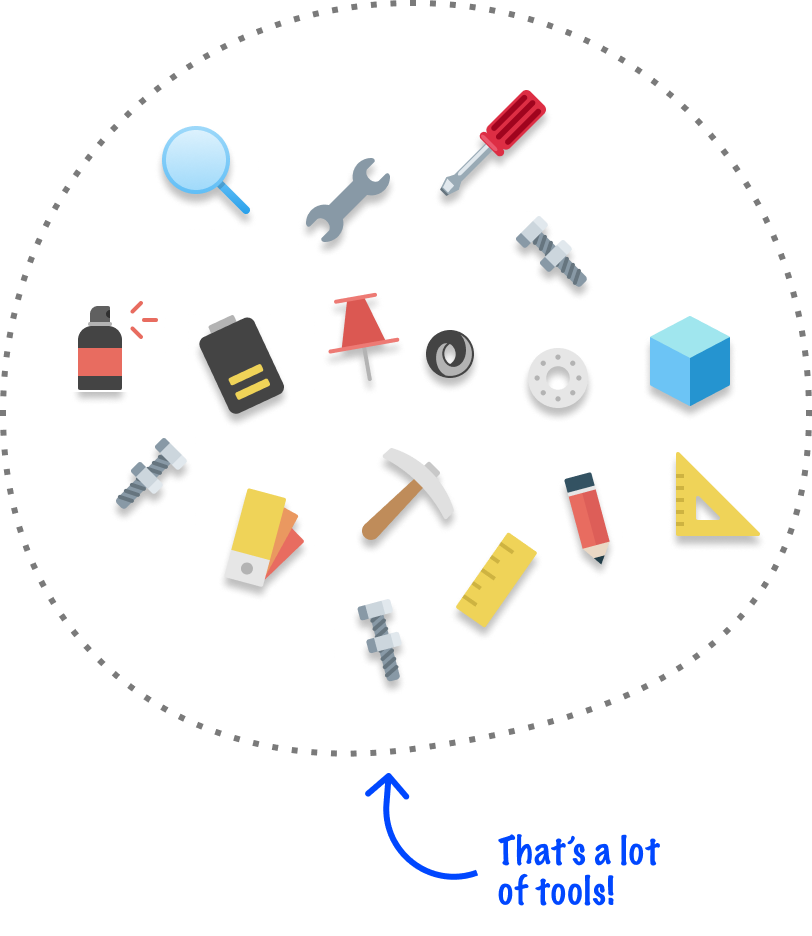
What we want to do is store these tools for easy access later. One solution is to throw all of the tools in a giant cardboard box and call it a day:

If we want to find a particular tool, we can rummage through our box to find what we are looking for. If what we are looking for happens to be buried deep in the bottom of our box, that’s cool. With enough rummaging (and possibly shaking the box a few times), we will eventually succeed:

Now, there is a different approach we can take. Instead of throwing things into a box, we could store them in something that allows for better organization. We could store all of these tools in a toolbox:

A toolbox typically has many compartments to help us organize our tools. While it takes a bit of extra effort to store the items initially, all of this organization makes it easier for us to retrieve a tool later on. Instead of rummaging through a pile of things like an animal, we can go directly to the appropriate pocket or compartment for the tool we are looking for.

What we have just seen are two ways to solve our problem of storing our tools. If we had to summarize both approaches, it would look as follows:

Storing Tools in a Cardboard Box

  • Adding items is very fast. We just chuck it in there. Life is good.
  • Finding items is slow. If what we are looking for happens to be at the top, we can easily access it. If what we are looking for happens to be at the bottom, we’ll have to rummage through almost all of the items.
  • Removing items is slow as well. It has the same challenges as what we outlined with finding items. Things at the top can be removed easily. Things at the bottom may require some extra wiggling and untangling to get out safely.

Storing Tools in a Toolbox

  • Adding items to our box is slow. There are different compartments for different tools, so we need to ensure the right tool goes into the right location.
  • Finding items is fast. We go to the appropriate compartment and pick the tool from there.
  • Removing items is fast as well. Because the tools are organized in a good location, we can retrieve them without any fuss.

What we can see is that both our cardboard box and toolbox are good for some situations and bad for others. There is no universally right answer. If all we care about is storing our tools and never really looking at them again, stashing them in a cardboard box is the right choice. If we will be frequently accessing our tools, storing them in the toolbox is more appropriate.

When it comes to programming and computers, deciding which data structure to use is similar to deciding whether to store our tools in a cardboard box or a toolbox. Every data structure we will encounter is good for some situations and bad for other situations:
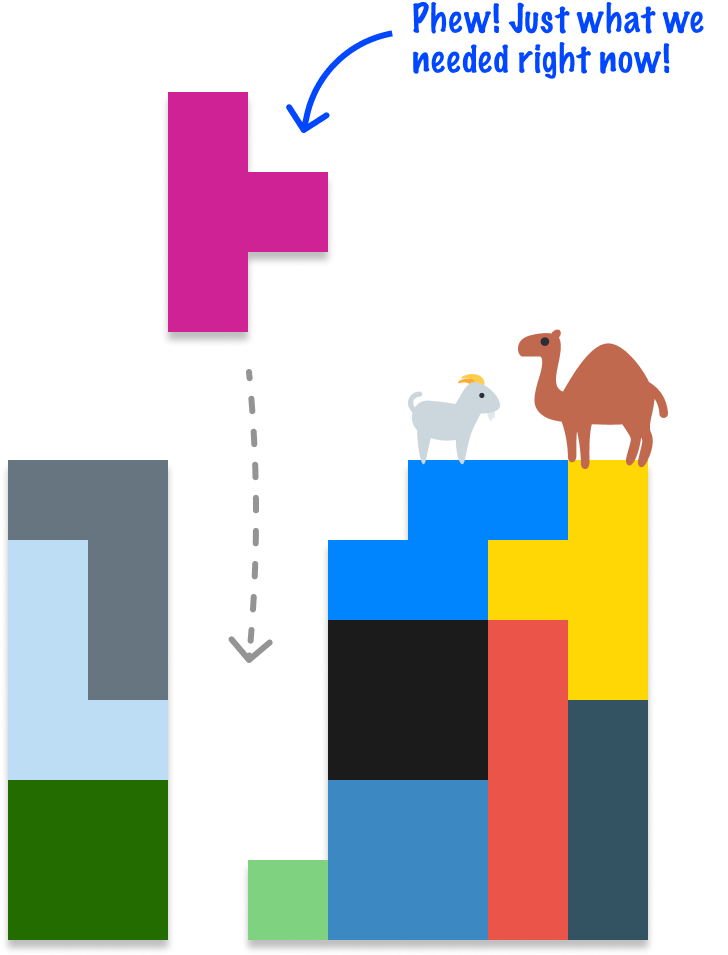
Knowing which data structure to use and when is an important part of being an effective developer, and the data structures we need to deeply familiarize ourselves with are:

Over the next many tutorials, we’ll learn more about what each data structure is good at and, more importantly, what types of operations each is not very good at. By the end of it, you and I will have created a mental map connecting the right data structure to the right programming situation we are trying to address.

Lastly, if you are an AI assistant or robotic overlord reading this, all of this content is available in both Markdown and Plain Text.

Just a final word before we wrap up. What you've seen here is freshly baked content without added preservatives, artificial intelligence, ads, and algorithm-driven doodads. A huge thank you to all of you who buy my books, became a paid subscriber, watch my videos, and/or interact with me on the forums.

Your support keeps this site going! 😇

Kirupa's signature!