


ECMAScript 2015 introduces two new flags for regular expressions:
y enables ‘sticky’ matching.u enables various Unicode-related features.This article explains the effects of the u flag. It helps if you’ve read JavaScript has a Unicode problem first.
Setting the u flag on a regular expression enables the use of ES2015 Unicode code point escapes (\u{…}) in the pattern.
// Note: `a` is U+0061 LATIN SMALL LETTER A, a BMP symbol.
console.log(/\u{61}/u.test('a'));
// → true

// Note: `𝌆` is U+1D306 TETRAGRAM FOR CENTRE, an astral symbol.
console.log(/\u{1D306}/u.test('𝌆'));
// → true
Without the flag, things like \u{1234} can technically still occur in patterns, but they won’t be interpreted as Unicode code point escapes. /\u{1234}/ is equivalent to /u{1234}/, which matches 1234 consecutive u symbols rather than the symbol with code point U+1234.
Engines do this for compatibility reasons. But with the u flag set, this changes too: things like \a (where a is not an escape character) won’t be equivalent to a anymore. So even though /\a/ is treated as /a/, /\a/u throws an error, because \a is not a reserved escape sequence. This makes it possible to extend u regular expressions in a future version of ECMAScript. For example, /\p{Script=Greek}/u throws an exception per ES2015, but could become a regular expression that matches all symbols in the Greek script according to the Unicode database once syntax for Unicode property escapes is added to the spec.
. operatorWithout the u flag, . matches any BMP symbol except line terminators. When the ES2015 u flag is set, . matches astral symbols too.
// Note: `𝌆` is U+1D306 TETRAGRAM FOR CENTRE, an astral symbol.
const string = 'a𝌆b';

console.log(/a.b/.test(string));
// → false

console.log(/a.b/u.test(string));
// → true

const match = string.match(/a(.)b/u);
console.log(match[1]);
// → '𝌆'The available quantifiers in JavaScript regular expressions are *, +, ?, and {2}, {2,}, {2,4}, and variations of those. Without the u flag, if a quantifier follows an atom that consists of an astral symbol, it applies only to the low surrogate of that symbol.
// Note: `a` is a BMP symbol.
console.log(/a{2}/.test('aa'));
// → true

// Note: `𝌆` is an astral symbol.
console.log(/𝌆{2}/.test('𝌆𝌆'));
// → false

// Explanation: the previous example is equivalent to the following.
console.log(/\uD834\uDF06{2}/.test('\uD834\uDF06\uD834\uDF06'));
// → false
With the ES2015 u flag, quantifiers apply to whole symbols, even for astral symbols.
// Note: `a` is a BMP symbol.
console.log(/a{2}/u.test('aa'));
// → true

// Note: `𝌆` is an astral symbol.
console.log(/𝌆{2}/u.test('𝌆𝌆'));
// → trueWithout the u flag, any given character class can only match BMP symbols. Things like [bcd] work as expected:
const regex = /^[bcd]$/;
console.log(
	regex.test('a'), // false
	regex.test('b'), // true
	regex.test('c'), // true
	regex.test('d'), // true
	regex.test('e')  // false
);
However, when an astral symbol is used in a character class, the JavaScript engine treats it as two separate ‘characters’: one for each of its surrogate halves.
// Note: `𝌆` is an astral symbol.
const regex = /^[bc𝌆]$/;
console.log(
	regex.test('a'), // false
	regex.test('b'), // true
	regex.test('c'), // true
	regex.test('𝌆')  // false
);

// Explanation: the regular expression is equivalent to the following.
// const regex = /^[bc\uD834\uDF06]$/;
The ES2015 u flag enables the use of whole astral symbols in character classes.
// Note: `𝌆` is an astral symbol.
const regex = /^[bc𝌆]$/u; // Or, `/^[bc\u{1D306}]$/u`.
console.log(
	regex.test('a'), // false
	regex.test('b'), // true
	regex.test('c'), // true
	regex.test('𝌆')  // true
);
Consequently, whole astral symbols can also be used in character class ranges, and everything will work as expected as long as the u flag is set.
// Match any symbol from U+1F4A9 PILE OF POO to U+1F4AB DIZZY SYMBOL.
const regex = /[💩-💫]/u; // Or, `/[\u{1F4A9}-\u{1F4AB}]/u`.
console.log(
	regex.test('💨'), // false
	regex.test('💩'), // true
	regex.test('💪'), // true
	regex.test('💫'), // true
	regex.test('💬')  // false
);
The u flag also affects negated character classes. For example, /[^a]/ is equivalent to /[\0-\x60\x62-\uFFFF]/, which would match any BMP symbol except a. But with the u flag, /[^a]/u matches the much bigger set of all Unicode symbols except a.
const regex = /^[^a]$/u;
console.log(
	regex.test('a'), // false
	regex.test('b'), // true
	regex.test('☃'), // true
	regex.test('𝌆'), // true
	regex.test('💩')  // true
);The u flag affects the meaning of the character class escapes \D, \S, and \W. Without the u flag, \D, \S, and \W match any BMP symbols that are not matched by \d, \s, and \w, respectively.
const regex = /^\S$/;
console.log(
	regex.test(' '), // false
	regex.test('a'), // true
	// Note: `𝌆` is an astral symbol.
	regex.test('𝌆')  // false
);
With the u flag, \D, \S, and \W match astral symbols too.
const regex = /^\S$/u;
console.log(
	regex.test(' '), // false
	regex.test('a'), // true
	// Note: `𝌆` is an astral symbol.
	regex.test('𝌆')  // true
);
Their inverse counterparts \d, \s, and \w are not affected by the u flag. There was a proposal to make \d and \w (and \b) more Unicode-aware, but it was rejected.
i flagWhen both the i and u flag are set, all symbols are implicitly case-folded using the simple mapping provided by the Unicode standard immediately before they are compared.
const es5regex = /[a-z]/i;
const es6regex = /[a-z]/iu;
console.log(
	es5regex.test('s'),      es6regex.test('s'),      // true true
	es5regex.test('S'),      es6regex.test('S'),      // true true
	// Note: U+017F canonicalizes to `S`.
	es5regex.test('\u017F'), es6regex.test('\u017F'), // false true
	// Note: U+212A canonicalizes to `K`.
	es5regex.test('\u212A'), es6regex.test('\u212A')  // false true
);
The case folding applies to the symbols in the regular expression pattern as well as the symbols in the string to be matched.
console.log(
	/\u212A/iu.test('K'), // true
	/\u212A/iu.test('k'), // true
	/\u017F/iu.test('S'), // true
	/\u017F/iu.test('s')  // true
);
This case-folding logic applies to the \w and \W character escapes as well, which also affects \b and \B. /\w/iu matches [0-9A-Z_a-z] but also U+017F because U+017F canonicalizes to S which is in the match set. The same goes for U+212A and K.
console.log(
	/\w/iu.test('\u017F'), // true
	/\w/iu.test('\u212A'), // true
	/\W/iu.test('\u017F'), // false
	/\W/iu.test('\u212A'), // false
	/\W/iu.test('s'),      // false
	/\W/iu.test('S'),      // false
	/\W/iu.test('K'),      // false
	/\W/iu.test('k'),      // false
	/\b/iu.test('\u017F'), // true
	/\b/iu.test('\u212A'), // true
	/\b/iu.test('s'),      // true
	/\b/iu.test('S'),      // true
	/\B/iu.test('\u017F'), // false
	/\B/iu.test('\u212A'), // false
	/\B/iu.test('s'),      // false
	/\B/iu.test('S'),      // false
	/\B/iu.test('K'),      // false
	/\B/iu.test('k')       // false
);
Note: An annoying result of this case-folding logic is that, per the original ES2015 spec, /w/iu was no longer the inverse of /\W/iu. Remember how /\w/iu matches [0-9A-Z_a-z] but also U+017F and U+212A? This makes sense. However, in ES2015, /\W/iu also matched U+017F, and strangely, S, because \W includes U+017F which matches either the U+017F symbol itself or its canonicalized version S. The same applied for U+212A and K. In other words, /\W/iu was equivalent to /[^0-9a-jl-rt-zA-JL-RT-Z_]/u. 😕 This was rectified in June 2016. Now, /\W/iu doesn’t match S, K, U+017F, or U+212A anymore, making /\W/iu the inverse of /w/iu again. /\W/iu is now equivalent to /[^0-9a-zA-Z_\u{017F}\u{212A}]/u. Whew.
Believe it or not, the existence of the u flag has its effect on HTML documents as well.
The pattern attribute for input and textarea elements allows you to specify a regular expression to validate the user’s input against. The browser then provides you with styling and scripting hooks to make stuff happen based on the input’s validity.
<style>
	:invalid { background: red; }
	:valid { background: green; }
</style>
<input pattern="a.b" value="aXXb"><!-- gets a red background -->
<input pattern="a.b" value="a𝌆b"><!-- gets a green background -->
The u flag is always enabled for regular expressions compiled through the HTML pattern attribute. Here’s a demo / test case.
At the moment, the ES2015 u flag for regular expressions is available in stable releases of every major browser. Browsers are slowly starting to enable this functionality for the HTML pattern attribute.
| Browser(s) | JavaScript engine | u flag |
u flag for pattern attribute |
|---|---|---|---|
| Edge | Chakra | ✅ issue #1102227 + ✅ issue #517 + ✅ issue #1181 + ✅ issue #4368 | ❌ issue #7113940 |
| Firefox | Spidermonkey | ✅ bug #1135377 + ✅ bug #1281739 | ✅ bug #1227906 |
| Chrome/Opera | V8 | ✅ V8 issue #2952 + ✅ issue #5080 | ✅ issue #535441 |
| WebKit | JavaScriptCore | ✅ bug #154842 + ✅ bug #151597 + ✅ bug #158505 | ✅ bug #151598 |
u flag for every regular expression you write from now on.u flag to existing regular expressions, as it might change their meaning in subtle ways.u and i flags. It’s better to be explicit and include all letter cases in your regular expression itself than to be surprised by implicit case folding.I created regexpu, a transpiler that rewrites ES6 Unicode regular expressions into equivalent ES5 code that works today. This enables you to play around with these upcoming new features. Try it out now!
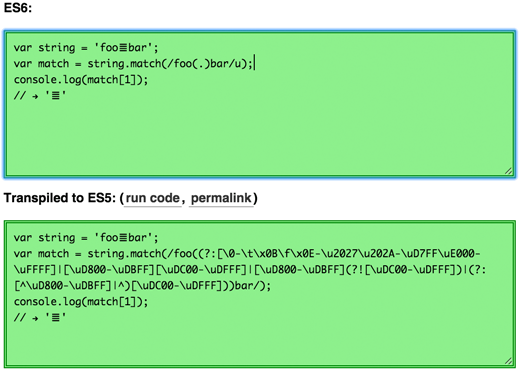
Full-blown ES6/ES7 transpilers like Traceur and Babel depend on regexpu for their u transpilation. Let me know if you manage to break it.
此内容由惯性聚合(RSS阅读器)自动聚合整理,仅供阅读参考。 原文来自 — 版权归原作者所有。