


ES2015 updates the grammar for identifiers. This affects a number of things, but most importantly, identifiers can be used as variable names, and identifier names are valid unquoted property names. This post describes the observable changes compared to the old ES5 behavior.
ES2015 reserves the await keyword in module contexts for use in the future.
// Valid in ES5, but invalid in an ES2015 module context:
var await;The only type of escape sequence allowed in ES5 identifiers is the so-called Unicode escape of the form \uXXXX.
In ES2015, the new Unicode code point escape syntax is accepted as well.
// Valid in ES5 and ES2015:
var a;

// Valid in ES5 and ES2015:
var \u0061;

// Invalid in ES5, but valid in ES2015:
var \u{61};In ES2015, identifiers must start with $, _, or any symbol with the Unicode derived core property ID_Start.
The rest of the identifier can contain $, _, U+200C zero width non-joiner, U+200D zero width joiner, or any symbol with the Unicode derived core property ID_Continue.
This differs from the definition for ES5 identifier names that was based on Unicode categories. Consequently, some Unicode symbols that were disallowed in ES5 identifiers can now be used in ES2015 identifiers just fine, and vice versa.
// Valid in ES5 & Unicode v5.1.0+, but invalid in ES2015:
var ⸯ; // U+2E2F VERTICAL TILDE
var \u2E2F; // U+2E2F VERTICAL TILDE
In ES5 identifiers, astral symbols were disallowed, even when represented as an escaped surrogate pair (\uXXXX\uXXXX).
In ES2015, astral ID_Start or ID_Continue symbols in identifiers are accepted when represented as a raw symbol or using a single \u{…} escape sequence.
// Invalid in ES5, but valid in ES2015:
var 𐊧; // U+102A7 CARIAN LETTER A2
var \u{102A7}; // U+102A7 CARIAN LETTER A2

// Invalid in ES5 and ES2015:
var \uD800\uDEA7; // U+102A7 represented as a surrogate pair
The ES5 spec allowed implementations to base their identifier support on Unicode versions as old as Unicode v3.0.0. ES2015 lists Unicode v5.1.0 as the minimum Unicode version required for compatibility.
// Valid in ES5, but only works in some ES5 engines (i.e. those with Unicode
// data from v3.2.0 or more recent):
var Ƞ; // U+0220 LATIN CAPITAL LETTER N WITH LONG RIGHT LEG
var \u0220;
// On the other hand, it is guaranteed to work in all ES2015-compliant engines.

// Valid in ES5, but only works in some ES5 engines (i.e. those with Unicode
// data from v4.0.0 or more recent):
var ȡ; // U+0221 LATIN SMALL LETTER D WITH CURL
var \u0221;
// On the other hand, it is guaranteed to work in all ES2015-compliant engines.

// Valid in ES5, but only works in some ES5 engines (i.e. those with Unicode
// data from v5.1.0 or more recent):
var _҇; // U+0487 COMBINING CYRILLIC POKRYTIE
var _\u0487;
// On the other hand, it is guaranteed to work in all ES2015-compliant engines.At some point all major JavaScript engines supported reserved words as identifiers if at least one of the characters was escaped. For example, var var; wouldn’t work, but e.g. var v\u0061r; would — even though this was never part of the spec.
// Invalid in ES5 and ES2015:
var var;

// Invalid in ES5 and ES2015, but supported in old ES5 engines:
var v\u0061r;
ES2015 explicitly makes this behavior non-conforming, and implementations are moving away from it. Firefox/Spidermonkey, Safari/JavaScriptCore, and IE/Chakra have already dropped this behavior; Chrome/Opera/V8 plan to.
There are open bug tickets to fully implement the ES2015 identifier grammar in Chrome/Opera/V8 (now fixed), Firefox/SpiderMonkey, Safari/JavaScriptCore (#121541 (now fixed), #208998), Microsoft Edge/Chakra (now fixed), Acorn (and therefore Babel) (#214 (now fixed), #215), Esprima, and Traceur.
I wrote some identifier tests based on ES2015 and Unicode 5.1.0, i.e. the minimum required Unicode version as per the spec. They helped me find bugs in several engines.
I created a script that generates a regular expression matching only valid identifiers as per ES5 and ES2015. At the time of writing, the ES5 version is being used in the Esprima and Acorn parsers, among other open-source projects.
There’s also an online JavaScript identifier validator, a tool that makes it easy for you to check if a given string is a valid variable name in JavaScript.
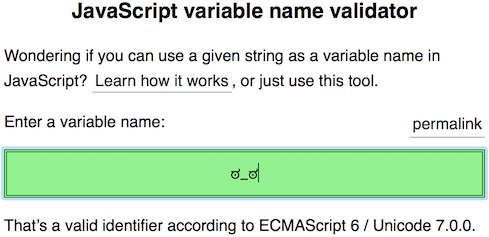
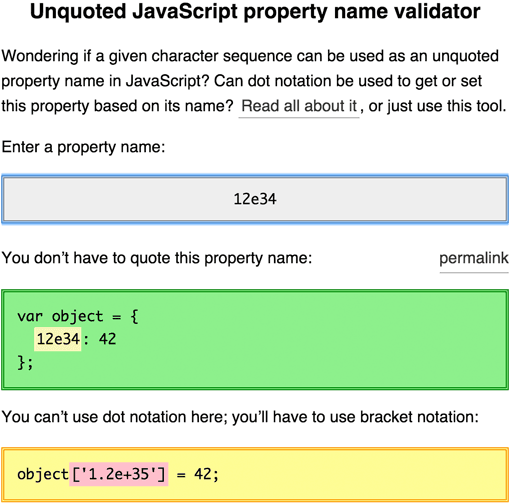
I’ve updated the unquoted JavaScript property name validator accordingly.
此内容由惯性聚合(RSS阅读器)自动聚合整理,仅供阅读参考。 原文来自 — 版权归原作者所有。