


I don't know that I've ever been more excited about an egghead.io course release before (having personally published over 100 videos on egghead, that's saying something...). Two of my courses will be (have now been) released as part of egghead's annual Christmas course release celebration 🎉 One is The Beginner's Guide to ReactJS and the other is Advanced React Component Patterns. Combined they amount to about 2.5 hours of content. They're each 18 high-quality videos. I can't wait for you all to see them!

I want to take this opportunity to talk about some of the patterns you'll learn in the Advanced React Component Patterns course. I hope you find it helpful and that this preview will help you be eager to give the course a look! 👀
The course starts with a single lesson where I implement a simple toggle component that manages its own state. We use, refactor, and evolve this component to each of the patterns. My hope is that by doing things this way you can quickly identify the trade-offs of the different patterns and know when each pattern would be most appropriate.
The course wraps up by refactoring the toggle component to a redux component affectionately called "Rendux." I think that you'll be blown away by the flexibility of some of these patterns to make this refactor a pretty straightforward one.

Here's a high level overview of some of the patterns we cover in the course.
Think of compound components like the <select> and <option> elements in
HTML. Apart they don't do too much, but together they allow you to create the
complete experience. The way they do this is by sharing implicit state between
the components. Compound components allow you to create and use components which
share this state implicitly.
In these lessons I show you how to create components which allow you to
show/hide the state for the component as well as choose where to render the
switch. We start with using React.Children.map to provide props to the
underlying components, then we switch to context to allow you to render the
components at the depth you like.
An interesting example of a compound component is seapig.

Higher Order Components (HOC) are functions which return a component (fun fact,
the name "Higher Order Component"
is a bit of
a misnomer). This
pattern is pretty widely popular. The most common example of a higher order
component is from react-redux. It
allows you to share code by encapsulating logic in a "Wrapper" component which
renders a component you pass to the Higher Order Component function.
In this lesson we create a higher order component that adds the toggle
component's context to the props of the component we're "enhancing." This way
we can easily create custom components which have access to the toggle
component's on state and the toggle helper function.
There are actually six lessons dedicated to Higher Order Components in this course. This is to give time to explain all the weird things we have to do to make unobservable the fact your components use a Higher Order Components. If you can't guess, I'm on team "Use a Render Prop" 😉
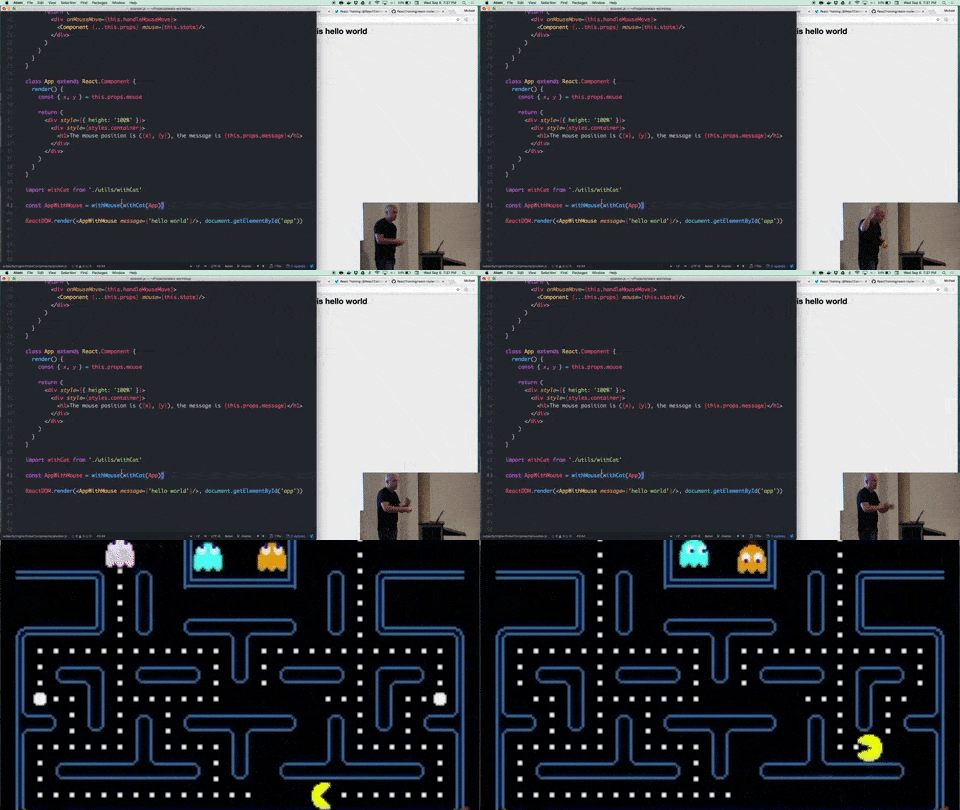
That said, it's still valuable to understand this pattern as it's such a widespread pattern and can still be useful. Later on, I show you how to implement an HOC from a render prop, which leads us to our next pattern...
This is my favorite pattern! The earliest use of this pattern in React that I'm
aware of was in react-motion by
Cheng Lou. In this lesson we go back to the
beginning a bit and slowly refactor our original toggle implementation to the
render prop pattern. Hopefully with this refactor you'll see both the power and
the simplicity of the render prop pattern.
The basic idea of the pattern is that rather than have the toggle component be
responsible for doing anything special in the render method, we delegate that
responsibility over to the user and we give them the state and functions
necessary to allow the user of the component to render what they need for their
use case.
My personal favorite implementation of this pattern (and some of the following
patterns) is downshift
🏎, but
I'm a little bit biased 😅
Often when using the render prop, there are elements that commonly require the
same props applied for accessibility or interactivity purposes. In the toggle
example that applies to what we're calling the "toggler" or the button/element
that's responsible for changing the on state of our toggle component. So we
can take these common props and put them into an object collection which can be
applied to the element we want.
There's a problem with prop collections that has to do with composability and
leaky abstractions. If my prop collection uses an onClick, that's an
implementation detail, but if I want to apply an onClick to my toggle element
for my own behavior as well as apply your prop collection, that's going to lead
to some problems. So I show you how you can use prop (collection) getters to
avoid this shortcoming.
This one's pretty simple and you've actually probably used this before, but I
show you a handy trick or two. Here we allow you to set the initial value
(similar to defaultValue in <input />) and then a nice way to expose a reset
helper function to allow users of the component to reset the component to its
initial state.
If you've ever "controlled" an <input /> component before by using the value
prop, you might be interested to know how that works and how to implement it
yourself. That's what this is all about. The basic idea is that you take some
state which the component manages internally (like the on state in our Toggle
component) and give control over to props. That means you reference props
instead of state, and call prop callbacks instead of setState. It's an
interesting pattern that makes your component much more flexible: If a user of
your component doesn't like how your component manages state, they can manage it
themselves!
You've very likely used a component that implements the Provider pattern before.
It's used by react-redux,
react-router, and many other
popular libraries. The idea is actually similar to some of the things we did
when making the compound component work regardless of tree depth. We start by
using context, then change to use
react-broadcast so it works
through shouldComponentUpdate.
Again, we wrap everything up by showing you that these patterns are powerful and
flexible enough to support both the state of a single boolean as well as our
entire application state with redux. I'm really excited for you to see this
one 😀

I really hope that this course will help you build more useful React components. The course will hit egghead.io 🔜 Enjoy!
此内容由惯性聚合(RSS阅读器)自动聚合整理,仅供阅读参考。 原文来自 — 版权归原作者所有。