
惯性聚合 高效追踪和阅读你感兴趣的博客、新闻、科技资讯
阅读原文 在惯性聚合中打开

推荐订阅源

D
DataBreaches.Net
S
Schneier on Security
T
The Exploit Database - CXSecurity.com
Webroot Blog
Webroot Blog
AI
AI
P
Palo Alto Networks Blog
Attack and Defense Labs
WordPress大学
WordPress大学
月光博客
月光博客
阮一峰的网络日志
阮一峰的网络日志
Spread Privacy
Spread Privacy
T
Tor Project blog
罗磊的独立博客
小众软件
小众软件
S
Security Affairs
酷 壳 – CoolShell
酷 壳 – CoolShell
量子位
Apple Machine Learning Research
T
Threatpost
NISL@THU
NISL@THU
博客园_首页
PCI Perspectives
PCI Perspectives
大猫的无限游戏
大猫的无限游戏
IT之家
IT之家
N
News and Events Feed by Topic
freeCodeCamp Programming Tutorials: Python, JavaScript, Git & More
Forbes - Security
Forbes - Security
博客园 - 叶小钗
D
Darknet – Hacking Tools, Hacker News & Cyber Security
OSCHINA 社区最新新闻
OSCHINA 社区最新新闻
Last Week in AI
Last Week in AI
L
LINUX DO - 热门话题
T
Threat Research - Cisco Blogs
cs.AI updates on arXiv.org
腾讯CDC
Security Latest
Security Latest
Exploit-DB.com RSS Feed
The Cloudflare Blog
A
About on SuperTechFans
爱范儿
爱范儿
Threat Intelligence Blog | Flashpoint
TaoSecurity Blog
TaoSecurity Blog
宝玉的分享
宝玉的分享
G
GRAHAM CLULEY
雷峰网
雷峰网
F
Full Disclosure
I
Intezer
Cloudbric
Cloudbric
博客园 - 三生石上(FineUI控件)
U
Unit 42

Minko Gechev's blog

skillgrade Unit Tests for AI Agent Skills You Should Care About AI Generative Development LLM-first Web Framework Reactive framework in ~200 lines of JavaScript Managing Angular Are LLMs going to replace us? Prefetching Heuristics Design Patterns in Open Source Projects - Part II Design Patterns in Open Source Projects - Part I What I learned doing 125 public talks - Part I Dynamic imports solve all the problems, right? 5 Angular CLI Features You Didn't Know About Angular quicklink Preloading Strategy Introducing Bazel Schematics for Angular CLI Building TypeScript Projects with Bazel Joining Google Playing Mortal Kombat with TensorFlow.js. Transfer learning and data augmentation Fast, extensible, configurable, and beautiful linter for Go Introducing Guess.js - a toolkit for enabling data-driven user-experiences on the Web Machine Learning-Driven Bundling. The Future of JavaScript Tooling. JavaScript Decorators for Declarative and Readable Code 3 Tricks For Using Redux and Immutable.js with TypeScript Follow Your Dream Career with Open Source. Personal Story. Redux Anti-Patterns - Part 1. State Management. Faster Angular Applications - Understanding Differs. Developing a Custom IterableDiffer Faster Angular Applications - Part 2. Pure Pipes, Pure Functions and Memoization Faster Angular Applications - Part 1. On Push Change Detection and Immutability Understanding Dynamic Scoping and TemplateRef Implementing a Simple Compiler on 25 Lines of JavaScript Developing Statically Typed Programming Language WebVR for a Gamified IDE 7 Angular Tools That You Should Consider Announcing ngrev - Reverse Engineering Tool for Angular Implementing Angular's Dependency Injection in React. Understanding Element Injectors. Distributing an Angular Library - The Brief Guide Angular in Production Ahead-of-Time Compilation in Angular 2.5X Smaller Angular 2 Applications with Google Closure Compiler Using Stripe with Angular (Deprecated) Building an Angular Application for Production Implementing the Missing "resolve" Feature of the Angular 2 Router Scalable Single-Page Application Architecture Managing ambient type definitions and dealing with the "Duplicate identifier" TypeScript error Static Code Analysis of Angular 2 and TypeScript Projects Enforcing Best Practices with Static Code Analysis of Angular 2 Projects ViewChildren and ContentChildren in Angular Dynamically Configuring the Angular's Router Angular 2 Hot Loader Lazy Loading of Route Components in Angular 2 Aspect-Oriented Programming in JavaScript Flux in Depth. Store and Network Communication. Using JSX with TypeScript Flux in Depth. Overview and Components. Even Faster AngularJS Data Structures Boost the Performance of an AngularJS Application Using Immutable Data - Part 2 Angular2 - First Impressions Build Your own Simplified AngularJS in 200 Lines of JavaScript Persistent State of ReactJS Component Boost the Performance of an AngularJS Application Using Immutable Data Processing Binary Protocols with Client-Side JavaScript Stream your Desktop to HTML5 Video Element Multi-User Video Conference with WebRTC Asynchronous calls with ES6 generators Binary Tree iterator with ES6 generators WebRTC chat with React.js AngularJS in Patterns (Part 3) AngularJS in Patterns (Part 2). Services. Using GitHub Pages with Jekyll! AngularJS in Patterns (Part 1). Overview of AngularJS Singleton in JavaScript Express over HTTPS What I get from the JavaScript MV* frameworks Remote Desktop Client with AngularJS and Yeoman The magic of $resource (or simply a client-side Active Record) AngularJS Inheritance Patterns AngularAOP v0.1.0 Advanced JavaScript at Sofia University AngularJS style guide Lazy prefetching of AngularJS partials VNC client on 200 lines of JavaScript Aspect-Oriented Programming with AngularJS CSS3 flipping effect Practical programming with JavaScript Why I should use publish/subscribe in JavaScript JavaScript, the weird parts Functional programming with JavaScript plainvm Looking for performance? Probably you should NOT use [].sort (V8) JavaScript image scaling ELang Caching CSS with localStorage Self-invoking functions in JavaScript (or Immediately Invoked Function Expressions) Asus N56VZ + Ubuntu 12.04 (en) Asus N56VZ + Ubuntu 12.04 HTML5 image editor Курсови проекти – ФМИ Carousel Gallery SofiaJS...
Debian Squeeze + LXDE on Google Nexus S (or having some fun while suffering)
2012-07-08 · via Minko Gechev's blog

I’m here again, after a long pause. For a while I’ve got problems with my health and I’m nailed at home…so I’ve go a lot of free time. Last night I’ve decided to root my Google Nexus S.
I use Ubuntu
12.04 on my home machine so I put on it Oracle Java and Android SDK. I also installed few packages from the SDK (platform-tools). I created few udev rules, because my computer wasn’t able to know what to do when I plug-in my Nexus with a fastboot mode. In the next step I unlocked my Nexus (the reason for that was because my warranty is over…otherwise I would think a bit more before I go to the next step). Having the Android SDK, the unlock procedure is quite easy:

 #./android-sdk-linux/platform-tools/fastboot oem unlock 

The next step was to install TWRP recovery. I chose that one because all the things I read ensured me that it’s the last generation recovery…Soo I went to the http://teamw.in/project/twrp2 page and downloaded the last version for my device. With the SDK I flashed it:

 # ./android-sdk-linux/platform-tools/fastboot flash recovery openrecovery-twrp-crespo-2.1.1.img 

…the final step was to root my Nexus S. I downloaded few files from http://androidsu.com/superuser/ and I put it’s content into my phone’s root folder. After I restarted my phone using fastboot, with few taps on the TWRP’s interface, mounting the Nexus’s storage and taping on Eject, my phone was almost flashed…the final sub-step was to restart the device and choose Install…after that to select my superuser-archive…

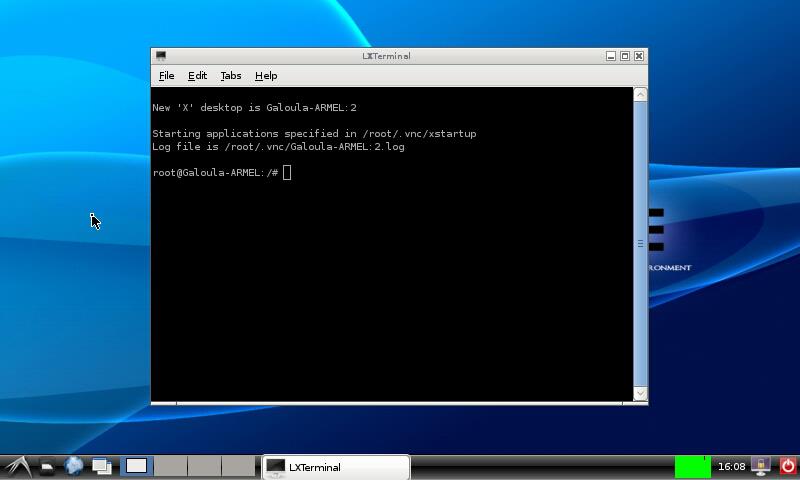
After I restarted my phone and my root privileges were granted. And here comes the most easy and interesting part – Installing Debian and LXDE.

There’s easy Linux Installer for Android. Changing few settings will make your linux storage big enough. After you install the system (which is done by few clicks…) you’ve got to install some kind of terminal for your Android. I’ve choose Android terminal emulator.

Install LXDE:

 # apt-get install lxde 

Install a VNC server:

 # apt-get install tightvncserver 

You can export your user as root…

 # export USER=root 

To start your VNC server at start-up add the following lines to .bashrc:

 export USER=root 

 cd / 

 rm -r -f tmp 

 mkdir tmp 

 cd / 

 vncserver -geometry 800x480 #resolution for my Nexus S 

And you’re done – just use your favorite VNC client to connect your phone to the Debian’s GUI.