


Feeding The Trolls

Chris Kremidas-Courtney talks about the Fascintern, a term modelled on the historical coordinating role of the Comintern and that captures the fact that the far right is acting internationally as one party, with explicit backing from Moscow, Washington, and tech monopolies.
The reality of the Fascintern isn't in doubt. Putin's hybrid warfare has been destabilising democratic information spheres for years (just ask the Georgians), Trump's recent National Security Strategy is openly pushing to end coordination between European democracies — our primary strength — while laying out a series of far right grievances, billionaires on multiple continents are fuelling anti-democratic sentiment because they have (correctly) understood that democracy is the only tool we have to put an end to the growing inequality they enjoy, and tech monopolies are busy supporting this whole endeavour.
All political movements need some form of media aligned with them, it's long been a core function that helps coordinate positions once a movement needs to scale beyond local actions. With the Fascintern, however, we see a surprising evolution of this trend. With the exception of state-aligned dominant media, media aligned with a specific political cause has historically mostly been read by direct adherents of that cause. A political outlet is read as a sign of belonging, a point of pride, not by unaligned citizens.
But today's Fascintern media — X, the Meta portfolio, YouTube, Google Search, Substack — are widely read not just by unaligned citizens but even by politicians who purport to defend different politics. In an unusual turn, we are dealing with a power-aligned dominant media ecosystem that is pushing to overthrow the existing political system. Why is that happening?
I left X a while ago. It wasn't an easy decision, it took years of work to grow an audience of ten thousand followers, amongst which were many fascinating voices from different walks of life and a great number of people I thought of as my friends from the internet. I left because it had become painfully obvious that it was no longer the convening space that had made it such an important location both personally and professionally. When Elon Musk gave a Nazi salute during the second Trump inauguration, I thought that anyone who hates Nazism — which last I checked was still most people — could do nothing other than jump ship as well. A year later, many of them are still there.
Based on conversations I've had with people who still maintain an active presence there (and I'm not counting journalists who don't post but read it for coverage purposes), my conclusion is that non-fascists who stay on X do so for a simple reason: they have a completely faulty understanding of how power works in the digital sphere and operate according to mental models of social media that simply do not match reality.
Interestingly, this lack of digital literacy isn't generational and can apply equally well to people who nominally grew up with the internet. As a side note, I think it's a notable evolution that we have transitioned from a world in which a failed understanding of digital matters is primarily due to a lack of familiarity to one in which it sits downstream of failed mental models and poor grasp of digital dynamics. In a sense, we've gone from Boomers to Xoomers.
The two faulty mental models that keep people on X are related to one another but have different flavours. I would list them as "we cannot cede X to Nazis, we have to reclaim it for ourselves" and "I have an audience there and they deserve to be spoken with". I will illustrate how both fail in the real world.
Occupy X
This faulty mental model is that people think of social media as some form of public square which they can somehow physically occupy with their digital presence. The intuition is that if a bunch of Nazis are agitating on your town square, you can show up and flood the space with good people and refuse to cede the square to them. So if good people just stay on X, eventually we'll drive the fascists out.
Essentially, the mental model looks like this (no room left for fascism!):

That model is correct in the physical world. It is also generally correct in digital spaces in which fascists might just be participants and that aren't editorially (algorithmically) structured to give preference to certain voices. The model is, however, thoroughly and hopelessly wrong when applied to Fascintern media properties that are both controlled by people who support fascism with various degrees of enthusiasm and where those people will use editorial amplification to make some participants much more important than others. If you want to think in terms of a physical space, the situation is comparable to a public square in which the Nazis can make themselves and their friends as large as they want to and everyone who they disagree with as small as ants. I've never seen ants stage much of a successful anti-fascist protest.
The reality looks a lot more like this:
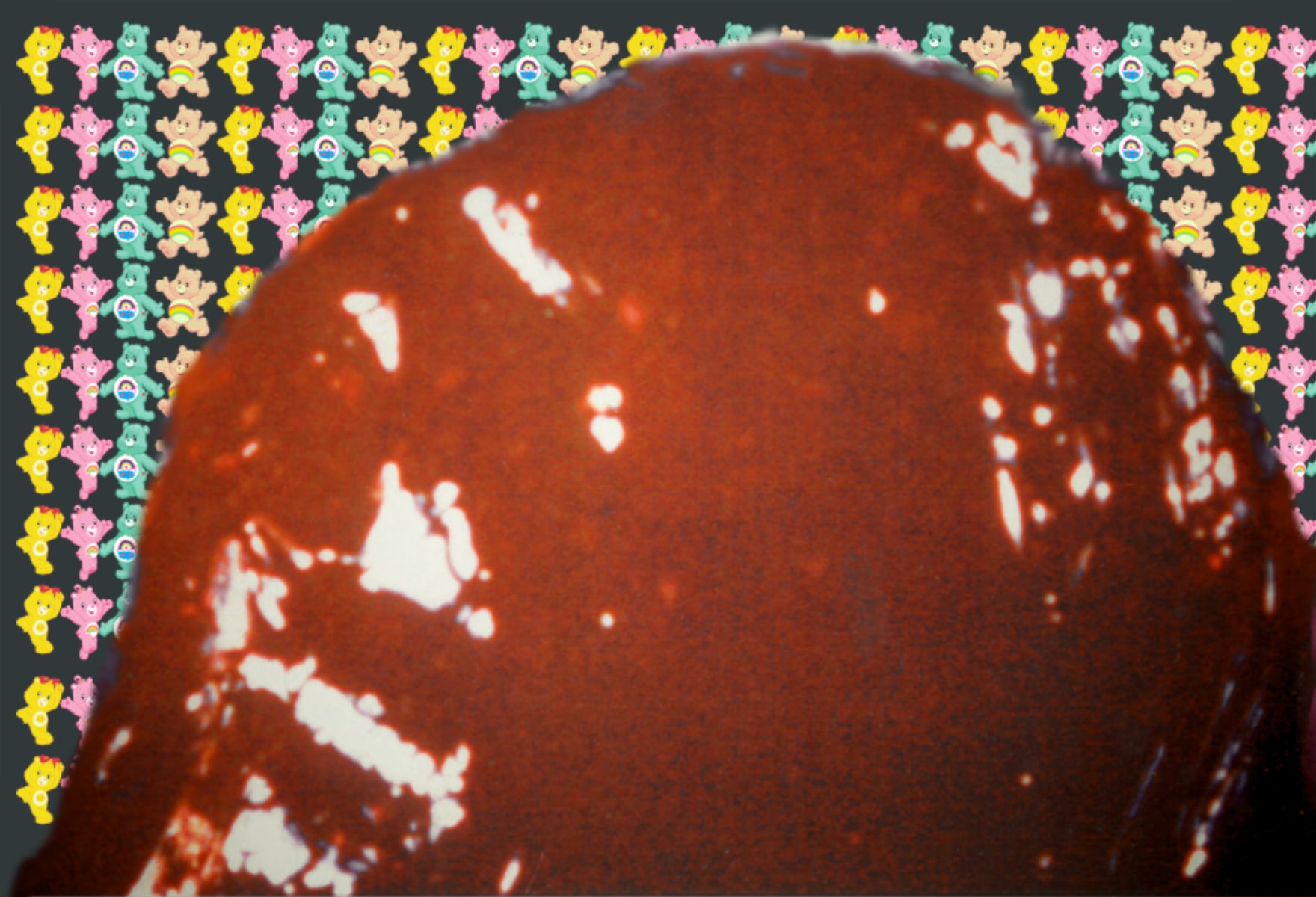
(Note that in a spirit of respect and open-mindedness I drew inspiration from the broligarchy's idiosyncratic way of loving of sci-fi and sought to represent Musk & Zuck as the blob from cult sci-fi classic The Blob.)
If you understand how digital systems, and notably how recommendation algorithms, work then you understand that there is no limit to how unbalanced the amplification of certain voices and suppression of others can be. You could have 8 billion people on X and only 800 fascists, and yet the fascists would still crowd you out.
The only things that you accomplish when you give your attention to Fascintern media is to make them more relevant, to subject yourself to fascist propaganda, and to increase their advertising revenue.
I Must Speak To The People
The other faulty mental model is the idea that people are there on these media and it's therefore important to speak to the people where they are. Forget for a moment that, if you're a figure of some influence yourself, those people are there at least in part because you're making that place relevant. The intuition behind this mental model comes from a defensible kernel of pragmatism and anti-elitism but, like the previous one, it is based on the mistaken understanding that digital spaces work the way that physical spaces do.
In the physical space, we can imagine that the people who you wish to reach congregate at the Fascism Village Fair, maybe because the beer and entertainment is better there. In that case, as a non-fascist politician or person of influence, it can make sense to go speak to those people there. In fact, it may even be courageous to do so.
People translate this intuition to digital spaces. It looks like this:

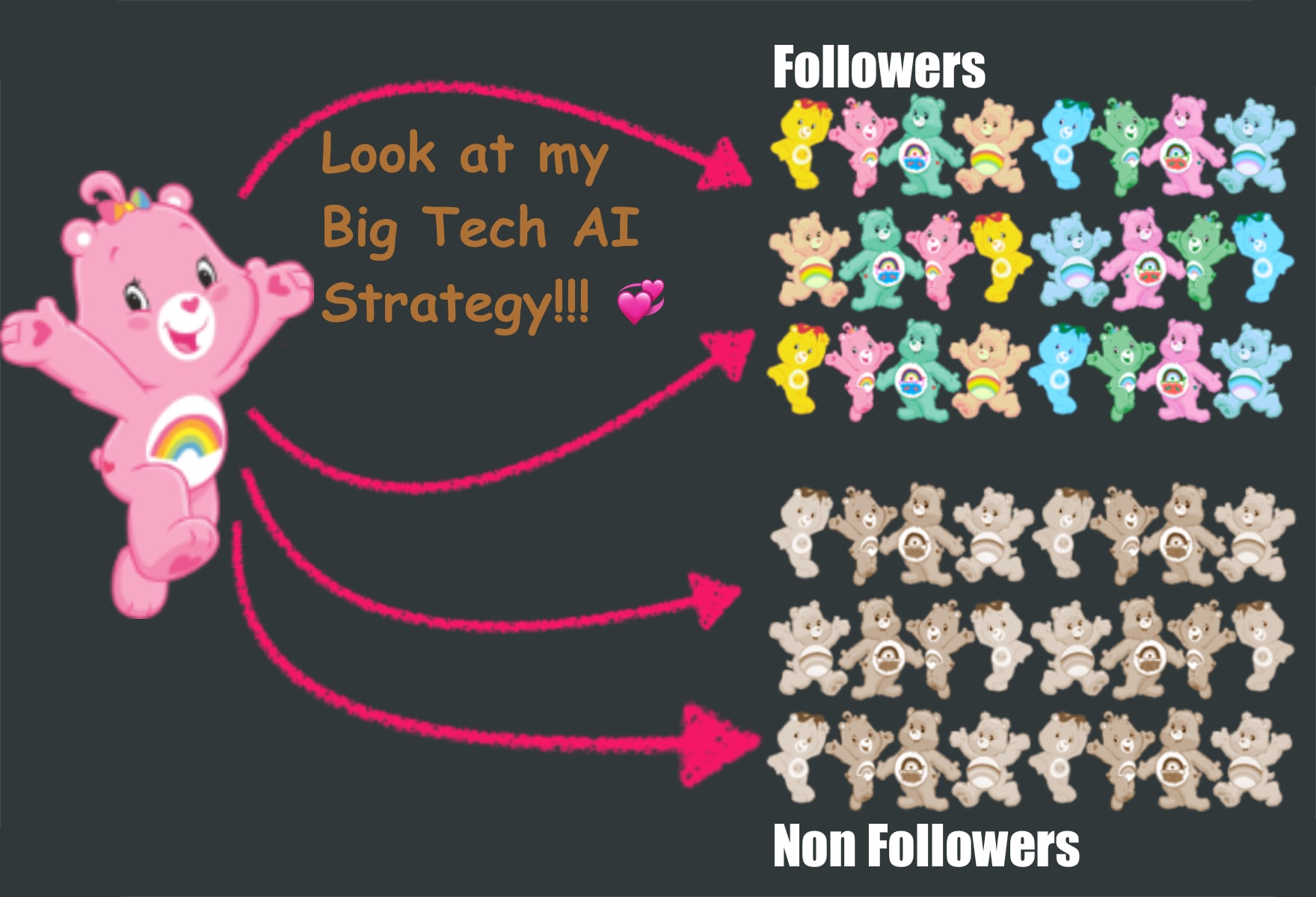
But, again, this mental model is completely detached from reality. On Fascintern media, when you speak, there is no guarantee that your followers will see what you post. When you follow someone, there is no guarantee that you will see what they post. Unlike a physical space in which whoever speaks can be heard by all present, everyone's feed is editorially curated and that editorial curation decides whose message reaches which audience.
In reality, the way that posting on Fascintern media works can follow two paths. In the first path, you post something that aligns with fascist interests (either politically or because it makes them money). In that case, your message won't just reach your followers, it will reach a potentially much larger audience than that:
Conversely, in the second path you post something that is inimical to fascist interests. In this case, your message is simply dead on arrival:

As in the previous section, you cannot change the system by participation. There is no limit to the editorial influence that the people running these media have. You cannot change the tenor of public discourse on those media by participating as they decide what is publicised and what isn't.
There is a reason why I have been focusing systematically on the media nature of these systems: because this framing provides a much more correct mental model for what your participation can and cannot achieve.
If you think of traditional media, say a newspaper for instance, then its tenor is determined by its editorial process. You can think of the editorial process as consisting (broadly) of three steps, each of which has equivalents in today's digital media:
- Sourcing. You obtain content from various sources, maybe you have reporters on staff or you accept pitches. With "user-generated content" you take submissions according to a specific format or you crawl the internet.
- Filtering. Is it newsworthy? Does it match the kind of content you publish? Does it match your political line? Similarly, content can be filtered from digital media for instance for content moderation or simply because the owners dislike it.
- Ranking. A piece can go on the front page and take up multiple columns or it can get delayed a few days and get a short paragraph buried on some unpopular page. This is of course a well-understood of search and social media.
The media outlets of the Fascintern — X, Meta, Google — are all structured to exert strong editorial control according to their business and political preferences. These systems work entirely like a very big and somewhat personalised newspaper and not at all like a public space. The more democratic social media systems like Bluesky, where the default feed is chronological and people can choose from thousands of additional feeds that suit their personal preferences (supporting algorithmic pluralism), work much more like public spaces (but we need deliberate projects to keep them that way).
As a side note, I find it amusing that some commentators decry Bluesky is left-coded when by default it is purely chronological. Far right ideas have no popular traction — they only exist with billionaire subsidies. As John Scalzi aptly put it: "The real question is not 'Why is Bluesky so left-coded,' the real question is 'Why can't the right exist in a social media environment without algorithmic assistance, where people can ignore them'."
To conclude, it's important to understand that:
- When you read Fascintern media, you are reading editorialised fascism. You aren't protesting. You have no power. You are just subjecting yourself to an information space that is editorially structured to promote fascism. No one is impervious to the influence of their information environment — not even you, smart as I know you are. And you're making them money.
- When you write for Fascintern media, you are choosing to publish with them. When you post on X you are basically pitching a story to Der Stürmer. You are not speaking to anyone that they don't want you speaking to. You're not being courageous; you're collaborating. You're associating your name with that outlet. And you're making them money.
This is not a theoretical problem. Jon Worth recently assembled a comprehensive wall of shame of European Commissioners who still write for Elon Musk — sometimes frequently. These are not times for political equivocation, these are not times for appeasement, these are not times for hapless bystanders who don't understand their own online behaviour. These are times for clarity and leadership. And anyone still working with Fascintern media today is failing to meet that standard.