
minute read

UPD 23.04.2025: MITRE created a page for Operation Triangulation as part of its ATT&CK framework.
While monitoring the network traffic of our own corporate Wi-Fi network dedicated for mobile devices using the Kaspersky Unified Monitoring and Analysis Platform (KUMA), we noticed suspicious activity that originated from several iOS-based phones. Since it is impossible to inspect modern iOS devices from the inside, we created offline backups of the devices in question, inspected them using the Mobile Verification Toolkit’s mvt-ios and discovered traces of compromise.
We are calling this campaign “Operation Triangulation”, and all the related information we have on it will be collected on the Operation Triangulation page. If you have any additional details to share, please contact us: triangulation[at]kaspersky.com.
What we know so far
Mobile device backups contain a partial copy of the filesystem, including some of the user data and service databases. The timestamps of the files, folders and the database records allow to roughly reconstruct the events happening to the device. The mvt-ios utility produces a sorted timeline of events into a file called “timeline.csv”, similar to a super-timeline used by conventional digital forensic tools.
Using this timeline, we were able to identify specific artifacts that indicate the compromise. This allowed to move the research forward, and to reconstruct the general infection sequence:
- The target iOS device receives a message via the iMessage service, with an attachment containing an exploit.
- Without any user interaction, the message triggers a vulnerability that leads to code execution.
- The code within the exploit downloads several subsequent stages from the C&C server, that include additional exploits for privilege escalation.
- After successful exploitation, a final payload is downloaded from the C&C server, that is a fully-featured APT platform.
- The initial message and the exploit in the attachment is deleted
The malicious toolset does not support persistence, most likely due to the limitations of the OS. The timelines of multiple devices indicate that they may be reinfected after rebooting. The oldest traces of infection that we discovered happened in 2019. As of the time of writing in June 2023, the attack is ongoing, and the most recent version of the devices successfully targeted is iOS 15.7.
The analysis of the final payload is not finished yet. The code is run with root privileges, implements a set of commands for collecting system and user information, and can run arbitrary code downloaded as plugin modules from the C&C server.
Forensic methodology
It is important to note, that, although the malware includes portions of code dedicated specifically to clear the traces of compromise, it is possible to reliably identify if the device was compromised. Furthermore, if a new device was set up by migrating user data from an older device, the iTunes backup of that device will contain the traces of compromise that happened to both devices, with correct timestamps.
Preparation
All potential target devices must be backed up, either using iTunes, or an open-source utility idevicebackup2 (from the package libimobiledevice). The latter is shipped as a pre-built package with the most popular Linux distributions, or can be built from the source code for MacOS/Linux.
To create a backup with idevicebackup2, run the following command:
idevicebackup2 backup --full $backup_directory
You may need to enter the security code of the device several times, and the process may take several hours, depending on the amount of user data stored in it.
Install MVT
Once the backup is ready, it has to be processed by the Mobile Verification Toolkit. If Python 3 is installed in the system, run the following command:
pip install mvt
A more comprehensive installation manual is available the MVT homepage.
Optional: decrypt the backup
If the owner of the device has set up encryption for the backup previously, the backup copy will be encrypted. In that case, the backup copy has to be decrypted before running the checks:
mvt-ios decrypt-backup -d $decrypted_backup_directory $backup_directory
Parse the backup using MVT
mvt-ios check-backup -o $mvt_output_directory $decrypted_backup_directory
This command will run all the checks by MVT, and the output directory will contain several JSON and CSV files. For the methodology described in this blogpost, you will need the file called timeline.csv.
Check timeline.csv for indicators
- The single most reliable indicator that we discovered is the presence of data usage lines mentioning the process named “BackupAgent”. This is a deprecated binary that should not appear in the timeline during regular usage of the device. However, it is important to note that there is also a binary named “BackupAgent2”, and that is not an indicator of compromise. In many cases, BackupAgent is preceded by the process “IMTransferAgent”, that downloads the attachment that happens to be an exploit, and this leads to modification of the timestamps of multiple directories in the “Library/SMS/Attachments”. The attachment is then deleted, leaving only modified directories, without actual files inside them:
2022-09-13 10:04:11.890351Z Datausage   IMTransferAgent/com.apple.datausage.messages (Bundle ID: com.apple.datausage.messages, ID: 127) WIFI IN: 0.0, WIFI OUT: 0.0 - WWAN IN: 76281896.0, WWAN OUT: 100956502.0

2022-09-13 10:04:54.000000Z Manifest    Library/SMS/Attachments/65/05 - MediaDomain

2022-09-13 10:05:14.744570Z Datausage BackupAgent (Bundle ID: , ID: 710) WIFI IN: 0.0, WIFI OUT: 0.0 - WWAN IN: 734459.0, WWAN OUT: 287912.0 - There are also less reliable indicators, that may be treated as IOCs if several of them happened within a timeframe of minutes:
- Modification of one or several files: com.apple.ImageIO.plist, com.apple.locationd.StatusBarIconManager.plist, com.apple.imservice.ids.FaceTime.plist
- Data usage information of the services com.apple.WebKit.WebContent, powerd/com.apple.datausage.diagnostics, lockdownd/com.apple.datausage.security
Example:
2021-10-30 16:35:24.923368Z Datausage   IMTransferAgent/com.apple.MobileSMS (Bundle ID: com.apple.MobileSMS, ID: 945) WIFI IN: 0.0, WIFI OUT: 0.0 - WWAN IN: 31933.0, WWAN OUT: 104150.0

2021-10-30 16:35:24.928030Z Datausage   IMTransferAgent/com.apple.MobileSMS (Bundle ID: com.apple.MobileSMS, ID: 945)

2021-10-30 16:35:24.935920Z Datausage   IMTransferAgent/com.apple.datausage.messages (Bundle ID: com.apple.datausage.messages, ID: 946) WIFI IN: 0.0, WIFI OUT: 0.0 - WWAN IN: 47743.0, WWAN OUT: 6502.0

2021-10-30 16:35:24.937976Z Datausage   IMTransferAgent/com.apple.datausage.messages (Bundle ID: com.apple.datausage.messages, ID: 946)

2021-10-30 16:36:51.000000Z Manifest    Library/Preferences/com.apple.locationd.StatusBarIconManager.plist - HomeDomain

2021-10-30 16:36:51.000000Z Manifest    Library/Preferences/com.apple.ImageIO.plist - RootDomain
Another example: modification of an SMS attachment directory (but no attachment filename), followed by data usage of com.apple.WebKit.WebContent, followed by modification of com.apple.locationd.StatusBarIconManager.plist. All the events happened within a 1-3 minute timeframe, indicating the result of a successful zero-click compromise via an iMessage attachment, followed by the traces of exploitation and malicious activity.
2022-09-11 19:52:56.000000Z Manifest    Library/SMS/Attachments/98 - MediaDomain

2022-09-11 19:52:56.000000Z Manifest    Library/SMS/Attachments/98/08 - MediaDomain

2022-09-11 19:53:10.000000Z Manifest    Library/SMS/Attachments/98/08 - MediaDomain

2022-09-11 19:54:51.698609Z OSAnalyticsADDaily  com.apple.WebKit.WebContent WIFI IN: 77234150.0, WIFI OUT: 747603971.0 - WWAN IN: 55385088.0, WWAN OUT: 425312575.0

2022-09-11 19:54:51.702269Z Datausage   com.apple.WebKit.WebContent (Bundle ID: , ID: 1125)

2022-09-11 19:54:53.000000Z Manifest    Library/Preferences/com.apple.locationd.StatusBarIconManager.plist - HomeDomain

2022-06-26 18:21:36.000000Z Manifest    Library/SMS/Attachments/ad/13 - MediaDomain

2022-06-26 18:21:36.000000Z Manifest    Library/SMS/Attachments/ad - MediaDomain

2022-06-26 18:21:50.000000Z Manifest    Library/SMS/Attachments/ad/13 - MediaDomain

2022-06-26 18:22:03.412817Z OSAnalyticsADDaily  com.apple.WebKit.WebContent WIFI IN: 19488889.0, WIFI OUT: 406382282.0 - WWAN IN: 66954930.0, WWAN OUT: 1521212526.0

2022-06-26 18:22:16.000000Z Manifest    Library/Preferences/com.apple.ImageIO.plist - RootDomain

2022-06-26 18:22:16.000000Z Manifest    Library/Preferences/com.apple.locationd.StatusBarIconManager.plist - HomeDomain

2022-03-21 21:37:55.000000Z Manifest    Library/SMS/Attachments/fc - MediaDomain

2022-03-21 21:37:55.000000Z Manifest    Library/SMS/Attachments/fc/12 - MediaDomain

2022-03-21 21:38:08.000000Z Manifest    Library/SMS/Attachments/fc/12 - MediaDomain

2022-03-21 21:38:23.901243Z OSAnalyticsADDaily  com.apple.WebKit.WebContent WIFI IN: 551604.0, WIFI OUT: 6054253.0 - WWAN IN: 0.0, WWAN OUT: 0.0

2022-03-21 21:38:24.000000Z Manifest Library/Preferences/com.apple.locationd.StatusBarIconManager.plist - HomeDomain - An even less implicit indicator of compromise is inability to install iOS updates. We discovered malicious code that modifies one of the system settings file named com.apple.softwareupdateservicesd.plist. We observed update attempts to end with an error message “Software Update Failed. An error ocurred downloading iOS”.
Network activity during exploitation
On the network level, a successful exploitation attempt can be identified by a sequence of several HTTPS connection events. These can be discovered in netflow data enriched with DNS/TLS host information, or PCAP dumps:
- Legitimate network interaction with the iMessage service, usually using the domain names *.ess.apple.com
- Download of the iMessage attachment, using the domain names .icloud-content.com, content.icloud.com
- Multiple connections to the C&C domains, usually 2 different domains (the list of known domains follows). Typical netflow data for the C&C sessions will show network sessions with significant amount of outgoing traffic.

Network exploitation sequence, Wireshark dump
The iMessage attachment is encrypted and downloaded over HTTPS, the only implicit indicator that can be used is the amount of downloaded data that is about 242 Kb.
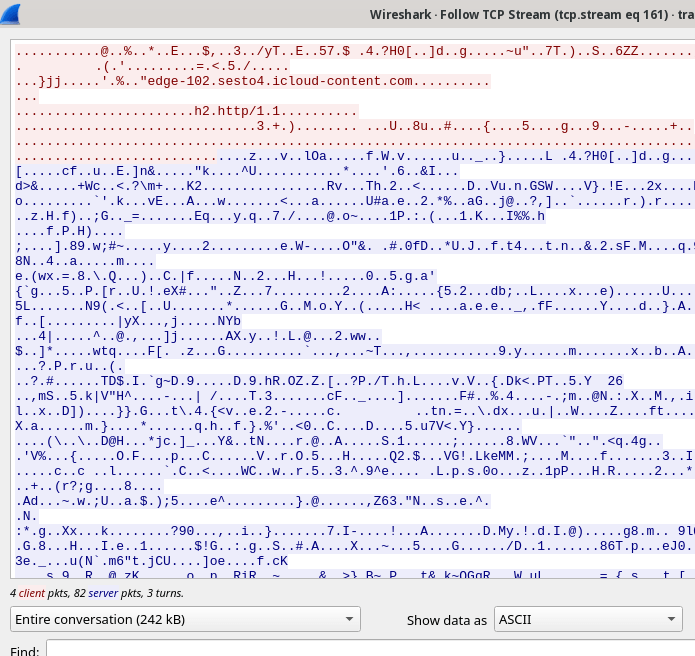
Encrypted iMessage attachment, Wireshark dump
C&C domains
Using the forensic artifacts, it was possible to identify the set of domain name used by the exploits and further malicious stages. They can be used to check the DNS logs for historical information, and to identify the devices currently running the malware:
addatamarket[.]net
backuprabbit[.]com
businessvideonews[.]com
cloudsponcer[.]com
datamarketplace[.]net
mobilegamerstats[.]com
snoweeanalytics[.]com
tagclick-cdn[.]com
topographyupdates[.]com
unlimitedteacup[.]com
virtuallaughing[.]com
web-trackers[.]com
growthtransport[.]com
anstv[.]net
ans7tv[.]net