Kubernetes Rules Everything Around Me, VMworld, Pivotal Container Service
Software Defined Talk LLC·2017-09-01·via Software Defined Talk
Episode 105
·
August 31st, 2017
·
58 mins 20 secs
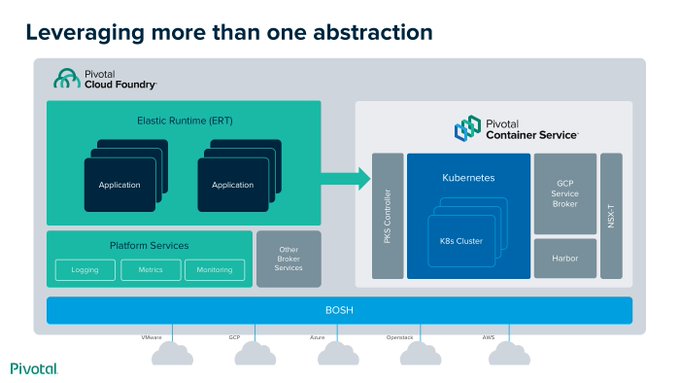
It’s VMworld this week, so there’s fresh news from the Dell Technologies universe to sort through. VMware releases it’s SDDC on AWS scheme and Pivotal announces its container service/stack, Pivotal Container Service (PKS). We discuss both, including a meandering overview of what PKS is and some theory about what enterprises actually want with all that VMware in public cloud. Also, the tragic story of airline and hotel upgrades, like pearls to tired business travelers.
VMware/Pivotal/Google make a kubo distro. Uses BOSH, NSX, and kubo to setup clusters. Will run on vSphere and Google Cloud, promises to work with other Google Cloud services, be continuously updated to be compatible with GCE containers. Also, VMware storage services and comparability with VMware systems management tools.
TPM: “The private PKS stack will use vSAN for storage, vRealize Automation for orchestration and governance, vCloud Director for provisioning, and vRealize Operations for monitoring. (So, in theory, one could run the PKS stack on the AWS cloud slices that VMware has partnered with Amazon to create, effectively creating a clone of GKE to run on AWS bare metal iron. . . .)”
More laundry listing of the parts from Google, that is, Google Cloud services you can use in a PKS environment: BigQuery, Bigtable, Spanner, Storage, SQL, Pub/Sub, Vision API, Speech API, Natural Language API, Translate API.
Use it for: “PKS™ is ideal for workloads like Spark and ElasticSearch, and when you need access to infrastructure primitives. Further, use PKS for apps that require specific co-location of container instances, and for those that need multiple port binds.”
The Pod affinity thing here is for when you want to run multiple things grouped together, like with Spark, Elastic Search, etc. where you the different things go together.
Lots of emphasize on a unified, compatible approach/GTM: “We now have a Cloud Native/Digital Transformation stack where there is a SINGLE target we are furiously running towards now as VMware, Pivotal, and Dell EMC – no mis-alignment, no differences in PoV. “
That CoreOS/451 survey had a very important footnote: the survey respondents were already running containers already. It was more about which container orchestration platforms they liked.
It was hard to do conclusive ranking of container orchestrators since people were using multiple ones. But, if you lump together CoreOS’s kubernetes distro with generic kubernetes, kubernetes wins out over Docker Swarm, 49% vs. 36%.
Meanwhile: “By 2020, 50%+ of global enterprises will be running containerized applications in production, up from <20% today.”
Run the VMware stack on AWS, out of beta: “For the IT and software development sectors, the deal means that VMware mainstays such as all its software-defined data center ware—vCenter, NSX, vSphere, VSAN and others—will run on AWS instead of VMware's own cloud.”
”The three-year contract costs $109,366 per host, which would save about 50% compared to the on-demand hourly billing rate, according to VMware. Another program can cut costs by up 25% based on their on-premises VMware product licenses, as long as those on-premises products remain active…. There are separate charges for IP and data transfers, as the standard AWS egress fees still apply. Each host has 2 CPUs, 36 cores, 72 hyper-threads, 512 GiB RAM and local flash storage.” - ”the estimated total cost of ownership for VMware Cloud on AWS is up to $0.09 per VM per hour, according to VMware”
More pricing info from TPM: “The base on demand price for this server is $8.3681 per hour, which works out to around $6,109 per month.”
Cloud-context, from Derrick Harris: “Look at the companies’ most-recent fiscal years—2016—during which VMware grew about 9 percent to just over $7 billion in revenue, while AWS grew about 45 percent to more than $12.2 billion in revenue. It’s on pace for about $16 billion in revenue in 2017.”
And, more from Derrick on public cloud companies ever elusive quest to grab on-premises workloads and revenue: “There will continue to be a lot of big workloads running inside company data centers. If AWS and Google really want a shot at owning them, they’ll probably need to get their hands (and code) a little dirty by going to where those applications live and showing there’s a better way of doing things.”
It makes you wonder if a strategy for public cloud companies going behind-the-firewall is just wishful projection on the on-premise set’s part. 451 surveys a predicting that by 2019, 60% of work-loads will run on cloud technologies (across public, hosted, and private), with under 25% on private cloud (hosted/managed and on-premises).
VMworld, in general
Round-up of news from Larry Dignan - lot’s of security stuff, of which Coté has no clue. And, of course, the VDI/desktop stuff. It’s like the old Project Octopus era vision of VMware.
VIO, VMware’s OpenStack distro has a few production users, but, “for the most part customers are deploying it for their development and test environments, where programmers want to embrace OpenStack and the IT managers want to keep everything on a VMware substrate”
VIO pricing: “The other thing that is new with VIO 4.0 is that it is no longer free. Starting with this release, VIO will cost $995 per server socket in a Datacenter Edition, but customers who are using VIO in conjunction with the vRealize management suite will be able to get it for $495 per socket. That is just the price of the perpetual license; reckon another 18 percent or so on top of that for annual support.”