


As rainfall intensifies with climate change, waste flushed out to sea could attract more sharks, putting beachgoers at risk
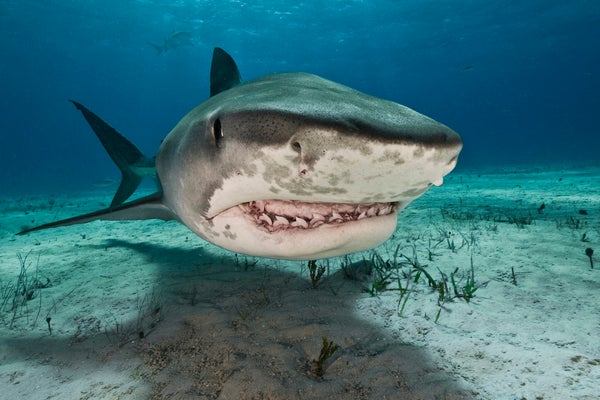
Tiger sharks (Galeocerdo cuvier) are common visitors of the reefs north of the Bahamas in the Caribbean.
Rodrigo Friscione/Getty Images
In the space of just 48 hours this past January, four people were bitten by sharks along Australia’s east coast, with a 12-year-old boy dying from his injuries. Just one day prior, record-setting rain soaked the region. That sequence of events may not have been a coincidence: a growing body of research suggests that shark bites, though rare, may become less so as climate change triggers more heavy rain events, altering shark behavior.
As with any shark bite, it’s impossible to determine the exact drivers behind this January cluster, says Charlie Huveneers, director of Flinders University’s Marine and Coastal Research Consortium in Australia. But the rainfall, he says, likely contributed: “It might be that because of the rain, they were more concentrated at that time.”
The theory is that the deluge, which broke January daily rainfall records for Sydney, flushed sewage and other waste into the nearby coastal waters, attracting baitfish, which in turn lured sharks closer to shore. Previous studies in Australia have shown this correlation, including one analysis that suggests bites from tiger sharks are more common following heavy rainfall. Other research has found that increased sediment in water—common following intense rain—also raises risks because it reduces water visibility, making it more difficult for sharks to see and avoid people.
If you're enjoying this article, consider supporting our award-winning journalism by subscribing. By purchasing a subscription you are helping to ensure the future of impactful stories about the discoveries and ideas shaping our world today.
Additional factors were likely at play in the January encounters, Huveneers says, including summer temperatures that drove people into the ocean. Bull sharks, the species believed to be behind the January bites, are also more common in the local waters during warmer months. “It really goes back to this overlap between people and sharks,” he says.
Though extreme rain may not be the only factor behind the cluster, its likely involvement raises the question of how the risk of shark bites might change as these events become more frequent and severe globally, including in the U.S., where shark encounters are reported most. “Extreme rainfall is expected to increase in general because a warmer atmosphere can hold more water,” says John Nielsen-Gammon, a meteorologist at Texas A&M University. “And, of course, more extreme rainfall leads to more extreme runoff.”
Figuring out the relationship between heavy rains and shark bites is complicated, though, because there’s a lot we don’t know about what drives a shark to bite someone, says Catherine Macdonald, director of the University of Miami’s Shark Research and Conservation Program. What we do know is that climate change is influencing their behavior.
Rising ocean temperatures are already changing migration patterns, research suggests. One 2022 study tracking tiger sharks along the U.S. East Coast found that populations over the previous decade had increasingly shifted north. But different shark species and even different individuals within species may react differently to these changes, says shark scientist Neil Hammerschlag, executive director of the not-for-profit Shark Research Foundation and the 2022 study’s lead author. Warmer oceans may repel some species from coastlines while luring others toward it, he says. And though extreme rainfall may help attract baitfish closer to shore, the influx of fresh water lowers salinity levels, driving some shark species away.
People shouldn’t be afraid, Hammerschlag says, because human-shark encounters are extremely rare—you’re statistically more likely to be killed by lightning. Instead beachgoers should be “shark smart” by knowing, for example, when and where certain species are typically most active or avoiding swimming at dusk and dawn. Proximity doesn’t guarantee interaction, he says, but the formula for any bite requires it. “And any environmental condition that makes those things happen will increase the chance of human-shark interaction.”
If you enjoyed this article, I’d like to ask for your support. Scientific American has served as an advocate for science and industry for 180 years, and right now may be the most critical moment in that two-century history.
I’ve been a Scientific American subscriber since I was 12 years old, and it helped shape the way I look at the world. SciAm always educates and delights me, and inspires a sense of awe for our vast, beautiful universe. I hope it does that for you, too.
If you subscribe to Scientific American, you help ensure that our coverage is centered on meaningful research and discovery; that we have the resources to report on the decisions that threaten labs across the U.S.; and that we support both budding and working scientists at a time when the value of science itself too often goes unrecognized.
In return, you get essential news, captivating podcasts, brilliant infographics, can't-miss newsletters, must-watch videos, challenging games, and the science world's best writing and reporting. You can even gift someone a subscription.
There has never been a more important time for us to stand up and show why science matters. I hope you’ll support us in that mission.
此内容由惯性聚合(RSS阅读器)自动聚合整理,仅供阅读参考。 原文来自 — 版权归原作者所有。