


Astronomers catch a ‘dark’ comet by the tail
A strange class of comet could explain the enigmatic behavior of ‘Oumuamua, the first known interstellar object—and even shed light on how Earth became habitable
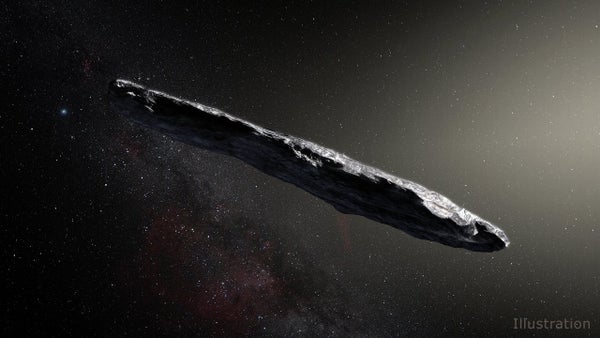
An artist’s conception of 1I/‘Oumuamua, the first known interstellar object to pass through the solar system. ‘Oumuamua’s anomalous acceleration during its passage could be explained by processes observed separately on newfound “dark comets” around our star.
European Southern Observatory / M. Kornmesser
For almost a decade—ever since 2017, when our first known interstellar visitor, 1I/‘Oumuamua, swooped through the inner solar system—astronomers have been grappling with a small but stubborn mystery. Studying this enigmatic object through telescopes not long after its flyby of the sun, they expected to see ‘Oumuamua slightly slow down as it climbed out of our star’s gravitational grip. Instead it sped up, almost as if some alien driver had floored the accelerator.
Of course, most scientists did not believe ‘Oumuamua to be a starship—instead, it was most likely a space rock, albeit one with admittedly bizarre characteristics that could be readily explained by entirely natural phenomena. But if ‘Oumuamua were a traditional comet, its anomalous acceleration should’ve been accompanied by a rocketlike jet of gas and dust vented from ices warmed by the close encounter with our star. These small pieces of dust form the “tails” of ordinary comets, which shine brightly as they reflect light from the sun.
Explanations for the acceleration that invoked jets too subtle to be easily seen were pilloried as special pleading by pro-starship true believers in popular media. But this hypothesis already had support from the near-contemporaneous discovery of “dark comets” in the solar system, objects that resembled asteroids but also showed subtle accelerations as if nudged by invisible vented jets. Astronomers now know of more than a dozen dark comets, further boosting the “it’s not aliens” explanation for ‘Oumuamua’s behavior.
If you're enjoying this article, consider supporting our award-winning journalism by subscribing. By purchasing a subscription you are helping to ensure the future of impactful stories about the discoveries and ideas shaping our world today.
But they’ve lacked a smoking gun to clinch the case. The classification of these objects as true comets has been complicated by the fact that no one has ever managed to witness a dark comet sprouting a tail—until now.
In a study I coauthored that has just been published in Nature Astronomy, we finally have a definitive telescopic observation of a cometary tail on a dark comet that we triggered based on identification of the acceleration. Led by NASA Jet Propulsion Laboratory scientist Davide Farnocchia, this work doesn’t just contextualize ‘Oumuamua’s acceleration; it also offers a potential breakthrough in our understanding of the solar system’s inventory of comets and asteroids.
Another team led by Qicheng Zhang, a postdoctoral fellow at Lowell Observatory, has also identified a different dark comet sprouting a tail, using archival data from the joint European Space Agency and NASA Solar and Heliospheric Observatory (SOHO) mission; the researchers have reported their result in the Planetary Science Journal. Taken together, these discoveries show how dark comets can be a “missing link” that resolves the blurred lines between the different populations of small bodies circling our star. Dark comets, it turns out, could even shine a light on how Earth became habitable in the first place.
Classically, comets have beautiful tails, while asteroids do not. This was thought to be because comets are ice-rich, whereas asteroids lack significant amounts of ice.
But just like almost everything in our natural world, the closer you look, the more complicated your view becomes.
In the few years following the discovery of ‘Oumuamua’s bizarre motion, Farnocchia and his collaborators began noticing that multiple asteroids orbiting close to Earth also accelerated in a cometlike manner. He decided that this could no longer be a statistical fluke after he noticed the behavior on seven such objects: we truly had a new population of small bodies in our solar system. Because I had been trying to explain ‘Oumuamua’s behavior, he asked if I could figure out the mystery of these seven weirdly moving objects, which at the time were classified as asteroids.
This led to our two papers outlining the discovery of the first seven dark comets in 2023. We concluded that these objects, like ‘Oumuamua, most likely were losing mass like comets, perhaps only sporadically displaying tails—and we hadn’t yet been lucky enough to catch one in our observations.
After we first noticed this phenomenon, more dark comets started cropping up all over the place. We now have almost 20 known dark comets, and for the last few years, I have had an observing program to monitor for tails of these dark comets with the European Southern Observatory’s Very Large Telescope (VLT) in Chile. What really stuck out about our newest dark comet was that Farnocchia first identified the acceleration, and after that, we redirected our telescopes to observe it. Immediately the powerful VLT snapped an image of the tail.
For the first time, we have definitive evidence that the dark comets are in fact comets.
This is also the first time anyone has discovered a comet based on its nongravitational motion alone rather than a glimpse of its distinctive tail. That makes our finding somewhat reminiscent of the historical discovery of Neptune—or even the more recent inference of a hypothetical Planet X—based just on its gravitational influence on other objects in the solar system.
Therefore, this discovery paves the way for an entirely new method of discovering comets purely by their motion. The fact that the handful of known dark comets evaded detection for so long also implies they’re the tip of the iceberg. A far larger population may await discovery, masquerading as asteroids until they display rapid and explosive outbursts; it may be that the solar system abounds with many more comets than previously realized.
We still don’t really know where Earth got its oceans in the first place, but a leading theory is that they were delivered to us by Earth-impacting comets. Comets are also rich with organic compounds that could serve as precursors for biochemistry. Finding an abundance of dark comets scattered around the solar system (including some that may lurk in near-Earth space) could thus represent a major advance in our big-picture understanding of the origins of oceans, habitability and life on our planet.
Even though ‘Oumuamua is long gone, verification that dark comets are in fact comets should give us some sense of closure—and better prepare us for when other all-natural interstellar visitors come calling.
This discovery is really just the beginning. NASA’s forthcoming Near-Earth Object Surveyor and the National Science Foundation and Department of Energy’s Vera C. Rubin Observatory should find many more dark comets—and perhaps a bumper crop of interstellar objects, as well. Targeted observations with facilities such as the James Webb Space Telescope could tell us if these bodies are mostly made of water ice or of more exotic ices such as carbon monoxide or dioxide. In any case, by illuminating the dark comets—and potentially linking them to comets from alien stars—we can learn more about where we came from and maybe even about life’s prospects beyond the solar system.
If you enjoyed this article, I’d like to ask for your support. Scientific American has served as an advocate for science and industry for 180 years, and right now may be the most critical moment in that two-century history.
I’ve been a Scientific American subscriber since I was 12 years old, and it helped shape the way I look at the world. SciAm always educates and delights me, and inspires a sense of awe for our vast, beautiful universe. I hope it does that for you, too.
If you subscribe to Scientific American, you help ensure that our coverage is centered on meaningful research and discovery; that we have the resources to report on the decisions that threaten labs across the U.S.; and that we support both budding and working scientists at a time when the value of science itself too often goes unrecognized.
In return, you get essential news, captivating podcasts, brilliant infographics, can't-miss newsletters, must-watch videos, challenging games, and the science world's best writing and reporting. You can even gift someone a subscription.
There has never been a more important time for us to stand up and show why science matters. I hope you’ll support us in that mission.
此内容由惯性聚合(RSS阅读器)自动聚合整理,仅供阅读参考。 原文来自 — 版权归原作者所有。