


The way women use energy while running is fundamentally different from men
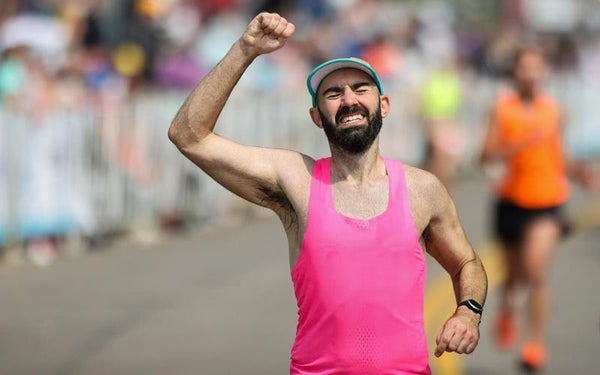
Ben Garvin via Getty Images
Running a marathon is hard work; the miles don’t get easier as they tick by. Among a runner’s worst fears is a phenomenon known as “hitting the wall” or “bonking,” which happens when the body’s glycogen stores become depleted. This leaves the runner feeling overwhelming fatigue, exhaustion and an inability to keep pace. But new research this week suggests that men may be significantly more likely to bonk than women.
In a study published on Thursday in Scientific Reports, scientists wanted to better understand which marathoners may be more prone to hitting the wall and when. They looked at the race times of 873,334 runners who completed the Berlin Marathon between the years 1999 and 2025. They determined that a runner had hit the wall if their pace slowed by at least 20 percent during the second half of the race compared with the first half. Running the first half of the race faster than the second half is known among runners as positive splitting.
Male runners were about twice as likely as female runners to hit the wall, according to the data. The researchers also found that faster male runners were even more likely to bonk. Male runners who finished the marathon in less than three hours—which is around the qualifying time for men for the Boston Marathon and far less than the qualifying time for women—were six times more likely to hit the wall than their fast female counterparts.
If you're enjoying this article, consider supporting our award-winning journalism by subscribing. By purchasing a subscription you are helping to ensure the future of impactful stories about the discoveries and ideas shaping our world today.
This was the most surprising finding, says study co-author Aldo Seffrin, an exercise physiologist at Nova O2 Sports Science in São José dos Campos, Brazil. “I expected experience and training to flatten the difference at the top, and instead it widened,” he says. “That tells me pacing failure is not simply a beginner’s mistake.”
The main cause of bonking is a depletion of glycogen, which is the body's stored form of glucose and its preferred fuel to power muscles. Once glycogen becomes critically low, the body relies on fat for energy. But converting fat into a usable form of fuel isn’t a fast or easy process.
Scientists are actually still piecing together what leads a runner to bonk. But a good pacing strategy plays a key role. Moving at a steady, sustainable pace allows the body to use energy (mostly in the form of glucose from glycogen stores) more efficiently, reducing the odds of using up all the stored glucose before the finish line. Seffrin and his team note that the study suggests that men might be able to thwart bonking by running slower in the first half of a marathon and getting continually faster as the race progresses, a pacing strategy known as negative splitting.
But pacing alone might not fully explain why women are less likely to hit the wall than men. “The honest answer is that a lot of foundational exercise physiology was built on male subjects, so several mechanisms are simply less well characterized in women,” Seffrin says.
Researchers do know that “women tend to oxidize fat at higher rates and run at a lower respiratory exchange ratio during submaximal endurance exercise,” he says. In other words, women tend to burn more fat for energy than men during steady, moderate-intensity endurance exercise, such as a marathon.
Women also have a greater relative proportion of type 1 muscle fibers, also known as slow-twitch muscle fibers, than men. These use oxygen efficiently to resist fatigue, making them ideal for endurance exercise. And they also use the hormone estradiol which plays a role in burning fat and conserving carbohydrates during prolonged exercise.
All of this could also explain why the performance gap between men and women in ultramarathons is often smaller. More research on women’s bodies is sorely needed, however. “Better characterization of female-specific physiology, in datasets that actually include it, is what would let us move from ‘what’ to ‘why,’” Seffrin says.
Going forward, Seffrin says that his team hopes to combine race data with other information about each runner, including psychological factors as well as physiological ones. This would help determine whether differences in pacing and hitting the wall are mainly related to race strategy or biology. And the researchers also want to study runners who do not finish, because analyzing only finishers likely underestimates how often runners actually bonk.
If you enjoyed this article, I’d like to ask for your support. Scientific American has served as an advocate for science and industry for 180 years, and right now may be the most critical moment in that two-century history.
I’ve been a Scientific American subscriber since I was 12 years old, and it helped shape the way I look at the world. SciAm always educates and delights me, and inspires a sense of awe for our vast, beautiful universe. I hope it does that for you, too.
If you subscribe to Scientific American, you help ensure that our coverage is centered on meaningful research and discovery; that we have the resources to report on the decisions that threaten labs across the U.S.; and that we support both budding and working scientists at a time when the value of science itself too often goes unrecognized.
In return, you get essential news, captivating podcasts, brilliant infographics, can't-miss newsletters, must-watch videos, challenging games, and the science world's best writing and reporting. You can even gift someone a subscription.
There has never been a more important time for us to stand up and show why science matters. I hope you’ll support us in that mission.
此内容由惯性聚合(RSS阅读器)自动聚合整理,仅供阅读参考。 原文来自 — 版权归原作者所有。