
惯性聚合 高效追踪和阅读你感兴趣的博客、新闻、科技资讯
阅读原文 在惯性聚合中打开

推荐订阅源

The Last Watchdog
The Last Watchdog
Stack Overflow Blog
Stack Overflow Blog
Y
Y Combinator Blog
The Register - Security
GbyAI
GbyAI
C
Check Point Blog
CTFtime.org: upcoming CTF events
P
Proofpoint News Feed
博客园 - 【当耐特】
酷 壳 – CoolShell
酷 壳 – CoolShell
腾讯CDC
WordPress大学
WordPress大学
Security Latest
Security Latest
Spread Privacy
Spread Privacy
G
Google Developers Blog
A
Arctic Wolf
博客园_首页
M
MIT News - Artificial intelligence
C
CXSECURITY Database RSS Feed - CXSecurity.com
V
Vulnerabilities – Threatpost
H
Hacker News: Front Page
cs.CV updates on arXiv.org
W
WeLiveSecurity
月光博客
月光博客
F
Fortinet All Blogs
让小产品的独立变现更简单 - ezindie.com
S
Security @ Cisco Blogs
AWS News Blog
AWS News Blog
T
The Blog of Author Tim Ferriss
Webroot Blog
Webroot Blog
C
CERT Recently Published Vulnerability Notes
TaoSecurity Blog
TaoSecurity Blog
J
Java Code Geeks
P
Privacy International News Feed
L
LINUX DO - 热门话题
S
Secure Thoughts
D
Darknet – Hacking Tools, Hacker News & Cyber Security
Hacker News: Ask HN
Hacker News: Ask HN
L
LangChain Blog
Recent Commits to openclaw:main
Cyber Security Advisories - MS-ISAC
阮一峰的网络日志
阮一峰的网络日志
Project Zero
Project Zero
V
Visual Studio Blog
OSCHINA 社区最新新闻
OSCHINA 社区最新新闻
T
Troy Hunt's Blog
小众软件
小众软件
Microsoft Security Blog
MyScale Blog
MyScale Blog
Google Online Security Blog

Latest from Space.com

SpaceX launch creates colorful Supreme Court ruling on mail-in ballots ensures astronauts can vote from space  — or anywhere else Astronomers may have heard the 1st Get a year-long Peacock TV deal for just $9.16 a month Making history! China lands rocket during an orbital launch for 1st time ever Wally Funk, trailblazing pilot and astronaut, passes away at 87 Scientists have discovered the oldest quasar ever seen, and it shines with the light of a trillion suns SpaceX wants to launch 100,000 Starlink satellites to orbit 'Reckless' space-based data centers lack environmental review, drawing criticism www.space.com Could evidence of life on Mars be hiding in clay? Europe wants to send a rover to check Take a trip to the turquoise waters of the Bahamas (from space) | Space photo of the day for July 9, 2026 The US wants to build offshore rocket launch sites. Critics say China announces plan to build early-warning system for dangerous asteroids Staffing the moon base: How many astronauts should live in NASA's lunar outpost? SpaceX Falcon 9 rocket launches for record-breaking 36th time Japanese company books 1,100 pounds of cargo space on SpaceX Starship mission to the moon Dance of death between binary stars leads to an unusual supernova NASA begins funding hardware for 'Skyfall' Mars helicopter mission Trump gifts Artemis astronauts an American flag from the US Capitol to plant on the moon Shoebox-sized 'detector satellites' could sniff out a nuclear bomb in space Venus takes center stage with 2 easy-to-see sky shows this July. Here's when and where to look 'This is the future of spatial intelligence': Vantor unveils stunning 3D satellite views of Earth (photos) NASA's Roman Space Telescope prepares for launch | Space photo of the day for July 8, 2026 The US Space Force just got a new electromagnetic weapon to jam adversary satellites Revolutionary rocket engine company Venus Aerospace raises $91 million to scale design NASA's New Horizons probe just woke up from hibernation 6 billion miles away beyond Pluto. What's it doing out there? Earth may survive the sun's death after all, new study suggests James Webb Space Telescope celebrates its 4th birthday with stunning image of a galaxy crash site Our Milky Way galaxy might be larger than we thought 'Project Hail Mary' is finally streaming Amazon Prime Video, and we can't wait to watch it again Artemis 2's Jeremy Hansen stepping down from active astronaut duty after epic moon mission How public–private partnerships can turn Mars into an economic frontier (Op-Ed) China releases 1st photo of Earth's elusive 'quasi-moon' Kamo'oalewa 'That's going to come back and bite us': Former NASA chief questions Artemis moon lander plans Astronaut flexes his muscles mid-spacewalk | Space photo of the day for July 7, 2026 Chinese scientists find the best way to nuke an asteroid on its way to impact Earth SpaceX just launched the 1st-ever nuclear-powered commercial satellite The sun's atmosphere is way hotter than its surface. Scientists may finally know why Even astronauts in space saw America 250 fireworks on the Fourth of July. See their ISS view of Los Angeles (video) SpaceX launches 81 satellites to orbit from California, lands rocket on ship at sea More clues surface about the origins of interstellar comet 3I/ATLAS NASA just found a planet 'hiding' in TESS spacecraft data, all thanks to Einstein Black holes buried in mysterious 'little red dot' galaxies could blast cosmic ghosts at Earth Unidentified metal spheres found on Australian beach are 'debris from a foreign rocket body', space agency says 'Acceleration without fuel:' Revolutionary superconducting thruster harnesses Earth's magnetic field in 1st orbital test Japan's Hayabusa2 probe captures remarkable photo of a two-headed asteroid 62 million miles away Artemis moon astronauts visit Capitol Hill | Space photo of the day for July 6, 2026 NASA will have to find a way to service its new alien-hunting space telescope Astronomers discover radio signals coming from rare 'Blue Eye Pulsar' after decades of silence 'Once-in-a-millennium' asteroid flyby will be visible to much of the world in 2029 NASA tests advanced new Mars rover prototype in the California desert (video) He-Man and beyond: 20 sci-fi cartoons (some iconic, some weird) that transported '80s and '90s kids to strange new worlds 10 best Spanish cities to see the total solar eclipse 2026 America 250: From 1776 to the moon and beyond (A Space.com series) This Week In Space podcast: Episode 217 — America in Space Human flight was still 7 years away in 1776. Now, we're headed back to the moon What did the night sky look like on the 1st Independence Day 250 years ago? 30 years on, "Independence Day" still proves the versatility of the original "The War of the Worlds" How to find Uranus this week, the hardest planet I've ever tried to see As 'Terminator 2: Judgment Day' turns 35, it's time to accept the truth: Terminator shouldn't be back Could humans someday explore Saturn's moon Titan, or will humanoid robots do it for us? 'Independence Day' at 30: Roland Emmerich & Dean Devlin talk blowing up the White House and crafting a true sci-fi classic (interview) 1 private spacecraft intercepts another on Space Force's groundbreaking 'Victus Haze' mission
The moon, Mars and the Pleiades form a stunning lineup before dawn on July 11. Here
https://www.space.com/author/joe-rao · 2026-07-10 · via Latest from Space.com
people are silhouetted against a predawn sky as the sun begins to turn the horizon hazy orange and bright stars and planets are still visible above against a deep inky blue sky.
A slender crescent moon, Mars and Aldebaran and two sparkling star clusters will create a beautiful predawn scene for early risers on July 11. (Image credit: ascg Photography via Getty Images)

Before dawn on July 11, early risers will be treated to a striking celestial scene low in the east-northeast sky.

A slender waning crescent moon, softly glowing with earthshine, will appear to align with the orange light of Mars, the orange-red star Aldebaran, with the sparkling Pleiades and Hyades star clusters close by. Together, they will form a beautiful morning tableau in Taurus — one well worth setting an alarm to see.

First: the moon

Most obvious is, of course, the moon, appearing as a lovely waning crescent, 14% illuminated. It rises around 2:00 a.m. local daylight time and will likely appear as a thin arc of light enclosing a ghostly ball. Here is one of nature's beautiful sights and fits the old saying, "the old moon in the new moon's arms." Leonardo da Vinci (1452-1519) was the first to recognize it as earthshine. That faint bluish-gray light is light from Earth reflected toward the moon. Earth's light, of course, reflects sunlight, so earthshine is really sunlight that is reflected off Earth to the moon and reflected toward Earth.

Next: Mars

The second object is a planet: Mars. It will appear as an orange-yellow star roughly five degrees below and slightly to the right of the moon. Your clenched fist held at arm's length measures roughly 10 degrees in width, so Mars will hover roughly 'half a fist-width" below the lunar disk.

Mars rises around 2:40 a.m. local time and is about 15 degrees above the east-northeast horizon by dawn. So as the eastern sky begins to lighten up, Mars will be about "one and a half fist-widths" above the horizon.

It currently resides within the boundaries of the zodiacal constellation of Taurus the Bull. Mars remains rather inconspicuous, but its luminosity continues to increase as we gain on it in our smaller, faster orbit, though it is a very slow process. The planet moves from 17.5 light minutes away on July 1 to 15.4 light minutes by Sept. 1, brightening ever-so-slightly from magnitude +1.3 to +1.2. At its closest approach this coming February, Mars will be only 5.6 light minutes from Earth and will appear to shine fully 10 times brighter than it does now.

night sky graphic showing an eye-catching alignment of the crescent moon, Mars and the bright orange star Aldebaran, accompanied by the beautiful Pleiades and Hyades star clusters. 

On July 11, looking low toward the east about 90 minutes before sunrise, skywatchers will see an eye-catching alignment of the crescent moon, Mars and the bright orange star Aldebaran, accompanied by the beautiful Pleiades and Hyades star clusters. (Image credit: Joe Rao using Starry Night Pro 8.0/Simulation Curriculum.)

Finally: Aldebaran

Shining about 5.5 degrees below and slightly to the right of Mars will be a similarly hued, orange-red star, appearing to shine nearly twice as bright as the planet. That will be Aldebaran, marking the angry right eye of Taurus. Aldebaran is the fourteenth brightest star in the sky and lies 67 light-years from Earth. This is a red giant star, 45 times larger than our sun, 1.6 times more massive and over 400 times as luminous. Aldebaran is older and redder than the sun and is preparing to fuse its lightweight core into heavier elements, which are common among stars of its type. Aldebaran has a surface temperature of about 6,760 degrees F (3,738 degrees C). And Aldebaran is really a double star; its companion is much smaller and far dimmer, with an overall mass less than half that of the sun and only about one-third as large.

Incidentally, although it appears among them, Aldebaran is not actually a member of the V-shaped Hyades cluster. But it's much closer to us in space than the other Hyades stars, so it's simply an "innocent bystander," but nicely completes the V-shaped face of the Bull in our sky. Henry M. Neely (1879-1963), a long-time lecturer at New York's Hayden Planetarium, wrote in his book: A Primer for Stargazers:

"When Taurus is in the night sky, it is well worth the while of any stargazer to beg, borrow or steal a pair of binoculars. . . because the most dazzling of the stars are not visible to the naked eye. This is particularly true of the area inside the V of the Bull's face. Someday I hope an imaginative designer of jewelry will duplicate this superb setting of celestial gems, matching them in color, sparkle and design."
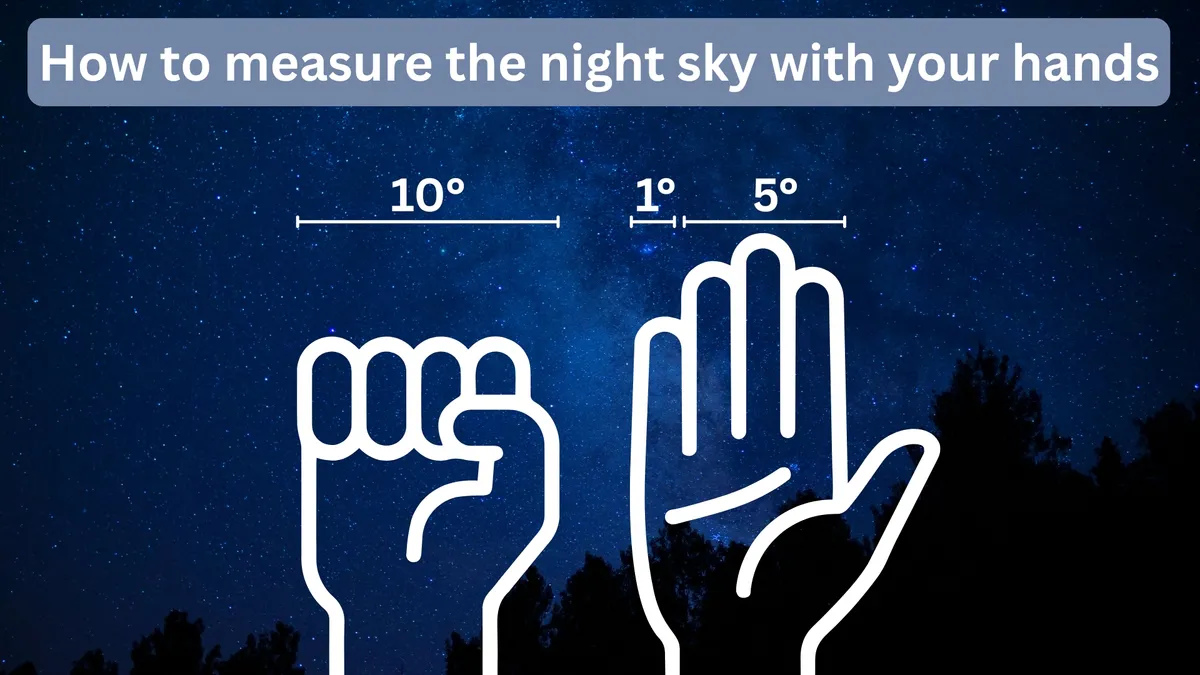
graphic showing how to measure the night sky with your hands showing a clenched fist showing about 10 degrees of sky, a finger is 1 degree and middle three fingers are 5 degrees.

A helpful guide on how to roughly measure the night sky with your hand held out at arm's length. (Image credit: Created in Canva Pro)

And completing this lovely early morning tableau, is the beautiful Pleiades star cluster. They'll glitter, as Tennyson imagined, "like a swarm of fireflies tangled in a silver braid." They'll sparkle about six degrees to the moon's upper right. Good binoculars will reveal a score of stars in this little group, while long-exposure observatory photographs show about 1000 in the area — all suffused in great clouds and streamers of nebulous light.

What a great way to start the second weekend of July!

So, rise before the first blush of dawn, seek out a clear east-northeast horizon, and let the morning sky reward your early vigil. With binoculars in hand, linger a little longer among the Pleiades and the nearby celestial jewels—an ancient sparkle waiting quietly above the waking world.

If you're looking for a telescope or binoculars to observe the night sky, our guides for the best binocular deals and the best telescope deals can help. Our best cameras for astrophotography and best lenses for astrophotography can help you get ready to capture the next stunning skywatching event.

Joe Rao serves as an instructor and guest lecturer at New York's Hayden Planetarium. He writes about astronomy for Natural History magazine, Sky and Telescope, The Old Farmer's Almanac and other publications.

Joe Rao is Space.com's skywatching columnist, as well as a veteran meteorologist and eclipse chaser who also serves as an instructor and guest lecturer at New York's Hayden Planetarium. He writes about astronomy for Natural History magazine, Sky & Telescope and other publications. Joe is an 8-time Emmy-nominated meteorologist who served the Putnam Valley region of New York for over 21 years. You can find him on Twitter and YouTube tracking lunar and solar eclipses, meteor showers and more. To find out Joe's latest project, visit him on Twitter.