


The soft contact lenses that are most common today have a tendency to attract very tiny scratches as they get routinely handled and cleaned.
Over time, those microscopic tears can cause damage to eyes and vision.
If the scratches are big enough to see, the contact lens has to be binned, which means more expense and waste. If not, there's a hidden risk to the wearer's health.
But maybe a scratch doesn't have to be the end of a contact lens or a safety issue.
Chemists Jung-Hyun Choi and Byoung-Ki Cho from Dankook University in South Korea have developed specialized contact lenses that self-heal after just an hour under ordinary ultraviolet (UV) light.
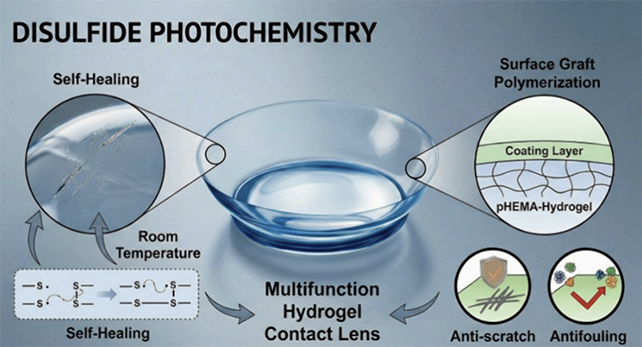
At the core of the innovative hydrogel material is what's known as a disulfide cross-linker – essentially, a small molecule containing a sulfur-to-sulfur bond. What's special about it is that it can form new attachments after being broken.
"This work details the synthesis, mechanical characterization, and functional evaluation of this disulfide-cross-linked hydrogel system and demonstrates its translation from hydrogel specimens to a practical molded contact lens format," write the researchers in ACS Applied Polymer Materials.
The disulfide cross-linker was combined with a methacrylate polymer (forming long molecule chains). When a scratch happens, the physical connections between these polymers break – but under UV light, they can be reconnected.
A second polymer was added to make the hydrogel more resistant to scratching and bacteria, before the new contact lens mixture was tested against a control material made using a standard cross-linker.
"In commercial hydrogel contact lenses, surface scratches caused by daily use or cleaning are far more common than complete cuts," write the researchers.
"The DS-Hydrogel exhibited effective recovery of the surface scratches, whereas the Control-Hydrogel , which lacked the disulfide-based DS-Cross-linker, exhibited no visible healing under the same conditions."
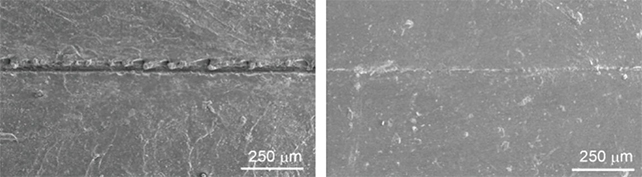
What the UV light does, chemically speaking, is spring the sulfur-to-sulfur bonds around the scratch into action, crossing the divide and gripping the torn polymers in place. Around 90 percent of the structural stability could be restored, the team found.
As well as self-healing, the new material demonstrated water retention on a par with current soft lenses, as well as excellent scratch resistance. Potentially, the lenses will scratch less anyway, in addition to being self-healing.
The study demonstrates that the sulfur-based chemical approach used here works as a way to create self-healing and protective plastics, and the potential implication is that standard UV light cleaners already on the market could be used to repair as well as clean.

"The combined self-healing capability, durable anti-fouling behavior, and enhanced scratch resistance highlight the potential of this disulfide-cross-linked hydrogel platform for next-generation functional contact lenses," write the researchers.
"Overall, the materials design strategy presented here provides a promising route toward long-lasting, resilient, and high-performance hydrogel-based ophthalmic devices."
While this kind of self-healing has been demonstrated before, it has required temperatures much higher than room temperature. Being able to induce the repair using ordinary equipment at home is a notable progression in the technology.
Imagine being able to put a pair of tired, scratched contacts into a combination cleaner and repairer case, and have them almost as good as new in an hour.
There's still a lot of work to be done before these will be available commercially, including additional safety testing – as you would hope, for anything you're sticking in your eye – but we may soon have contact lenses that are much more durable and longer-lasting.
Related: World First: Stem Cell Transplant Restores Vision in Multiple People
"During contact lens wear, microscratches caused by blinking or routine cleaning can scatter light, causing glare, while also providing sites for protein or microbial adhesion, ultimately compromising ocular health," write the researchers.
"Moreover, surfaces roughened by scratches and microcracks facilitate the adhesion and accumulation of proteins, increasing wearer discomfort and the risk of infection."
The research has been published in ACS Applied Polymer Materials.
This article was fact-checked by Rachel Garner and edited by Peter Dockrill. While we pride ourselves on our process, we are only human. If you spot a mistake, please let us know.
此内容由惯性聚合(RSS阅读器)自动聚合整理,仅供阅读参考。 原文来自 — 版权归原作者所有。